

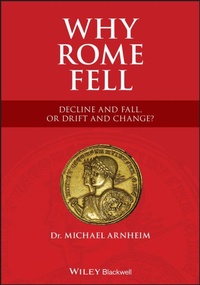
Why Rome Fell
Decline and Fall? Or, Drift and Change?
1st Edition
Published on 12. May 2022
Book
Paperback/Softback
560 pages
978-1-119-69137-2 (ISBN)
Description
Starting with the seminal Decline and Fall of the Roman Empire by Edward Gibbons, the fall of Rome has remained a topic of intense scholarship and lively discussion for the past two hundred and fifty years. Recent works incite debate and controversy as academics and educated consumers consider the core question: why the Roman Empire ceased to exist in the West but continued for another thousand years in the East. Several conflicting explanations have been put forward, but the problem still tantalizes the historical community, as evidenced by the regular publication and success of books on the topic. In Why Rome Fell, Michael Arnheim presents new research to explore a paradoxical conflict between east and west, Christianity and traditional pagan rites, which would see landholders take power, reduce the impact of the Emperor, and lay the groundwork for the Fall.
More details
Language
English
Place of publication
New York
United States
Target group
Professional and scholarly
Dimensions
Height: 251 mm
Width: 175 mm
Thickness: 27 mm
Weight
848 gr
ISBN-13
978-1-119-69137-2 (9781119691372)
Copyright in bibliographic data and cover images is held by Nielsen Book Services Limited or by the publishers or by their respective licensors: all rights reserved.
Schweitzer Classification
Other editions
Additional editions
E-Book
03/2022
1st Edition
Wiley
€26.99
Available for download
E-Book
02/2022
1st Edition
Wiley
€26.99
Available for download
Content
CONTENTS
Introduction: The Problem
Part I : Transition from the Ancient to the Medieval World
Chapter 1 -- From Principate to Dominate
Chapter 2 -- Diocletian, Hammer of the Aristocracy
Chapter 3 -- Constantine the Reformer
Chapter 4 -- The Christian Empire
Chapter 5 -- The Fundamental Paradox
Chapter 6 -- Political Fragmentation and the Manorial System
Part II -- Conflicting Theories
Chapter 7 -- Two Models of Government
Chapter 8 -- Competing Schools of History
Chapter 9 -- Gibbon's Decline and Fall of the Roman Empire
Chapter 10 -- The Role of Christianity
Chapter 11 -- The Military Explanation
Chapter 12 - "Late Antiquity"
Chapter 13 -- "Eirenic" Settlements
Chapter 14 -- The Pirenne Thesis
Chapter 15 -- The Malaria Hypothesis
Part III -- Conclusion
Chapter 16 -- Fall plus Continuity
Introduction: The Problem
Part I : Transition from the Ancient to the Medieval World
Chapter 1 -- From Principate to Dominate
Chapter 2 -- Diocletian, Hammer of the Aristocracy
Chapter 3 -- Constantine the Reformer
Chapter 4 -- The Christian Empire
Chapter 5 -- The Fundamental Paradox
Chapter 6 -- Political Fragmentation and the Manorial System
Part II -- Conflicting Theories
Chapter 7 -- Two Models of Government
Chapter 8 -- Competing Schools of History
Chapter 9 -- Gibbon's Decline and Fall of the Roman Empire
Chapter 10 -- The Role of Christianity
Chapter 11 -- The Military Explanation
Chapter 12 - "Late Antiquity"
Chapter 13 -- "Eirenic" Settlements
Chapter 14 -- The Pirenne Thesis
Chapter 15 -- The Malaria Hypothesis
Part III -- Conclusion
Chapter 16 -- Fall plus Continuity