

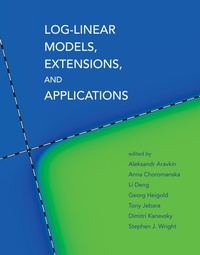
Log-Linear Models, Extensions, and Applications
Description

Log-linear models play a key role in modern big data and machine learning applications. From simple binary classification models through partition functions, conditional random fields, and neural nets, log-linear structure is closely related to performance in certain applications and influences fitting techniques used to train models. This volume covers recent advances in training models with log-linear structures, covering the underlying geometry, optimization techniques, and multiple applications. The first chapter shows readers the inner workings of machine learning, providing insights into the geometry of log-linear and neural net models. The other chapters range from introductory material to optimization techniques to involved use cases. The book, which grew out of a NIPS workshop, is suitable for graduate students doing research in machine learning, in particular deep learning, variable selection, and applications to speech recognition. The contributors come from academia and industry, allowing readers to view the field from both perspectives.
Contributors Aleksandr Aravkin, Avishy Carmi, Guillermo A. Cecchi, Anna Choromanska, Li Deng, Xinwei Deng, Jean Honorio, Tony Jebara, Huijing Jiang, Dimitri Kanevsky, Brian Kingsbury, Fabrice Lambert, Aurélie C. Lozano, Daniel Moskovich, Yuriy S. Polyakov, Bhuvana Ramabhadran, Irina Rish, Dimitris Samaras, Tara N. Sainath, Hagen Soltau, Serge F. Timashev, Ewout van den Berg
More details
Other editions
Additional editions
Persons
Anna Choromanska is Assistant Professor at New York University's Tandon School of Engineering.
Li Deng is Chief Artificial Intelligence Officer of Citadel.
Georg Heigold is Research Scientist at Google.
Tony Jebara is Associate Professor of Computer Science at Columbia University.
Dimitri Kanevsky is Research Scientist at Google.
Stephen J. Wright is Professor of Computer Science at the University of Wisconsin?Madison.
