

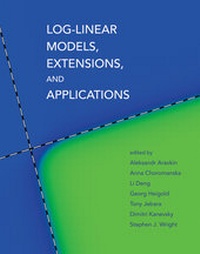
Log-Linear Models, Extensions, and Applications
Published on 27. November 2018
Book
Hardback
214 pages
978-0-262-03950-5 (ISBN)
Description
Advances in training models with log-linear structures, with topics including variable selection, the geometry of neural nets, and applications.
Log-linear models play a key role in modern big data and machine learning applications. From simple binary classification models through partition functions, conditional random fields, and neural nets, log-linear structure is closely related to performance in certain applications and influences fitting techniques used to train models. This volume covers recent advances in training models with log-linear structures, covering the underlying geometry, optimization techniques, and multiple applications. The first chapter shows readers the inner workings of machine learning, providing insights into the geometry of log-linear and neural net models. The other chapters range from introductory material to optimization techniques to involved use cases. The book, which grew out of a NIPS workshop, is suitable for graduate students doing research in machine learning, in particular deep learning, variable selection, and applications to speech recognition. The contributors come from academia and industry, allowing readers to view the field from both perspectives.
Contributors
Aleksandr Aravkin, Avishy Carmi, Guillermo A. Cecchi, Anna Choromanska, Li Deng, Xinwei Deng, Jean Honorio, Tony Jebara, Huijing Jiang, Dimitri Kanevsky, Brian Kingsbury, Fabrice Lambert, Aurélie C. Lozano, Daniel Moskovich, Yuriy S. Polyakov, Bhuvana Ramabhadran, Irina Rish, Dimitris Samaras, Tara N. Sainath, Hagen Soltau, Serge F. Timashev, Ewout van den Berg
Log-linear models play a key role in modern big data and machine learning applications. From simple binary classification models through partition functions, conditional random fields, and neural nets, log-linear structure is closely related to performance in certain applications and influences fitting techniques used to train models. This volume covers recent advances in training models with log-linear structures, covering the underlying geometry, optimization techniques, and multiple applications. The first chapter shows readers the inner workings of machine learning, providing insights into the geometry of log-linear and neural net models. The other chapters range from introductory material to optimization techniques to involved use cases. The book, which grew out of a NIPS workshop, is suitable for graduate students doing research in machine learning, in particular deep learning, variable selection, and applications to speech recognition. The contributors come from academia and industry, allowing readers to view the field from both perspectives.
Contributors
Aleksandr Aravkin, Avishy Carmi, Guillermo A. Cecchi, Anna Choromanska, Li Deng, Xinwei Deng, Jean Honorio, Tony Jebara, Huijing Jiang, Dimitri Kanevsky, Brian Kingsbury, Fabrice Lambert, Aurélie C. Lozano, Daniel Moskovich, Yuriy S. Polyakov, Bhuvana Ramabhadran, Irina Rish, Dimitris Samaras, Tara N. Sainath, Hagen Soltau, Serge F. Timashev, Ewout van den Berg
More details
Series
Language
English
Place of publication
Cambridge
United States
Publishing group
MIT Press Ltd
Target group
Professional and scholarly
College/higher education
US School Grade: From College Freshman to College Graduate Student
Product notice
Cloth over boards
Illustrations
51 color illus.; 102 Illustrations
Dimensions
Height: 254 mm
Width: 203 mm
Thickness: 22 mm
ISBN-13
978-0-262-03950-5 (9780262039505)
Copyright in bibliographic data and cover images is held by Nielsen Book Services Limited or by the publishers or by their respective licensors: all rights reserved.
Schweitzer Classification
Other editions
Additional editions
Aleksandr Aravkin | Anna Choromanska | Li Deng
Log-Linear Models, Extensions, and Applications
E-Book
12/2018
MIT Press
€92.99
Available for download