

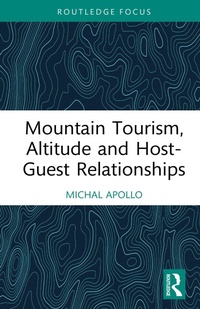
Mountain Tourism, Altitude and Host-Guest Relationships
Published on 16. December 2025
190 pages
978-1-040-50158-0 (ISBN)
Description

This insightful volume critically explores whether higher altitude of habitation affects host-guest exchanges in mountaineering tourism, in an effort to better understand and manage vulnerable destinations in a sustainable manner.
The book is based on empirical research conducted in the Mount Everest area in Nepal, part of the Sagarmatha National Park, which is a popular destination among tourists engaging in high-altitude mountaineering (subdivided into hiking, trekking and mountain climbing). By doing so it offers essential knowledge of mountaineering tourism whilst detailing recent developments linked to the diversification, commodification and commercialisation of mountaineering activity. This is discussed alongside the potentially positive impacts for marginalised high mountain communities.
This book is essential reading for students, academics, industry representatives and policymakers with an interest in adventure tourism and mountaineering.
The book is based on empirical research conducted in the Mount Everest area in Nepal, part of the Sagarmatha National Park, which is a popular destination among tourists engaging in high-altitude mountaineering (subdivided into hiking, trekking and mountain climbing). By doing so it offers essential knowledge of mountaineering tourism whilst detailing recent developments linked to the diversification, commodification and commercialisation of mountaineering activity. This is discussed alongside the potentially positive impacts for marginalised high mountain communities.
This book is essential reading for students, academics, industry representatives and policymakers with an interest in adventure tourism and mountaineering.
Reviews / Votes
"Mountains are prominent in narratives of travel and adventure. Much attention is given to stories about adventurers who've conquered them, much less on how this plays out for host communities. Mountain Tourism, Altitude and Host-Guest Relationships is timely and queries the wider implications for host communities. If mountain tourism is to serve anyone, it should serve the communities that call them home. Apollo's deep engagement with mountain communities showcases an abiding sensitivity and nuance that hits the heights."Joseph M. Cheer, Professor of Sustainable Tourism, Western Sydney University, AU
"Mountain environments are unique settings for the study of tourism. Importantly, the rich diversity of local communities are significant attractants alongside the mountains themselves. In today's world both physical and cultural elements are subject to rapid change from issues as varied as climate change, and rapidly improving access. This book reports on a series of in-depth examinations of the host-guest relationship within these unique contexts and offers pragmatic insights for the better management of tourism for both people and place."
David Simmons, Emeritus Professor of Tourism, Lincoln University & Deputy Chair of the Himalayan Trust, Christchurch, NZ
"This meticulously researched book provides a clear, innovative and modern framework to advance our understanding of host-guest relationships in mountain areas. This is a timely and refreshing study that masterfully integrates altitude and spatial zoning. It should be essential reading for both academics and practitioners alike."
Professor Eugenia Wickens, OTS Academy & Editor-in-Chief JOTS, Oxford, UK
"This book offers a timely and insightful exploration of mountain tourism, weaving together altitude dynamics and host-guest relationships with clarity and depth. It not only enriches academic discourse but also provides practical perspectives for sustainable tourism development. A must-read for scholars, practitioners, and policymakers seeking to understand the complexities of human-nature interactions in fragile mountain environments."
Senior Professor Vishwambhar Prasad Sati, Dean of the School of Earth Sciences and Natural Resources Management, Mizoram University, Aizawl, IN
More details
Series
Language
English
Place of publication
London
United Kingdom
Publishing group
Taylor & Francis Ltd
Target group
College/higher education
Illustrations
8 Tables, black and white; 12 Line drawings, black and white; 1 Halftones, black and white; 13 Illustrations, black and white
File size
101,00 MB
ISBN-13
978-1-040-50158-0 (9781040501580)
Copyright in bibliographic data and cover images is held by Nielsen Book Services Limited or by the publishers or by their respective licensors: all rights reserved.
Schweitzer Classification
Other editions
Additional editions
Michal Apollo
Mountain Tourism, Altitude and Host-Guest Relationships
Book
approx. 12/2025
1st Edition
Routledge
€78.60
Not yet published
Person
Michal Apollo is Assistant Professor at the Institute of Earth Sciences, University of Silesia in Katowice, Poland, and Fellow of Yale University's Global Justice Program, USA. He specialises in tourism management, consumer behaviour, and environmental and socio-economic issues. In his main research field, he focuses on human presence and well-being in high mountain regions. Michal is also an enthusiastic mountaineer, ultra-runner, diver, sailor, photographer, science populariser and NGO activist.
Content
Contents
List of figures xi
List of tables xiii
About the author xiv
Foreward by Dallen J. Timothy xvi
Preface xix
Acknowledgements xxi
1.Mountain tourism, altitude and horizontal zoning in relations between hosts and guests 1
2.Conceptual framework and methodological approach to research on host-guest relations in mountain areas 26
3.Phenomenon of the spatial and altitude factor in host-guest relationships (quantitative approach) 43
4.The reality of altitude of habitation on host-guest relationships (qualitative approach) 72
5.Altitude factor in host-guest relationships: altitude, zone, and possible reason 119
6.Management Implications 139
7.From euphoria to antagonism - the Irritation Index in the context of mountain tourism 154
Index 161
List of figures xi
List of tables xiii
About the author xiv
Foreward by Dallen J. Timothy xvi
Preface xix
Acknowledgements xxi
1.Mountain tourism, altitude and horizontal zoning in relations between hosts and guests 1
2.Conceptual framework and methodological approach to research on host-guest relations in mountain areas 26
3.Phenomenon of the spatial and altitude factor in host-guest relationships (quantitative approach) 43
4.The reality of altitude of habitation on host-guest relationships (qualitative approach) 72
5.Altitude factor in host-guest relationships: altitude, zone, and possible reason 119
6.Management Implications 139
7.From euphoria to antagonism - the Irritation Index in the context of mountain tourism 154
Index 161
