

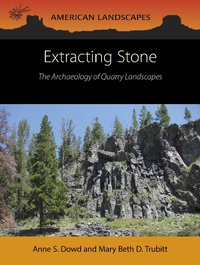
Extracting Stone
The Archaeology of Quarry Landscapes
Published on 4. April 2024
168 pages
978-1-78570-627-1 (ISBN)
Description

A comprehensive view of quarrying activities from three key regions in North America.
This exciting new addition to the the American Landscapes series provides an in-depth account of how flintknappers obtained and used stone based on archaeological, geological, landscape, and anthropological data. Featuring case studies from three key regions in North America, this book gives readers a comprehensive view of quarrying activities ranging from extracting the raw material to creating finished stone tools. Quarry landscapes were some of the first large-scale land modification efforts among early peoples in the New World. The chronological time periods covered by quarrying activities, show that most intensive use took place during parts of the Archaic and Woodland periods or between roughly 4000-1000 years ago when denser populations existed, but use began as early as the Paleoindian Period, about 13,000-9000 years ago, and ended in the Historic or Protohistoric periods, when colonists and Native Americans mined chert for gunflints and sharpening stones or abrasives. From the procurement systems approach common in the 1980s and 1990s, archaeologists can now employ a landscape approach to quarry studies in tandem with Geographic Information Systems (GIS) computer mapping and digital analysis, Light and RADAR (LiDAR) airborne laser scanning for recording topography, or high resolution satellite imagery. Authors Dowd and Trubitt show how sites functioned in a broad landscape context, which site locations or raw material types were preferred and why, what cultures were responsible for innovative or intensive quarry resource extraction, as well as how land use changed over time. Besides discussions of the way that industrialists used natural resources to change their technology by means of manufacture, trade, and exchange, examples are given of heritage sites that people can visit in the United States and Canada.
This exciting new addition to the the American Landscapes series provides an in-depth account of how flintknappers obtained and used stone based on archaeological, geological, landscape, and anthropological data. Featuring case studies from three key regions in North America, this book gives readers a comprehensive view of quarrying activities ranging from extracting the raw material to creating finished stone tools. Quarry landscapes were some of the first large-scale land modification efforts among early peoples in the New World. The chronological time periods covered by quarrying activities, show that most intensive use took place during parts of the Archaic and Woodland periods or between roughly 4000-1000 years ago when denser populations existed, but use began as early as the Paleoindian Period, about 13,000-9000 years ago, and ended in the Historic or Protohistoric periods, when colonists and Native Americans mined chert for gunflints and sharpening stones or abrasives. From the procurement systems approach common in the 1980s and 1990s, archaeologists can now employ a landscape approach to quarry studies in tandem with Geographic Information Systems (GIS) computer mapping and digital analysis, Light and RADAR (LiDAR) airborne laser scanning for recording topography, or high resolution satellite imagery. Authors Dowd and Trubitt show how sites functioned in a broad landscape context, which site locations or raw material types were preferred and why, what cultures were responsible for innovative or intensive quarry resource extraction, as well as how land use changed over time. Besides discussions of the way that industrialists used natural resources to change their technology by means of manufacture, trade, and exchange, examples are given of heritage sites that people can visit in the United States and Canada.
More details
Language
English
File size
45,97 MB
ISBN-13
978-1-78570-627-1 (9781785706271)
Other editions
Additional editions
Book
03/2024
Oxbow Books
€32.50
Shipment within 3-4 weeks
