

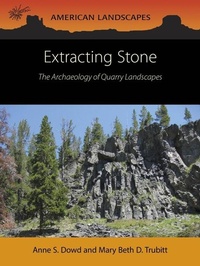
Extracting Stone
The Archaeology of Quarry Landscapes
Published on 5. March 2024
Book
Paperback/Softback
168 pages
978-1-78570-624-0 (ISBN)
Description
_Extracting Stone_ considers where chert or obsidian were mined and how North American stone quarry landscapes have been identified and studied from the time of pioneer William Henry Holmes (1846-1933) onward. Three especially significant extraction areas are examined in detail: Flint Mine Hill, New York, along the Hudson River; "Spanish Diggings", Arkansas, in the Ouachita Mountains; and Obsidian Cliff, Wyoming, in the headwaters of the Yellowstone River. The authors compare and contrast extraction scales with artifact distribution or use areas established through precise material characterization techniques to discuss trade and exchange, the emergence of inequalities, resource restriction or
control, and the technological systems of which these land- or quarry-scapes formed a part.
The chronological periods covered by quarrying activities show that most intensive use took place in the Archaic and Woodland periods, roughly 4000-1000 years ago when denser populations existed, but use began as early as the Paleoindian Period, about 13,000-9000 years ago and, in some cases, continues into the modern day. Recent research into early human population of the continent at sites such as White Sands in Nevada, where human footprints are found in association with those of extinct fauna, may push back these dates another 10,000 years, to 23,000 years ago.
Archaeologists are now employing a landscape approach to quarry systems, using new technologies such as Geographic Information System (GIS) computer mapping and Light and RADAR (LiDAR) aerial imaging. The authors demonstrate how sites functioned in a broad synchronic landscape context, which site locations or raw material types were preferred and why, what cultures were responsible for innovative or intensive quarry resource extraction, and how this land use changed over time.
An Appendix lists quarry sites that the general public can view.
control, and the technological systems of which these land- or quarry-scapes formed a part.
The chronological periods covered by quarrying activities show that most intensive use took place in the Archaic and Woodland periods, roughly 4000-1000 years ago when denser populations existed, but use began as early as the Paleoindian Period, about 13,000-9000 years ago and, in some cases, continues into the modern day. Recent research into early human population of the continent at sites such as White Sands in Nevada, where human footprints are found in association with those of extinct fauna, may push back these dates another 10,000 years, to 23,000 years ago.
Archaeologists are now employing a landscape approach to quarry systems, using new technologies such as Geographic Information System (GIS) computer mapping and Light and RADAR (LiDAR) aerial imaging. The authors demonstrate how sites functioned in a broad synchronic landscape context, which site locations or raw material types were preferred and why, what cultures were responsible for innovative or intensive quarry resource extraction, and how this land use changed over time.
An Appendix lists quarry sites that the general public can view.
More details
Language
English
Place of publication
Oxford
United Kingdom
Target group
Professional and scholarly
Product notice
Paperback (trade)
Unsewn / adhesive bound
Illustrations
b/w and colour
Dimensions
Height: 244 mm
Width: 182 mm
Thickness: 10 mm
Weight
454 gr
ISBN-13
978-1-78570-624-0 (9781785706240)
Copyright in bibliographic data and cover images is held by Nielsen Book Services Limited or by the publishers or by their respective licensors: all rights reserved.
Schweitzer Classification
Other editions
Additional editions
Dowd Anne S. Dowd | Trubitt Mary Beth D. Trubitt
Extracting Stone
The Archaeology of Quarry Landscapes
E-Book
04/2024
Oxbow Books
€29.49
Available for download
Dowd Anne S. Dowd | Trubitt Mary Beth D. Trubitt
Extracting Stone
The Archaeology of Quarry Landscapes
E-Book
04/2024
OXBOW BOOKS
€29.49
Available for download
Persons
Anne S. Dowd earned her doctorate in anthropology with a specialization in archaeology from Brown University. She is Principal Archaeologist at ArchaeoLOGIC USA, LLC, a consulting firm providing a full range of historic preservation services. Her research interests include lithic technology, quarrying, and raw material procurement. Mary Beth D. Trubitt received her Ph.D. in anthropology from Northwestern University. Professor Trubitt is currently the Station Archeologist for the Arkansas Archeological Survey's Henderson State University Research Station in Arkadelphia, where she also teaches. Her research interests include craft production and exchange of stone, marine shell, and pottery, and the development of complex societies in eastern North America.
Content
Acknowledgements
Foreword
Preface
Chapter 1. Introduction to the archaeology of quarry landscapes
Chapter 2. William Henry Holmes's contribution to the study of major North American stone quarries
Chapter 3. The role of landscape archaeology in understanding quarries
Chapter 4. Flint Mine Hill, New York
Chapter 5. "Spanish Diggings" and Arkansas Novaculite chert quarries in the Ouachita Mountains
Chapter 6. Obsidian Cliff, Wyoming
Chapter 7. Extracting stone in pre-Columbian North America
Appendix: Quarry sites that can be visited by the public
Bibliography
Foreword
Preface
Chapter 1. Introduction to the archaeology of quarry landscapes
Chapter 2. William Henry Holmes's contribution to the study of major North American stone quarries
Chapter 3. The role of landscape archaeology in understanding quarries
Chapter 4. Flint Mine Hill, New York
Chapter 5. "Spanish Diggings" and Arkansas Novaculite chert quarries in the Ouachita Mountains
Chapter 6. Obsidian Cliff, Wyoming
Chapter 7. Extracting stone in pre-Columbian North America
Appendix: Quarry sites that can be visited by the public
Bibliography