

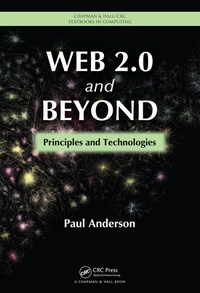
Web 2.0 and Beyond
Principles and Technologies
1st Edition
Published on 19. April 2016
412 pages
978-1-4398-2868-7 (ISBN)
Description

Web 2.0 and Beyond: Principles and Technologies draws on the author's iceberg model of Web 2.0, which places the social Web at the tip of the iceberg underpinned by a framework of technologies and ideas. The author incorporates research from a range of areas, including business, economics, information science, law, media studies, psychology, social informatics and sociology. This multidisciplinary perspective illustrates not only the wide implications of computing but also how other areas interpret what computer science is doing.
After an introductory chapter, the book is divided into three sections. The first one discusses the underlying ideas and principles, including user-generated content, the architecture of participation, data on an epic scale, harnessing the power of the crowd, openness and the network effect and Web topology. The second section chronologically covers the main types of Web 2.0 services-blogs, wikis, social networks, media sharing sites, social bookmarking and microblogging. Each chapter in this section looks at how the service is used, how it was developed and the technology involved, important research themes and findings from the literature. The final section presents the technologies and standards that underpin the operation of Web 2.0 and goes beyond this to explore such topics as the Semantic Web, cloud computing and Web Science.
Suitable for nonexperts, students and computer scientists, this book provides an accessible and engaging explanation of Web 2.0 and its wider context yet is still grounded in the rigour of computer science. It takes readers through all aspects of Web 2.0, from the development of technologies to current services.
After an introductory chapter, the book is divided into three sections. The first one discusses the underlying ideas and principles, including user-generated content, the architecture of participation, data on an epic scale, harnessing the power of the crowd, openness and the network effect and Web topology. The second section chronologically covers the main types of Web 2.0 services-blogs, wikis, social networks, media sharing sites, social bookmarking and microblogging. Each chapter in this section looks at how the service is used, how it was developed and the technology involved, important research themes and findings from the literature. The final section presents the technologies and standards that underpin the operation of Web 2.0 and goes beyond this to explore such topics as the Semantic Web, cloud computing and Web Science.
Suitable for nonexperts, students and computer scientists, this book provides an accessible and engaging explanation of Web 2.0 and its wider context yet is still grounded in the rigour of computer science. It takes readers through all aspects of Web 2.0, from the development of technologies to current services.
Reviews / Votes
Besides discussing technology development and current services, parts of Anderson's book address the needs of undergraduates and post-graduate research students. This book will help future researchers form a deeper understanding of what Web 2.0 is and how it could develop in the future. ... Web 2.0 and Beyond explains Web 2.0 and its wider context in an accessible and engaging style, helping readers, especially beginners, understand every aspect of Web 2.0 without difficulty.-Yijun Gao, First Monday, Volume 17, September 2012
"Some readers may not get past this book's title and spend too much time debating what Web 2.0 might mean. Without a doubt, the web has had a dramatic impact on society. Anderson (Intelligent Content, UK), an experienced computer/technology professional, steps back and takes a long look at the web relative to the technology in the past, where it is today, and trends for the future. Chapter 1 sets the stage for the three sections that follow. Although somewhat brief, this chapter establishes the author's perspective on the web. Section 1, "The Six Big Ideas," presents the elements that come together to create a technology that will continue to grow in importance worldwide. Section 2 presents the services that form the heart of what the author refers to as Web 2.0. The third section, "Framework for the Future," is a combination of a "look under the hood" to see how the web works and the author's thoughts on where it goes from here. Each chapter ends with "Exercises and Points to Ponder" and chapter references. Readers should spend some time exploring the exercises and key points, and pay close attention to some of the thought-provoking team exercises. ... Recommended."
-J. Beidler, University of Scranton for CHOICE Magazine
More details
Series
Edition
1. Auflage
Language
English
Place of publication
London
United Kingdom
Publishing group
Taylor & Francis Ltd
Target group
Professional and scholarly
Undergraduate and graduate students and researchers in information systems/information science, computer science, web development, educational technology, media studies, sociology, and psychology.
Illustrations
70 s/w Abbildungen, 5 s/w Tabellen
70 b/w images and 5 tables
ISBN-13
978-1-4398-2868-7 (9781439828687)
Copyright in bibliographic data and cover images is held by Nielsen Book Services Limited or by the publishers or by their respective licensors: all rights reserved.
Schweitzer Classification
Other editions
Additional editions
Book
05/2012
1st Edition
Chapman & Hall/CRC
€195.10
Shipment within 15-20 days
Person
Paul Anderson is a writer and technology forecaster for Intelligent Content Ltd. and was recently technical editor for JISC TechWatch, a horizon scanning service for UK universities. A graduate in computer science from the University of Leeds, he has worked for more than 25 years in industry and academia as a software developer, technology transfer officer, and technology futures specialist. He has also written extensively for a range of education, trade, and current affairs publications and was awarded the EPSRC's Computer Science Writer of the Year prize in 2007.
Content
What Is Web 2.0? THE SIX BIG IDEAS: User-Generated Content. Architecture of Participation. Data on an Epic Scale. Harnessing the Power of the Crowd. Openness. The Network Effect and Web Topology: What Size and Shape Is the Web and Why Does It Matter? WEB 2.0 SERVICES: Blogs. Wikis. Online Social Networks. Media Sharing. Social Bookmarking Sites. Microblogging Services. FRAMEWORK FOR THE FUTURE: Technology and Standards. Beyond Web 2.0. Epilogue. References. Index.
