

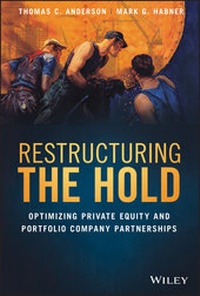
Restructuring the Hold
Description

Private equity represents a productive and fast-growing asset class--building businesses, creating jobs, and providing unlimited opportunity for investors and management teams alike, particularly if they know how to work together in candid and effective partnerships. Restructuring the Hold demonstrates how investors and managers can best work together to optimize company performance and the associated rewards and opportunities for everyone, not just the investors.
Through brief references to the parable of the Gramm Company, a middle market portfolio company, readers will follow the disappointments and triumphs of a management team experiencing their first hold period under private equity ownership, from the day they get purchased through the day they get sold. Restructuring the Hold provides the reader both general knowledge and more detailed better practices and frameworks relating to specific time periods during the hold. Within this book readers will find:
* An examination of a typical middle-market private equity hold period
* Guidance for newly acquired management teams on what to expect during the hold period
* Descriptions of better practice operating cadence between investors and management teams
* Examples of effective partnerships between investors and management teams
* Discussions of topics relevant to typical hold periods, including organizational structures, operations improvement, selling pipelines and acquisition integrations
With guidance from Restructuring the Hold, private equity principals and portfolio company executives can take steps toward greater collaboration and better outcomes. Through updated practices and strong relationships, they can partner effectively to improve portfolio company performance, which will lead to better outcomes for both investors and management teams.
More details
Other editions
Additional editions
Persons
THOMAS C. ANDERSON is a long-time Operating Partner, Chairman, and Board Director, previously with The Riverside Company, a global investment firm focused on the middle-market. He currently works with companies in active Board roles to accelerate growth and prepare for successful transactions.
MARK G. HABNER is CEO of BeckWay Group, which he co-founded with Anderson as an operating company serving private equity and their portfolio companies, providing hands-on expertise to accelerate sustainable earnings growth.
Content
List of Figures xi
Foreword xv
Preface xxi
About the Authors xxv
Acknowledgments xxix
Introduction 1
Core Audience 4
Organization of the Book 6
Chapter 1: Private Equity 9
The Asset Class 11
The Middle-Market 17
The Investment Cycle 22
The Motivation 24
Chapter 2: New Ownership 31
The Ideal Partnership 33
Anticipating Management Sentiment 36
Key Investment Period Roles 42
Operating Partner Involvement 49
Core Values 55
Chapter 3: Month 1: Consternation 59
Onboarding Together 62
Confirming Portco Leadership 69
Teaming Authentically 77
Overcoming Resistance 81
Chapter 4: Month 2: This Might Be Okay 87
Baselining the Investment Period 90
Reporting Monthly Financials 94
Starting with Momentum 97
Identifying Value Sources 101
Chapter 5: Month 3: Guarded Enthusiasm 113
Generating and Aggregating Ideas 116
Evaluating and Prioritizing Opportunities 122
Profiling and Planning Initiatives 127
Suspending Strategic Planning Formalities 137
Finalizing the Value Creation Plan 141
Chapter 6: Quarter 2: A Bit Overwhelmed 147
Ensuring Leadership Coverage 150
Organizing the Value Creation Team 159
Managing the Value Creation Program 162
Targeting, Tracking, and Triaging Value Creation 165
Chapter 7: Quarter 3: Gaining Momentum 173
Managing with Performance Indicators 176
Standardizing Operating Cadence 182
Incorporating the Board of Directors 189
Overcoming Bumps in the Road 195
Chapter 8: Quarter 4: Ringing the Bell 203
Confirming VCP Results 206
Rewarding Success 210
Planning Strategy Pragmatically 212
Integrating Plans and Budgets 216
Investment Period Outputs 227
Chapter 9: Year 2: Improving Infrastructure 229
Organizing Effectively 231
Operating Efficiently 238
Sourcing Strategically and Spending Economically 247
Financing Internally 256
Chapter 10: Year 3: Expanding Beyond 263
Optimizing Profitability 266
Pricing Intelligently 271
Pipelining Systematically 279
Integrating Pragmatically 286
Chapter 11: Year X: The Exit 297
Exit Timing 300
The Exit Process 302
Exit Preparation 305
Enjoying the Rewards 309
Chapter 12: Conclusion 313
References 317
Index 319
