

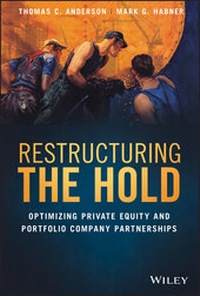
Restructuring the Hold
Description

Private equity represents a productive and fast-growing asset class--building businesses, creating jobs, and providing unlimited opportunity for investors and management teams alike, particularly if they know how to work together in candid and effective partnerships. Restructuring the Hold demonstrates how investors and managers can best work together to optimize company performance and the associated rewards and opportunities for everyone, not just the investors.
Through brief references to the parable of the Gramm Company, a middle market portfolio company, readers will follow the disappointments and triumphs of a management team experiencing their first hold period under private equity ownership, from the day they get purchased through the day they get sold. Restructuring the Hold provides the reader both general knowledge and more detailed better practices and frameworks relating to specific time periods during the hold. Within this book readers will find:
* An examination of a typical middle-market private equity hold period
* Guidance for newly acquired management teams on what to expect during the hold period
* Descriptions of better practice operating cadence between investors and management teams
* Examples of effective partnerships between investors and management teams
* Discussions of topics relevant to typical hold periods, including organizational structures, operations improvement, selling pipelines and acquisition integrations
With guidance from Restructuring the Hold, private equity principals and portfolio company executives can take steps toward greater collaboration and better outcomes. Through updated practices and strong relationships, they can partner effectively to improve portfolio company performance, which will lead to better outcomes for both investors and management teams.
More details
Other editions
Additional editions
Persons
THOMAS C. ANDERSON is a long-time Operating Partner, Chairman, and Board Director, previously with The Riverside Company, a global investment firm focused on the middle-market. He currently works with companies in active Board roles to accelerate growth and prepare for successful transactions.
MARK G. HABNER is CEO of BeckWay Group, which he co-founded with Anderson as an operating company serving private equity and their portfolio companies, providing hands-on expertise to accelerate sustainable earnings growth.
Content
List of Figures xi
Foreword xv
Preface xxi
About the Authors xxv
Acknowledgments xxix
Introduction 1
Core Audience 4
Organization of the Book 6
Chapter 1: Private Equity 9
The Asset Class 11
The Middle-Market 17
The Investment Cycle 22
The Motivation 24
Chapter 2: New Ownership 31
The Ideal Partnership 33
Anticipating Management Sentiment 36
Key Investment Period Roles 42
Operating Partner Involvement 49
Core Values 55
Chapter 3: Month 1: Consternation 59
Onboarding Together 62
Confirming Portco Leadership 69
Teaming Authentically 77
Overcoming Resistance 81
Chapter 4: Month 2: This Might Be Okay 87
Baselining the Investment Period 90
Reporting Monthly Financials 94
Starting with Momentum 97
Identifying Value Sources 101
Chapter 5: Month 3: Guarded Enthusiasm 113
Generating and Aggregating Ideas 116
Evaluating and Prioritizing Opportunities 122
Profiling and Planning Initiatives 127
Suspending Strategic Planning Formalities 137
Finalizing the Value Creation Plan 141
Chapter 6: Quarter 2: A Bit Overwhelmed 147
Ensuring Leadership Coverage 150
Organizing the Value Creation Team 159
Managing the Value Creation Program 162
Targeting, Tracking, and Triaging Value Creation 165
Chapter 7: Quarter 3: Gaining Momentum 173
Managing with Performance Indicators 176
Standardizing Operating Cadence 182
Incorporating the Board of Directors 189
Overcoming Bumps in the Road 195
Chapter 8: Quarter 4: Ringing the Bell 203
Confirming VCP Results 206
Rewarding Success 210
Planning Strategy Pragmatically 212
Integrating Plans and Budgets 216
Investment Period Outputs 227
Chapter 9: Year 2: Improving Infrastructure 229
Organizing Effectively 231
Operating Efficiently 238
Sourcing Strategically and Spending Economically 247
Financing Internally 256
Chapter 10: Year 3: Expanding Beyond 263
Optimizing Profitability 266
Pricing Intelligently 271
Pipelining Systematically 279
Integrating Pragmatically 286
Chapter 11: Year X: The Exit 297
Exit Timing 300
The Exit Process 302
Exit Preparation 305
Enjoying the Rewards 309
Chapter 12: Conclusion 313
References 317
Index 319
Introduction
Private equity as an investment class has skyrocketed in recent years, both globally and domestically. If you're not directly or indirectly involved in private equity today, there's a good chance you soon will be.
Before the 1980s, private equity was a new and largely unknown phenomenon. Today it represents one of the largest asset classes available to institutional investors, private investors, and management teams alike. In the US alone, a few thousand private equity firms control over 50,000 companies through some combination of direct investment, board control, and operational involvement.
Over the years, private equity firms have acquired a reputation for being ruthless, possessing a single-minded focus on their own profits at the expense of the companies and their employees they acquire. Even today, over 30 years after its release, we still hear plenty of references to the chart-topping 1987 movie Wall Street. Michael Douglas's character Gordon Gekko sanctimoniously purchases and dismantles companies with the single goal of lining his own pockets. "It's not a question of enough, pal," he lectures his idealistic young protégé, "it's a zero-sum game: Somebody wins, somebody loses." His philosophy is pithily summed up in the film's most memorable line: "Greed is good."
Douglas's portrayal of Gekko is of course a caricature, but distrust over the motives of private equity still runs wide and deep, even among well-informed and seasoned business professionals. The image seems universally ingrained: fancy-suited, hard-talking, ruthless investors buying, breaking up, and brokering companies for personal gain, brutally and heartlessly manhandling employees and their families without regard to the consequences of their actions. Many continue to doubt the intentions of private equity firms claiming to seek win-win outcomes in which everyone shares in a better and more profitable future.
The investing world has certainly spawned its share of Gekko-like characters leveraging junk bonds or pursuing other means to aggressively finance disreputable deals. But in its short history, private equity has matured quickly, embodying more professionalism and proficiency today than ever before - and more competition, too. Gone are the days where firms could buy a company at a low multiple of earnings price, leverage it through taking on lots of debt, loosely monitor the investment through quarterly board meetings, and sell the company a few years later at a higher exit multiple - all but guaranteeing exceptional returns. To succeed in private equity today, investors and management teams must work together to improve and grow businesses rather than financially engineer them.
More and more investors are searching harder than ever to find and buy promising companies, and the billions of "dry powder" dollars available for investment only serves to intensify competition. To differentiate in a very crowded and oversubscribed field, fund variations continue to proliferate based on company size, industry, investment horizon, and asset quality. One area of particular interest to growth-minded investors is the middle-market, loosely defined as those companies with annual revenues between $10 million and $1 billion, most of which will be sold at least once during the next dozen years.
Due to interest and competition, private equity firms that target the middle-market can no longer count on proprietary deal flow, transaction acumen, financial engineering, and multiple expansion to achieve even reasonable (let alone outsized) returns. It's now all about growing businesses: crafting strategies, building management teams, improving infrastructure, and actively driving value throughout the typical three- to seven-year hold period.
The need for understanding how to successfully navigate the hold period is undeniable. Achieving growth in earnings (EBITDA, or earnings before interest, taxes, depreciation, and amortization) today requires active operational involvement from private equity and accelerated and innovative action from the portfolio company. Yet while a great deal of ink has been spilled over the necessity of increased hands-on investor involvement and even more on management team effectiveness, very little has been said about the intersection of the two. What's missing in the conversation is an explanation about why it's important to have collaborative and constructive partnerships between private equity principals and portfolio company executives - and how to get there.
Restructuring the Hold: Optimizing Private Equity and Portfolio Company Partnerships illuminates an improved approach to private equity investing that centers on more productive and profitable working relationships and practices among management teams, equity partners, and boards of directors. Vastly different in concept and execution from the extremes of either the traditional hands-off approach or the equally ineffective we-tell-you-do method, Restructuring the Hold spells out how to develop a dynamic collaborative partnership based on trust and accountability between private equity principals and portfolio executives.
By examining how a truly collaborative partnership would develop and implement effective practices over the course of the hold period, Restructuring the Hold explains how management teams and their private equity partners can and should work together to achieve an efficient operating rhythm, accelerate sustainable EBITDA growth, and ultimately optimize exit value - benefiting investors and private equity firms as well as portfolio company management, company employees, and their families. Restructuring the Hold therefore serves four primary goals:
- Elevate portfolio company expectations for constructive partnerships with their private equity firm that leverages each of their complementary capabilities throughout the hold period.
- Encourage private equity firms to continuously up their game through embodying core values and better governing practices when collaborating with their portfolio companies.
- Empower portfolio company executives and equity partners to establish and execute an aggressive Value Creation Program based on attitude and capability that focuses on the hold period endgame.
- Achieve accelerated sustainable earnings growth and optimize enterprise value through authentic relationships, constructive partnerships, clear accountabilities, and better operating practices.
Built on a chapter by chapter explanation of the typical steps within the hold period, Restructuring the Hold illustrates how private equity and portfolio companies can form constructive partnerships and implement better practices to optimize the outcomes for everyone.
Core Audience
The lessons of Restructuring the Hold are applicable across the wide spectrum of private equity and other business sectors. It's relevant to anyone interested in how to establish more productive and more profitable working relationships and practices between and among management teams, private equity investors, and board directors. Whether you're a limited or general partner associated with a private equity firm, a banker at an investment or commercial institution, an individual investor in alternative asset classes, an executive at a portfolio company, or just someone interested in this essential business sector, Restructuring the Hold will reshape your thinking about how private equity and portfolio companies can and should work together to reconfigure outdated and ineffective approaches to hold periods.
The book is particularly suited for investors, executives, and managers associated and working with the portfolio companies of middle-market private equity firms. If you find yourself in one or more of the following groups, Restructuring the Hold will help you create sustainable value in your businesses:
- Sooners. Executives and managers soon to be part of the private equity world because their companies will soon be sold to private equity. These folks wonder what they should expect and what's about to "happen to me." Sooners don't know whether they should be excited or looking for another job.
- Improvers. Executives and managers already part of a private equity sponsored portfolio company. These individuals might want to better understand what's happening to them or might want to improve their game, their relationship with the private equity partners, and their careers as well.
- Again-ers. Executives and managers who have had one or more previous experiences with private equity, resulting in either positive or less-than-stellar experiences. These are the ones interested in making their next go-round not only financially successful but personally and professionally rewarding.
- Board directors. The board of directors for a portfolio company is interested in providing more insightful guidance to their executive teams during the hold and in advising management teams on how to best work within their new ownership structures to drive the best performance possible.
- Investors. Partners and other principals in private equity firms themselves, interested in establishing more personally, professionally, and financially rewarding partnerships with...
