

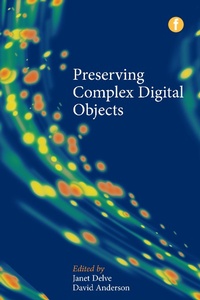
Preserving Complex Digital Objects
Description

This ground-breaking edited collection explores the challenges of preserving complex digital objects such as simulations, visualisations, digital art and video games.
Drawing on the outputs of the JISC-funded Preservation of Complex Objects (POCOS) symposia, enhanced with specialist pathfinder solutions, this book will cover topics such as the legal and technical challenges of preservation, curation and authority, and digital archaeology.
Written by international experts from a broad background of library, collecting institutions, information and computer science, and digital preservation backgrounds, this collection showcases the state of the art of the discipline and brings together stakeholder perspectives from across the preservation community. The collection is structured around six parts:
- Why and what to preserve: creativity vs preservation
- The memory institution: data archival perspectives
- Digital preservation approaches, practices and tools
- Case studies
- A legal perspective
- Pathfinder conclusions.
Readership: Academics and students on digital preservation, digital humanities and information management courses, and those working in preservation and collecting for memory institutions will find this a valuable read. It will also be of particular interest to computer scientists, artists, games and emulation communities, archaeologists and digital forensic scientists.
More details
Other editions
Additional editions
Persons
Janet Delve is co-leader of the interdisciplinary Future Proof Computing Group in the School of Creative Technologies at the University of Portsmouth. She is a member of the Digital Preservation Coalition Technology Watch Editorial Board.
David Anderson is co-leader of the interdisciplinary Future Proof Computing Group at the University of Portsmouth. He is the Director of CiTECH (the Centre for Cultural and Industrial Technologies Research) in the Faculty of Creative and Cultural Industries.
Content
Foreword - Adam Farquhar Preface - Neil Grindley Introduction - Janet Delve and David Anderson
PART 1: WHY AND WHAT TO PRESERVE: CREATIVITY VERSUS PRESERVATION
1. Standing on the shoulders of heavily armed giants - why history matters for game development - Dan Pinchbeck 2. Archaeology versus anthropology: what can truly be preserved? - Richard A. Bartle 3. Make or break? Concerning the value of redundancy as a creative strategy - Simon Biggs 4. Between code and space: the challenges of preserving complex digital creativity in contemporary arts practice - Michael Takeo Magruder
PART 2: THE MEMORY INSTITUTION/DATA ARCHIVAL PERSPECTIVE
5. Preservation of digital objects at the Archaeology Data Service - Jenny Mitcham 6. Preserving games for museum collections and public display: the National Videogame Archive - Tom Woolley, James Newman and Iain Simons 7. Bridging the gap in digital art preservation: interdisciplinary reflections on authenticity, longevity and potential collaborations - Perla Innocenti 8. Laying a trail of breadcrumbs - preparing the path for preservation - Drew Baker and David Anderson
PART 3: DIGITAL PRESERVATION APPROACHES, PRACTICE AND TOOLSPart 3.1: A good place to start: software preservation
9. Digital preservation and curation: the danger of overlooking software - Neil Chue Hong 10. How do I know that I have preserved software? - Brian Matthews, Arif Shaon and Esther Conway
Part 3.2: Tools and techniques
11. Digital preservation strategies for visualizations and simulations - Janet Delve, Hugh Denard and William Kilbride 12. The ISDA tools: preserving 3D digital content - Kenton McHenry, Rob Kooper, Luigi Marini and Michael Ondrejcek
Part 3.3: Metadata, paradata and documentation
13. Ecologies of research and performance: preservation challenges in the London Charter - Hugh Denard 14. A tangled web: metadata and problems in game preservation - Jerome McDonough 15. Metadata for preserving computing environments - Angela Dappert 16. Preserving games environments via TOTEM, KEEP and Bletchley Park - Janet Delve, Dan Pinchbeck and Winfried Bergmeyer 17. Documenting the context of software art works through social theory: towards a vocabulary for context classification - Leo Konstantelos
PART 4: CASE STUDIES
18. The Villa of Oplontis: a 'born-digital' project - John R. Clarke 19. Preservation of complex cultural heritage objects - a practical Implementation - Daniel Pletinckx
