

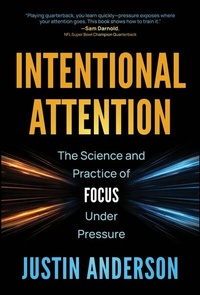
Intentional Attention
Description

"Pressure exposes where your attention goes. This book shows you how to train it." -Sam Darnold, NFL Super Bowl Champion Quarterback
For more than twenty years, Dr. Justin Anderson has led Premier Sport Psychology, a high-performance psychology consulting group that has become one of the most trusted names in mental training for sport and leadership. Working alongside elite athletes, coaches, and executives, Anderson and his team have transformed careers by helping clients target what truly separates those who sustain excellence from those who stumble when the heat rises. It is not a mysterious clutch gene, motivation, bravado, or positive thinking. It is a trainable skill.
"Intentional Attention" is the ability to deliberately direct and sustain focus on what drives performance, especially when distraction, emotion, and uncertainty surge. In a world engineered to capture our attention, this skill has become one of the rarest and most decisive competitive advantages.
In his trailblazing book, Anderson introduces a practical, science-backed framework for strengthening the attentional systems that drive performance. Drawing on gripping stories from locker rooms and boardrooms, as well as principles from high-performance psychology, Intentional Attention shows readers how to:
- Understand why the brain defaults to protection instead of execution
- Identify the attentional patterns that subtly undermine consistency
- Build daily routines for awareness, intention, execution, reflection, and renewal
- Perform with steadiness and confidence when the stakes are highest
Pressure is inevitable, but where your attention goes when it arrives makes all the difference. This book shows you how to train that skill and how to carry it into every arena of your life.
More details
Other editions
Additional editions
Person
DR. JUSTIN ANDERSON is a licensed psychologist, certified mental performance consultant, and founder of Premier Sport Psychology. Recognized as one of the foremost practitioners in performance psychology, his work spans professional teams across the NFL, NBA/ WNBA, MLB, NHL/PWHL, MLS/NWSL, Olympic athletes, collegiate athletic departments, and high-performing professionals across business, military, music/entertainment, and medicine nationwide. Anderson has built his career on a single conviction: helping the world's most driven people think clearly, compete fiercely, and lead at their best-in the moments that matter most and across the demands of everyday life.
Content
Foreword ix
Introduction xi
Part I The Cognitive Foundations of Intentional Attention: Understanding the System That Drives Performance 1
1 The Skill That Holds Everything Together 3
2 Hijacked: Our Minds Under Fire 9
3 The Old Brain in a Modern Arena 17
4 The Performance Control Tower: How Your Brain Manages Focus Under Fire 23
5 The Developmental Gap: Why Physical Peak Outpaces Mental Readiness 37
6 We Were Never Taught This 47
Part II Building Intentional Attention: Developing Attentional Management Within the Ia Framework 55
7 Introducing the Intentional Attention Framework(TM) 57
8 Awareness Is the Foundation: The Personal Attentional Attribute Inventory 65
9 Awareness of Attentional Patterns 103
10 Intention: The Bridge from Awareness to Action 125
11 Attentional Execution: Winning the Moment 145
12 Reflection: Learning Beyond the Whistle 165
13 Renewal: Recharging the Attentional System 177
Part III Transforming Attention: Applying Intentional Attention to Pressure, Purpose, and Life 203
14 Daily Reps: Building Attentional Fitness 205
15 Performing Under Pressure: From Clutch Moments to Chronic Demands 229
16 Stacking Wins: Sustaining Attention over Time 245
17 Train It Forward: Attention as the New Leadership Skill 265
References 279
About the Author 301
Index 303
Introduction: The Myth of the Naturally Clutch Performer
"Under pressure, we don't rise to the occasion-we sink to the level of our training."
-Adapted from Archilochus
I think I'm going to quit the game."
That's how he started. No hello. No small talk. Just a few words that hit the air like a confession.
He was an NBA All-Star. A former first-round pick. Eight years in the league. A player known for his grit, leadership, and consistency in big moments. But now, sitting across from me, he looked like a man unraveling. His body was beat up from the wear and tear of the season. His shot had abandoned him. And his confidence had quietly followed.
He was in the second-to-last year of his contract-the kind of year where every possession matters. Front offices start talking. Extension negotiations begin. Trade conversations heat up. For a player at his level, this wasn't just about playing well-it was about proving value. Cementing trust. Securing a deal that could be worth tens of millions of dollars.
And right now? He felt broken.
His slump was brutal. Over the last 22 games, he was shooting just 18% from three. His contract had a performance bonus clause that paid out if he cleared 33% from deep. Every miss wasn't just a hit to his ego-it was a hit to his wallet. Hundreds of thousands of dollars were vanishing with every miss.
He'd tried everything. More film. More shots. High-priced specialist shooting coaches. Extra reps after games. Practice during off days. In empty gyms. On the road. At home. Nothing helped. In fact, the harder he chased it, the further it seemed to slip away.
But what really broke him-the moment he knew he was spiraling-wasn't the slump. It was the defense. Or rather, the absence of it.
"They're leaving me open," he said. "That's the biggest insult. They're stepping back and daring me to shoot. Like I don't even belong out there."
It wasn't just about missed shots anymore. It was about identity. This was someone who had built a reputation on being clutch-trusted when the game was tight, the clock was low, and everything was on the line. Now, he didn't just feel like he was letting others down. He felt like he was disappearing.
What he was experiencing wasn't a lack of talent. It wasn't laziness. It wasn't even just a crisis of confidence.
It was attention: misplaced, overextended, and hijacked by pressure.
What he was experiencing wasn't rare. In fact, it's something we've seen hundreds of times. When we founded Premier, we saw the same pattern in youth and high school athletes-bright, driven competitors whose attention was consumed by outcomes instead of execution. As our work expanded into college programs, sales teams, and mid-level managers, the story repeated itself: talented people pulled off course by untrained attention. And when we began consulting with professional and Olympic athletes, Fortune 500 executives, and other elite performers, the pattern didn't disappear-it simply became more expensive. Whether the stakes were financial, reputational, or emotional, the underlying challenge was the same. Mismanaged attention doesn't discriminate by skill level or salary; it's a universal performance constraint. We've seen it across every level of competition and every arena of work. Attention, it turns out, shapes nearly every aspect of performance-it determines whether our best preparation ever gets expressed.
When we talked, it became clear that his mind wasn't just on his mechanics. It was ricocheting between contract incentives, media narratives, teammate expectations, and the rising fear of what failure might cost him. Every time he stepped onto the court, he wasn't playing the game in front of him-he was navigating a minefield of what the future might hold.
And here's what's interesting and most important to understand about this situation: His brain was doing exactly what it was designed to do.
In high-pressure environments, the human brain naturally shifts into protection mode. It starts scanning for threats, calculating risk, and tightening control-not to help us perform, but to protect us. Whether it's a collapsing shooting percentage or a charging bear, the brain's protective systems don't always differentiate between types of threat-they assess physical and existential threats in largely the same manner.
This isn't a character flaw or mental weakness. It's how we're wired.
The challenge is that while this threat-scanning response serves us well for survival, it can become a hindrance to performance. Clutch execution doesn't emerge from protection; it flows from clarity, presence, and assertive action. And while these responses might feel instinctive in the moment, they're actually skills that can be developed and refined.
Under Pressure, Performance Dips
The idea that some people are just "built differently"-wired to thrive in pressure moments with supernatural calm and precision-makes for compelling highlight reels, discussions with scouts at the Combine, and perhaps even better sports documentaries. But when we examine the evidence, this notion is largely mythical.
Michael Jordan is often cited as the embodiment of clutch greatness. And yes, he delivered in iconic moments. But what's most revealing is that even Jordan didn't consistently outperform his remarkable averages under pressure; he just essentially maintained them.
As Weisinger and Pawliw-Fry (2015) note in Performing Under Pressure, the highest performers do not perform better when the stakes rise; they perform closer to their baseline while others deteriorate.
Like other greats, Jordan didn't ascend into superhuman territory in clutch moments-he remained consistent. And in high-stress environments, that consistency is elite performance.
Decades of research across performance domains show that under intense stress, people rarely "rise to the occasion." Instead, they default to the level of their preparation. As Grossman (2008) observed in military and high-stakes performance contexts, pressure doesn't create new abilities-it exposes and amplifies existing training. Team-based decision-making studies echo this pattern: When arousal spikes and the stakes are high, even seasoned professionals fall back on the cognitive scripts they've rehearsed most often (Driskell et al., 1999).
This is also supported by what we are learning from studies on the brain. Neuroscience shows that in moments of uncertainty, the brain doesn't generate novel solutions-it retrieves and reconstructs patterns from previous experience (Schacter and Addis, 2007). Our default mode is familiarity, not innovation. Bargh and Chartrand (1999) found that much of this retrieval process operates below conscious awareness, pulling on whatever neural pathways have been most consistently reinforced.
When pressure spikes, your brain doesn't search for magic-it searches for established patterns. And those patterns, whether helpful or harmful, are built through repeated experience. The top performers under pressure aren't relying purely on instinct or raw grit. They're drawing on trained attentional systems-internal frameworks that help them filter out noise, interpret emotion constructively, and return to their strategic approach.
Neuroscientific research (Miller & Cohen, 2001) has shown that these systems are governed by the prefrontal cortex. These systems allow performers to override reactive impulses and sustain goal-directed focus. Similarly, Posner and Rothbart (2007) demonstrated that attentional networks-when trained deliberately-can regulate emotion, inhibit distraction, and support higher-order performance even under pressure.
Top performers learned to keep their attention anchored on the variables that drive performance. Not because they were born with something special, but because they've developed something specific.
Some discover this ability through experience and natural development, but increasingly, far more elite performers are training it with deliberate intention. We wanted to understand whether that ability could be trained-and if so, how consistently it could transform performance across domains.
Training the Mind's Most Valuable Resource
For nearly two decades, I've worked in some of the most competitive arenas in the world-serving as Director of High Performance Psychology for multiple teams in the NFL, NBA, MLB, and NHL, and as founder of Premier Sport Psychology and Premier Performance Advising. These roles have given me a front-row seat to thousands of teachable moments with some of the world's greatest athletes, coaches, and executives.
Across all of those touchpoints, one pattern has stood out with remarkable clarity: The performers who consistently deliver under pressure aren't fundamentally different from their peers in talent or drive. What sets them apart is how intentional they are in managing their mental resources.
Specifically, they have learned how to direct and sustain their attention with precision-especially when it...
