

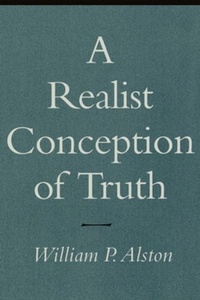
A Realist Conception of Truth
1st Edition
Published on 18. October 2018
288 pages
978-1-5017-2055-0 (ISBN)
Description

One of the most important Anglo-American philosophers of our time here joins the current philosophical debate about the nature of truth. William P. Alston formulates and defends a realist conception of truth, which he calls alethic realism (from "aletheia," Greek for truth). This idea holds that the truth value of a statement (belief or proposition) depends on whether what the statement is about is as the statement says it is. Michael Dummett and Hilary Putnam are two of the prominent and widely influential contemporary philosophers whose anti-realist ideas Alston attacks.
More details
Language
English
Place of publication
NY
United States
Target group
College/higher education
Professional and scholarly
Edition type
Digital original
ISBN-13
978-1-5017-2055-0 (9781501720550)
Copyright in bibliographic data and cover images is held by Nielsen Book Services Limited or by the publishers or by their respective licensors: all rights reserved.
Schweitzer Classification
Other editions
Additional editions
William P. Alston
A Realist Conception of Truth
Book
04/1997
Cornell University Press
€29.70
Shipment within 10-20 days
William P. Alston
A Realist Conception of Truth
Book
01/1996
Cornell University Press
€64.38
Shipment within 10-20 days
Person
AlstonWilliam P.:
The late William P. Alston was Professor of Philosophy Emeritus at Syracuse University. His books include A Realist Conception of Truth, Illocutionary Acts and Sentence Meanings, The Reliability of Sense Perception, and Perceiving God: The Epistemology of Religious Experience, all from Cornell.
The late William P. Alston was Professor of Philosophy Emeritus at Syracuse University. His books include A Realist Conception of Truth, Illocutionary Acts and Sentence Meanings, The Reliability of Sense Perception, and Perceiving God: The Epistemology of Religious Experience, all from Cornell.
Content
- Cover
- A REALIST CONCEPTION OF TRUTH
- Title
- Copyright
- Dedication
- CONTENTS
- Preface
- Introduction
- 1 Alethic Realism
- i Preliminary Formulation
- ii Bearers of Truth Value: Sentences
- iii Bearers of Truth Value: Statements and Beliefs
- iv Bearers of Truth Value: Propositions
- v The Nature of Propositions
- vi General Formulations of a Realist Conception of Truth
- vii Propositional Truth and the T-Schema
- viii Relation to Tarski
- ix Minimalism about Truth
- x Minimalist Realism and the Correspondence Theory
- xi Minimalist Realism and ''Deflationary" Accounts of Truth
- xii Objections to the Minimal-Realist Account of Truth
- 2 Alethic Realism and Metaphysical Realism
- i Metaphysical Antirealism: Flat Denials
- ii Metaphysical Antirealism: Reductions
- iii Realism and Idealism
- iv The Boundary between Flat Denials and Reductions
- v Logical Relations of Alethic Realism and Metaphysical Realisms
- 3 An Epistemological Objection to Alethic Realism
- i The Alleged Impossibility of Comparing judgements and Facts
- ii Can We Cognize Anything Other Than judgements?
- iii Counterattack by Blanshard
- 4 Dummett's Verificationist Alternative to Alethic Realism
- i Forms of Verificationism
- ii Dummett's Verificationist Semantics
- iii Critique of Verificationism
- iv Verificationist Semantics and the Concept of Truth
- v Compatibility of Verificationist Semantics and Realist Truth
- vi No Meaningful Sentences Are Only Defeasibly Verifiable
- vii Dummett on Realism
- 5 Putnam's Model-Theoretic Argument
- i The Argument
- ii Initial Difficulties with the Argument
- iii Another Reading of the Argument
- iv What Is an ''Interpretation"?
- v Indeterminacy of Reference
- vi Putnam's "Brain in a Vat" Argument
- 6 Putnam on "Conceptual Relativity
- i Putnam's Conceptual Relativity
- ii Hard-Nosed Absolutist Rejoinders
- iii More Moderate Absolutist Rejoinders
- iv Conceptual Relativity and the Nature of Truth
- 7 Epistemic Conceptions of Truth
- i The Realist Conception of Truth and Its Alternatives
- ii Varieties of Epistemic Conceptions of Truth
- iii Ideal Epistemic Conditions (1)
- iv ldeal Epistemic Conditions (2)
- v Are There Counterexamples to the Ideal justifiability Conception?
- vi The Concept of an Ideal Epistemic Situation Presupposes the Concept of Truth
- vii An Intensional Argument against the Claim
- viii Replies to the Intensional Argument
- ix An Epistemic Reinterpretation of Content
- x Back to Dummett
- xi Realist and Antirealist Prospects for Determining Truth Value
- xii A Nonconceptual Epistemic Theory of Truth
- 8 Doing without Truth
- i The Scope of This Chapter
- ii Reasons for De-Emphasizing Truth
- iii Why Truth Is Important
- iv Truth and Epistemology: Knowledge and Justification
- v Justification without Truth
- vi Troubles with Deontological Conceptions of justification
- vii Problems with Any Truth-Free justification
- viii Stich on the Unimportance of Truth
- Epilogue
- Bibliography
- Index
