

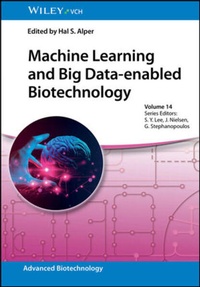
Machine Learning and Big Data-enabled Biotechnology
1st Edition
Published on 9. January 2026
432 pages
978-3-527-85052-5 (ISBN)
Description

The book discusses how Machine Learning and Big Data is and can be used in biotechnology for a wide breath of topics. It is separated
into three main parts, with the first covering DNA and ranging from ?synthetic biology part design (such as promoters)? to ?predictions from genome sequences?. The second part concerns proteins, with topics ranging from ?structure and design tools? to ?pathway discovery / retrobiosynthesis?, while the last part covers whole cells and ranges from ?Machine Learning approaches for gene expression? to ?Machine Learning predictions of phenotype and bioreactor performance?
into three main parts, with the first covering DNA and ranging from ?synthetic biology part design (such as promoters)? to ?predictions from genome sequences?. The second part concerns proteins, with topics ranging from ?structure and design tools? to ?pathway discovery / retrobiosynthesis?, while the last part covers whole cells and ranges from ?Machine Learning approaches for gene expression? to ?Machine Learning predictions of phenotype and bioreactor performance?
More details
Other editions
Additional editions
Hal S. Alper
Machine Learning and Big Data-enabled Biotechnology
Book
03/2026
1st Edition
Wiley-VCH
€159.00
Available immediately
Person
Dr. Hal Alper is the Kenneth A. Kobe Professor in Chemical Engineering and Executive Director of the Center for Biomedical Research Support at The University of Texas at Austin. He earned his Ph.D. in Chemical Engineering from the Massachusetts Institute of Technology in 2006 and was a postdoctoral research associate at the Whitehead Institute for Biomedical Research from 2006-2008, and at Shire Human Genetic Therapies from 2007-2008. Dr. Alper also serves on the Graduate Studies Committee for the Cell and Molecular Biology Department and the Biochemistry Department. He is currently the Principal Investigator of the Laboratory for Cellular and Metabolic Engineering at The University of Texas at Austin where his lab focuses on metabolic and cellular engineering in the context of biofuel, biochemical, and biopharmaceutical production in an array of model host organisms. His research focuses on applying and extending the approaches of synthetic biology, systems
biology, and protein engineering.
biology, and protein engineering.
Content
Part I - From DNA?
1 Deep learning approaches for synthetic biology part design
2 Automated approaches for GSM development from DNA sequence
3 Predictive models from genome sequences
Part II - ?.to Proteins?
4 De novo protein structure and design tools
5 Machine learning approaches for protein engineering
6 Pathway discovery / Retrobiosynthesis
7 Enzyme functional classifications
8 Proteomics machine learning approaches and de novo identification
Part III - ?to whole cells and beyond
9 Machine learning approaches for gene expression
10 Metabolomics big data approaches
11 Use of Generative AI and natural language processing for cell models
12 Metabolic production, strain engineering, and flux design
13 Automated function and learning in biofoundries/strain designs
14 Machine learning predictions of phenotype and bioreactor performance
1 Deep learning approaches for synthetic biology part design
2 Automated approaches for GSM development from DNA sequence
3 Predictive models from genome sequences
Part II - ?.to Proteins?
4 De novo protein structure and design tools
5 Machine learning approaches for protein engineering
6 Pathway discovery / Retrobiosynthesis
7 Enzyme functional classifications
8 Proteomics machine learning approaches and de novo identification
Part III - ?to whole cells and beyond
9 Machine learning approaches for gene expression
10 Metabolomics big data approaches
11 Use of Generative AI and natural language processing for cell models
12 Metabolic production, strain engineering, and flux design
13 Automated function and learning in biofoundries/strain designs
14 Machine learning predictions of phenotype and bioreactor performance
