

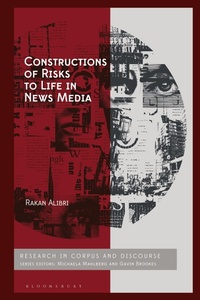
Constructions of Risks to Life in News Media
1st Edition
Published on 22. January 2026
288 pages
978-1-350-53064-5 (ISBN)
Description

This book investigates the construction of risks through discourse to provide new insights into the relationship between risk discourse and society.
It explores how British newspapers used language to discursively construct four different types of risks to life, namely terror attacks, earthquakes, road accidents, and heart attacks, between 2017 and 2020, examining what makes some risk events newsworthy, and how this relates to the way they are perceived.
The author offers new insights into risk reporting by using an approach combining theories and methodologies from corpus linguistics and critical discourse studies focusing on news values and risk perception. Through a focus on risks to life, related social actors, and consequences, he demonstrates salient discursive strategies found in risk reporting, including dramatisation, naturalisation, impersonalisation, blame, responsibility, and risk management. These strategies contribute differently to the construction of the risks and can potentially be linked to how the media amplify or attenuate risk perception in society, a consequence of media language use.
This interdisciplinary book goes beyond linguistics to engage with discussions related to media studies, e.g. the concentration of media ownership in the UK, and news values; risk literature, e.g. risk perception, sociological theories of risk, and risk communication; and the relationship between media and risk perception, and studies related to each risk.
It explores how British newspapers used language to discursively construct four different types of risks to life, namely terror attacks, earthquakes, road accidents, and heart attacks, between 2017 and 2020, examining what makes some risk events newsworthy, and how this relates to the way they are perceived.
The author offers new insights into risk reporting by using an approach combining theories and methodologies from corpus linguistics and critical discourse studies focusing on news values and risk perception. Through a focus on risks to life, related social actors, and consequences, he demonstrates salient discursive strategies found in risk reporting, including dramatisation, naturalisation, impersonalisation, blame, responsibility, and risk management. These strategies contribute differently to the construction of the risks and can potentially be linked to how the media amplify or attenuate risk perception in society, a consequence of media language use.
This interdisciplinary book goes beyond linguistics to engage with discussions related to media studies, e.g. the concentration of media ownership in the UK, and news values; risk literature, e.g. risk perception, sociological theories of risk, and risk communication; and the relationship between media and risk perception, and studies related to each risk.
More details
Series
Edition
1. Auflage
Language
English
Place of publication
London
United Kingdom
Publishing group
Bloomsbury Publishing PLC
Target group
Professional and scholarly
Illustrations
10 bw illus
ISBN-13
978-1-350-53064-5 (9781350530645)
Copyright in bibliographic data and cover images is held by Nielsen Book Services Limited or by the publishers or by their respective licensors: all rights reserved.
Schweitzer Classification
Other editions
Additional editions
Rakan Alibri
Constructions of Risks to Life in News Media
Book
approx. 02/2026
Bloomsbury Academic
€132.60
Not yet published
Person
Rakan Alibri is Assistant Professor in the Languages and Translation Department at Tabuk University, Saudi Arabia.
Content
List of Figures
List of Tables
1. Introduction
2. Laying the Groundwork: Risk Perception, Media, and Studies of Risks to Life
3. Data and Methodology
4. The Risks to Life
5. Social Actors
6. Death
7. Conclusion
References
Index
List of Tables
1. Introduction
2. Laying the Groundwork: Risk Perception, Media, and Studies of Risks to Life
3. Data and Methodology
4. The Risks to Life
5. Social Actors
6. Death
7. Conclusion
References
Index
