

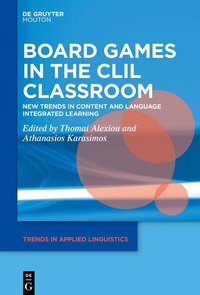
Board Games in the CLIL Classroom
Description

The present book explores how modern board gaming and language teaching can be beneficially combined to achieve optimal impact. Modern board games have a lot to offer language learners and teachers, and they should play a much more significant role in what has been labelled "Content and Language Integrated Learning" or CLIL.
Modern board games require cooperation, problem-solving, active discovery, interpretation and analysis. Most importantly, modern board games allow students to explore a hypothetical environment without the risk of language errors. The key ingredient of the present book is "game-based learning and teaching theory", or GBLTT, a theoretical framework which measures learning outcomes based on gaming and learning procedures. GBLTT is focused on balancing information and gameplay as well as putting a focus on the ability of each learner to retain language competence and to put their subject to realistic situations.
Reviews / Votes
This is a novel book and likely to be of interest across the profession of language teaching to a variety of participants. Board games can be an option to add variety and interest to the foreign language classroom provided, of course, participants in the learning process have a good idea of the principles for their effective exploitation. The book offers an interesting collection of chapters, with a good range of ideas and content, and plenty to spark good use of the technique among willing teachers.
James Milton, Emeritus Professor of Applied Linguistics, Swansea University, UK.
More details
Other editions
Additional editions
Persons
Content
- Intro
- Contents
- Introduction
- Chapter 1 CLIL-ing through board games: Evidence from class, challenges and perspectives
- Chapter 2 Using board games to practice grammar in adult foreign language classrooms: The case of "Dixit"
- Chapter 3 Once upon a time. . . in Senior High School: Implementing a story-telling board game as a teaching, learning and assessment tool
- Chapter 4 How can board games bridge the gap between content and language learning: The learners' point of view on the Hunger Grammar Games
- Chapter 5 Using board games for alternative assessment in CLIL
- Chapter 6 The role of games in the CLIL classroom: A case study exploring motivation levels
- Chapter 7 Establishing mutual understanding in CLIL-based L2 game interactions
- Chapter 8 Using games to teach maths in EFL: The case of trainee primary school teachers in France
- Chapter 9 Unlock-ed CLIL: An alternative escape from language classroom
- Chapter 10 Using a word guessing board game to elicit peer-scaffolds in content and language settings in Germany
- Notes on contributors
- Index
