

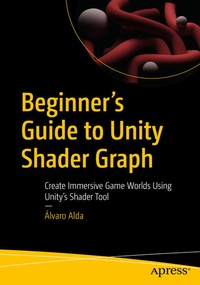
Beginner's Guide to Unity Shader Graph
Description

Discover how shaders can enhance your game and mesmerize players by making graphic gameplay elements more realistic and attractive. This book provides easy-to-follow recipes that will show you how to leverage the Unity Shader Graph to create more immersive, enjoyable games.
Author Álvaro Alda takes you through each effect step by step, so that you gain a foundational understanding of how they are created using the Shader Graph tool. Practical projects help you put what you're learning into context, from simple effects like 3D scan lines to more complicated effects such as black holes, bubble particles, water, and even interactive snow. Twelve different effects are demonstrated, to cover almost everything related to shader graph.
On completing this book, you will have a thorough understanding of the Shader Graph tool and samples to replicate and continue learning from. Whether you are an indie game developer or technical artist, Beginner's Guide to Unity Shader Graph will give you the confidence to use the Shader Graph tool to create games that will keep players glued to their screens.
What You Will Learn
- Understand the purpose and use of every node and function in Shader Graph
- Gain a working knowledge of the mathematics needed to use the fragment and vertex shaders
- Create complex effects with Shader Graph using post processing and taking full advantage of the URP of the Unity 3D engine
- Develop procedural textures using mathematical nodes in Shader Graph
Who Is This Book For
Technical artists, indie developers, and game developers with little to no knowledge of shaders, but who have basic knowledge of Unity. As the Shader Graph in Unity is similar to other shader editors like Amplify, Blender material nodes and Unreal shaders, this book can be used as reference when working with other platforms and game engines different from Unity.More details
Other editions
Additional editions
Person
Content
Chapter 1: Introduction to Shaders.- Chapter 2: Shader Graph.- Chapter 3: Mostly Used Nodes.- Chapter 4: Dynamic Shaders.- Chapter 5: Vertex Shaders.- Chapter 6: Distortion Shaders.- Chapter 7: Advanced Shaders.- Chapter 8: interactive Snow Effect.
