

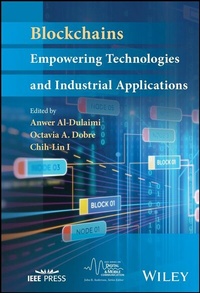
Blockchains
Description

A comprehensive guide to the most recent developments in blockchains in theoretical and industrial perspectives
Originally introduced as a method to keep track of Bitcoin transactions over a peer-to-peer network, blockchain is a continuously growing list of records, called blocks, which are linked and secured using cryptography into a chain held in public databases. The use of this technology has grown since its cryptocurrency creation and now store three types of information: 1) transactions, including the date, time, and value of purchases; 2) records of participates in transactions; and 3) unique code known as a "hash" that distinguishes one block from another. A single block on the blockchain can hold 1 MB of data, or potentially thousands of transactions -- this then can allow for hundreds of thousands of transactions to be recorded as each block can join the state-of-the-art blockchain.
Blockchains provides a detailed overview of the latest and most innovative concepts, techniques, and applications related to the developing blockchain. Aimed at novices and experts on the subject, the book focuses on blockchain technologies, integrated systems, and use cases, specifically by looking at three major technical areas: blockchain platforms and distributed database technologies, consensus and fault tolerance, and Blockchain as a Service (BaaS). These avenues of research are essential to support blockchain functionalities, such as acquiring and updating existing data, securing data resources and the recovery of failures, and using blockchains in various services that range from cryptocurrencies to cloud automation.
Blockchains readers will also find:
* Brainstorming activities that gradually builds the knowledge of readers on the described technology and deployment scenarios
* Investigation of specific topics such as novel networking protocols, wireless techniques, new infrastructure designs, operations management, and deployment strategies
* Discussion of technical challenges in blockchain, as well as how to manage cloud-based networks, service automation, and cyber security
* Numerous elementary and advanced examples on various topics at the end of the book that can be used for training purposes
* Illustrations including tables and diagrams to help elucidate points made throughout the volume
* Glossary of relevant terminology to blockchains in enterprise
Blockchains is a useful reference for researchers in vehicular networking and computer science, as well as cloud storage providers and governmental offices for data management.
More details
Other editions
Additional editions
Persons
Octavia A. Dobre, PhD, is a Professor and Research Chair in the Department of Electrical and Computer Engineering at Memorial University, Canada. She is an IEEE Fellow and is the Inaugural Editor-in-Chief for the IEEE Open Journal of the Communications Society.
Chih-Lin I, PhD, established the Green Communications Research Center of China Mobile, spearheading in her role as the CMCC Chief Scientist of Wireless Technologies major initiatives including 5G Key Technologies R&D.
Content
List of Contributors
Preface
Foreword
1 Introduction
Anwer Al-Dulaimi, Octavia A. Dobre, Chih-Lin I
2 Enabling technologies and distributed storage
Sina Rafati Niya, Burkhard Stiller
3 Consensus and distributed-transaction systems
Hans Walter Behrens, K. Selcuk Candan, Dragan Boscovic
4 Security, privacy and trust of distributed ledgers technology
Saqib Rasool, Muddesar Iqbal, Shancang Li, Tasos Dagiuklas,
Saptarshi Ghosh
5 Permissioned Blockchains
ZiLiang LAI and Eric LO
6 Attestation Infrastructures for Automotive Cybersecurity and
Vehicular Applications of Blockchains
Thomas Hardjono
7 Blockchains and Internet of things
Xavier Costa, Vincenzo Sciancalepore, Lanfranco Zanzi, Antonio Albanese
8 Blockchains for cybersecurity and AI systems
Petar Jevtic, Axel La Salle, Sasa Pesic, Dragan Boscovic, K. Selçuk Candan
9 6G Resource Management and Sharing: Blockchain and O-RAN
Hao Xu, Paulo Valente Klaine, Oluwakayode Onireti, Lei Zhang, Chih-Lin I
10 Blockchains for Smart Healthcare Systems
Dinh C. Nguyen and Pubudu Pathirana
11 Blockchain Standards
Hui Ding, Xiaofeng Chen, Kyeong Hee Oh, Ismael Arribas, Jörn Erbguth, Alexander Chuburkov, Lisa JY Tan, Xiangjuan Jia
About the Contributors
Anwer Al-Dulaimi is currently a Senior Manager of Emerging Technologies and a Distinguished Member of Technical Staff at EXFO, Montreal, Canada. He received the PhD degree in electrical and computer engineering from Brunel University, London, UK, in 2012 after obtaining MSc and BSc honors degrees in communication engineering. He was a Postdoctoral Fellow in the Department of Electrical and Computer Engineering, University of Toronto, sponsored by Blackberry's advanced research team. In his current role, Anwer is responsible for identifying future trends in mobile technology evolutions and the adaptation phases that EXFO needs to take for compliance. He is the chair of the newly established IEEE 5G/6G Innovation Testbed Project, which is working to develop a virtual testing platform for E2E network industry testing. He is the chair of the IEEE 1932.1 "Standard for Licensed/Unlicensed Spectrum Interoperability in Wireless Mobile Network." He is also representing EXFO in many industrial forums such as One6G and other collaborative projects. He has published many papers, edited books, and developed patents focusing on new generations of mobile networking technologies. He is the editor of the IEEE Future Networks Series on 5G and 6G published by IEEE Vehicular Technology Magazine, the editor of the Vehicular Networking Series in IEEE Communication Standards Magazine, and a guest editor of many other IEEE series issues. His research interests include 5G/6G networks, cloud computing, IoT, and cybersecurity. He is a Fellow of the Institution of Engineering and Technology (FIET) and has registered as a Chartered Engineer (CEng) by the British Engineering Council since 2010. He is a member of the NSERC discovery grants committee, a voting member of Mobile Communication Networks Standards Committee (MobiNet-SC), a senior member of IEEE and an IEEE ComSoc Distinguished Lecturer.
Antonio Albanese received his B.Sc. in Electronic and Telecommunication Engineering from Politecnico di Bari, Italy, in 2016 and his M.Sc. degree in Telecommunications Engineering from Politecnico di Milano, Italy, in 2018. Currently, he is the Chief Technology Officer at Flyhound Co., New York, USA while he is pursuing his Ph.D. in Telematic Engineering at Universidad Carlos III de Madrid, Spain. His research field covers millimeter waves, reconfigurable intelligent surfaces, aerial networks, and applied mathematical optimization, with a particular interest in wireless localization and prototyping.
Ismael Arribas is Co-founder, Kunfud®, Chief Compliance Officer at KRON WORLD S.L. Global and Collective Entrepreneur from Kingdom of Spain, and driving an independent compliance firm named Kunfud® since 2006. Ismael is committed with Standards at ISO TC 307, CEN-CENELEC JTC19, Liaison Officer between CEN-CENELEC and ETSI ISG- PDL, ITU-T FGDLT, and Q-22 at Study Group 16. He is Founding member of INATBA (https://inatba.org/) and Co-chair at Standards Committee in INATBA. He is also Principal Advisor for standardization at LaCChain (https://www.lacchain.net/#/home?lang=en) and IDB Lab. He is Co-Founder of various Startups like Blue Future Organization, Lumiversity, and CLAUDIA.
Hans Walter Behrens received his B.S. in Computer Science from the University of California, Irvine, and his M.S. and Ph.D. in Computer Science from Arizona State University. He serves as a visiting student researcher at Los Alamos National Laboratory, and has spent several years as Chief Technical Officer in several startups as well. His primary research interests include the security and privacy implications of distributed and decentralized systems, and in the creation of robust and resilient techniques that maintain functionality in the presence of active adversaries. His work has been published in conferences such as CCS, VLDB, ICBC, and ICC, and has been recognized by several awards, including the Dean's Fellowship and Herbold Foundation Graduate Engineering Scholarship. To learn more, visit behrens.dev/.
Dragan Boscovic is a research professor in the School of Computing, Informatics, & Decision Systems Engineering (CIDSE) at Arizona State University and Research Director of AZ Blockchain Applied Research Center, and Distinguished Visiting Scholar, mediaX, at Stanford University. Additionally, he is CEO and Founder of technology VizLore Group, headquartered in Arizona, and focuses on delivering innovative solutions related to IoT, Data Analytics, Blockchain distributed computing, and digital asset management. He holds a Ph.D. in EE and CS, Numerical Electromagnetic Modeling from the University of Bath, United Kingdom (1991). He has 25 years of high-tech experience acquired in an international setup (UK, France, China, USA) and is uniquely positioned to help data-driven technical advances within today's global data-intensive technology arena. He is a lateral thinker with broad exposure to a wide range of scientific methods and business practices. He has a proven track record in conceiving strategies and managing the development, investment, and innovation efforts related to advanced data analysis services, ML/AI applications, and mobile and IoT solutions and platforms.
Kasim Selçuk Candan is a Professor of Computer Science and Engineering at the Arizona State University (ASU) and the Director of ASU's Center for Assured and Scalable Data Engineering (CASCADE). His primary research interest is in the area of management and analysis of (non-traditional, heterogeneous, and imprecise) data. He has published over 200 journal and peer-reviewed conference articles, one book, several book chapters, and has several patents. Prof. Candan served as an associate editor of the Very Large Databases (VLDB) journal, IEEE Transactions on Cloud Computing, and IEEE Transactions on Multimedia. He is currently serving as Associate Editor for the ACM Transactions on Database Systems and IEEE Transactions on Knowledge and Data Engineering. He is a founding Managing Editor for the ACM Proceedings of the Management of Data (PACMMOD). He served as a member of the Executive Committee of ACM SIGMOD and is an ACM Distinguished Scientist. You can find more information about his research and an up-to-date resume at http://aria.asu.edu/candan.
Xiaofeng Chen, PhD, Zhejiang University, is senior technical standards expert and senior software testing and development expert. The main work direction includes engineering efficiency improvement, automated testing, continuous integration testing, NoSQL database research and testing, blockchain technology research and testing, application system and related platform demand analysis and testing, multi-platform and cross-platform project test method research, and test efficiency optimization. The author has actively participated in the development of blockchain standards of IEEE, ITU-T SG16 Q22, ISO/TC 307, and other international standardization organizations, the research work of national standards, industry and group standards, and the standard direction covers the basic technology, architecture, performance, security, and real economy applications of the blockchain. Xiaofeng led and participated in a team for development of more than 100 blockchain international, national, industry, and group standards. The author is currently working at Hangzhou Qulian Technology Co., Ltd., and is responsible for the company's quality system, safety system, and standardization system construction, improving product quality, improving and optimizing engineering efficiency, and enhancing the company's domestic and foreign influence.
Alexander Chuburkov is a national standardization expert (Russia, GOST R). Alexander leads the work in the WG "Smart contracts" of the Technical Committee on Standardization "Hardware and Software for Distributed Ledger Technologies" (TC159, Mirror Committee for ISO/TC307). Alexander led the work of the regulatory framework development at the ITU-T Focus Group on the Application of Distributed Ledger Technology (FG DLT).
Xavier Costa-Pérez is Head of Beyond 5G Networks R&D at NEC Laboratories Europe, Scientific Director at the i2Cat R&D Center and Research Professor at ICREA. His team contributes to products roadmap evolution as well as to European Commission R&D collaborative projects and received several awards for successful technology transfers. In addition, the team contributes to related standardization bodies: 3GPP, ETSI NFV, ETSI MEC and IETF. Xavier has been a 5GPPP Technology Board member, served on the Program Committee of several conferences (including IEEE Greencom, WCNC, and INFOCOM), published at top research venues and holds several patents. He also serves as Editor of IEEE Transactions on Mobile Computing and Transactions on Communications journals. He received both his M.Sc. and Ph.D. degrees in Telecommunications from the Polytechnic University of Catalonia (UPC) in Barcelona and was the recipient of a national award for his Ph.D. thesis.
Tasos Dagiuklas received the Engineering Degree from the University of Patras-Greece in 1989, the MSc from the University of Manchester, UK, in 1991, and the PhD degree from the University of Essex-UK in 1995, all in Electrical Engineering. He is a leading researcher and expert in the fields of Internet and multimedia...
