

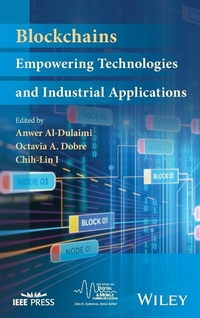
Blockchains
Description
Originally introduced as a method to keep track of Bitcoin transactions over a peer-to-peer network, blockchain is a continuously growing list of records, called blocks, which are linked and secured using cryptography into a chain held in public databases. The use of this technology has grown since its cryptocurrency creation and now store three types of information: 1) transactions, including the date, time, and value of purchases; 2) records of participates in transactions; and 3) unique code known as a "hash" that distinguishes one block from another. A single block on the blockchain can hold 1 MB of data, or potentially thousands of transactions - this then can allow for hundreds of thousands of transactions to be recorded as each block can join the state-of-the-art blockchain.
Blockchains provides a detailed overview of the latest and most innovative concepts, techniques, and applications related to the developing blockchain. Aimed at novices and experts on the subject, the book focuses on blockchain technologies, integrated systems, and use cases, specifically by looking at three major technical areas: blockchain platforms and distributed database technologies, consensus and fault tolerance, and Blockchain as a Service (BaaS). These avenues of research are essential to support blockchain functionalities, such as acquiring and updating existing data, securing data resources and the recovery of failures, and using blockchains in various services that range from cryptocurrencies to cloud automation.
Blockchains readers will also find:
Brainstorming activities that gradually builds the knowledge of readers on the described technology and deployment scenarios
Investigation of specific topics such as novel networking protocols, wireless techniques, new infrastructure designs, operations management, and deployment strategies
Discussion of technical challenges in blockchain, as well as how to manage cloud-based networks, service automation, and cyber security
Numerous elementary and advanced examples on various topics at the end of the book that can be used for training purposes
Illustrations including tables and diagrams to help elucidate points made throughout the volume
Glossary of relevant terminology to blockchains in enterprise
Blockchains is a useful reference for researchers in vehicular networking and computer science, as well as cloud storage providers and governmental offices for data management.
<b>A comprehensive guide to the most recent developments in blockchains in theoretical and industrial perspectives</b>
Originally introduced as a method to keep track of Bitcoin transactions over a peer-to-peer network, blockchain is a continuously growing list of records, called blocks, which are linked and secured using cryptography into a chain held in public databases. The use of this technology has grown since its cryptocurrency creation and now store three types of information: 1) transactions, including the date, time, and value of purchases; 2) records of participates in transactions; and 3) unique code known as a "hash" that distinguishes one block from another. A single block on the blockchain can hold 1 MB of data, or potentially thousands of transactions - this then can allow for hundreds of thousands of transactions to be recorded as each block can join the state-of-the-art blockchain.
<i>Blockchains</i> provides a detailed overview of the latest and most innovative concepts, techniques, and applications related to the developing blockchain. Aimed at novices and experts on the subject, the book focuses on blockchain technologies, integrated systems, and use cases, specifically by looking at three major technical areas: blockchain platforms and distributed database technologies, consensus and fault tolerance, and Blockchain as a Service (BaaS). These avenues of research are essential to support blockchain functionalities, such as acquiring and updating existing data, securing data resources and the recovery of failures, and using blockchains in various services that range from cryptocurrencies to cloud automation.
<i>Blockchains </i>readers will also find:
<ul><li>Brainstorming activities that gradually builds the knowledge of readers on the described technology and deployment scenarios</li><li>Investigation of specific topics such as novel networking protocols, wireless techniques, new infrastructure designs, operations management, and deployment strategies</li><li>Discussion of technical challenges in blockchain, as well as how to manage cloud-based networks, service automation, and cyber security</li><li>Numerous elementary and advanced examples on various topics at the end of the book that can be used for training purposes</li><li>Illustrations including tables and diagrams to help elucidate points made throughout the volume</li><li>Glossary of relevant terminology to blockchains in enterprise</li></ul><i>Blockchains </i>is<i> </i>a useful reference for researchers in vehicular networking and computer science, as well as cloud storage providers and governmental offices for data management.
More details
Other editions
Additional editions
Persons
Octavia A. Dobre, PhD, is a Professor and Research Chair in the Department of Electrical and Computer Engineering at Memorial University, Canada. She is an IEEE Fellow and is the Inaugural Editor-in-Chief for the IEEE Open Journal of the Communications Society.
Chih-Lin I, PhD, established the Green Communications Research Center of China Mobile, spearheading in her role as the CMCC Chief Scientist of Wireless Technologies major initiatives including 5G Key Technologies R&D.
<b>Anwer Al-Dulaimi, PhD,</b> is a Technical Product Owner at Center of Excellence, EXFO Inc. in Montreal, Canada. He is a member of NSERV discovery grants committee, senior member of IEEE, and a voting member of IEEE MobiNet Standards Committee. He co-edited the Wiley-IEEE Press title <i>5G Networks: Fundamental Requirements, Enabling Technologies</i> (2019).
<b>Octavia A. Dobre, PhD, </b>is a Professor and Research Chair in the Department of Electrical and Computer Engineering at Memorial University, Canada. She is an IEEE Fellow and is the Inaugural Editor-in-Chief for the<i> IEEE Open Journal of the Communications Society</i>.
<b>Chih-Lin I, PhD, </b>established the Green Communications Research Center of China Mobile, spearheading in her role as the CMCC Chief Scientist of Wireless Technologies major initiatives including 5G Key Technologies R&D.
Content
About the Editors
List of Contributors
Preface
Foreword
1 Introduction
Anwer Al-Dulaimi, Octavia A. Dobre, Chih-Lin I
2 Enabling technologies and distributed storage
Sina Rafati Niya, Burkhard Stiller
3 Consensus and distributed-transaction systems
Hans Walter Behrens, K. Selcuk Candan, Dragan Boscovic
4 Security, privacy and trust of distributed ledgers technology
Saqib Rasool, Muddesar Iqbal, Shancang Li, Tasos Dagiuklas,
Saptarshi Ghosh
5 Permissioned Blockchains
ZiLiang LAI and Eric LO
6 Attestation Infrastructures for Automotive Cybersecurity and
Vehicular Applications of Blockchains
Thomas Hardjono
7 Blockchains and Internet of things
Xavier Costa, Vincenzo Sciancalepore, Lanfranco Zanzi, Antonio Albanese
8 Blockchains for cybersecurity and AI systems
Petar Jevtic, Axel La Salle, Sasa Pesic, Dragan Boscovic, K. Selcuk Candan
9 6G Resource Management and Sharing: Blockchain and O-RAN
Hao Xu, Paulo Valente Klaine, Oluwakayode Onireti, Lei Zhang, Chih-Lin I
10 Blockchains for Smart Healthcare Systems
Dinh C. Nguyen and Pubudu Pathirana
11 Blockchain Standards
Hui Ding, Xiaofeng Chen, Kyeong Hee Oh, Ismael Arribas, Joern Erbguth, Alexander Chuburkov, Lisa JY Tan, Xiangjuan Jia