

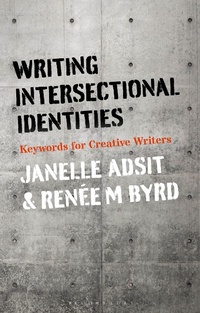
Writing Intersectional Identities
Keywords for Creative Writers
1st Edition
Published on 19. September 2019
248 pages
978-1-350-06575-8 (ISBN)
Description

Is it okay to write about people of other genders, races and identities? And how do I do this responsibly?
Whether you are working in fiction, poetry, drama or creative non-fiction, becoming conscious of how you represent people of different social identities is one of the most important responsibilities you have as a writer. This is the first practical guide to thinking and writing reflectively about these issues.
Organised in an easy-to-use A to Z format for practicing writers, teachers and students, Writing Intersectional Identities covers such key terms as:
Appropriation
Authenticity
Body
Class
Counternarrative
Disability
Essentialism
Gender
Indigenous
Power
Privilege
Representation
The book is meant for writers of fiction, poetry, screenplays and creative non-fiction who are seeking to develop a writing practice that is attentive to the world. The book is supported by a companion website at www.criticalcreativewriting.org.
Whether you are working in fiction, poetry, drama or creative non-fiction, becoming conscious of how you represent people of different social identities is one of the most important responsibilities you have as a writer. This is the first practical guide to thinking and writing reflectively about these issues.
Organised in an easy-to-use A to Z format for practicing writers, teachers and students, Writing Intersectional Identities covers such key terms as:
Appropriation
Authenticity
Body
Class
Counternarrative
Disability
Essentialism
Gender
Indigenous
Power
Privilege
Representation
The book is meant for writers of fiction, poetry, screenplays and creative non-fiction who are seeking to develop a writing practice that is attentive to the world. The book is supported by a companion website at www.criticalcreativewriting.org.
More details
Edition
1. Auflage
Language
English
Place of publication
London
United Kingdom
Publishing group
Bloomsbury Publishing PLC
Target group
College/higher education
ISBN-13
978-1-350-06575-8 (9781350065758)
Copyright in bibliographic data and cover images is held by Nielsen Book Services Limited or by the publishers or by their respective licensors: all rights reserved.
Schweitzer Classification
Other editions
Additional editions
Book
09/2019
Bloomsbury Academic
€50.94
Shipment within 15-20 days
Persons
Janelle Adsit is Assistant Professor of Creative Writing at Humboldt State University, USA. She is editor of Critical Creative Writing: Essential Readings on the Writer's Craft (2018) and author of the book Toward an Inclusive Creative Writing: Threshold Concepts to Guide the Literary Writing Curriculum (2017).
Renée M. Byrd is Associate Professor in the Department of Sociology at Humboldt State University, USA. Her research focuses on race, gender, and mass imprisonment. Her writing can be found in the journal Social Justice, Abolition: A Journal of Insurgent Politics and on her blog Persistent Connections at www.persistentconnections.wordpress.com.
Renée M. Byrd is Associate Professor in the Department of Sociology at Humboldt State University, USA. Her research focuses on race, gender, and mass imprisonment. Her writing can be found in the journal Social Justice, Abolition: A Journal of Insurgent Politics and on her blog Persistent Connections at www.persistentconnections.wordpress.com.
Content
Acknowledgements
Introduction
For Students
For Instructors
Appropriation
Audience
Authenticity
Author
Belonging
Body
Class
Colonialism
Community
Consciousness
Counternarrative
Diaspora
Disability
Emotion
Essentialism
Gender
Globalization
Identity
Indigenous
Intersectionality
Language
Minoritized
Multiculturalism
National
Positionality
Power
Privilege
Race
Religion
Representation
Sexuality
Bibliography and Suggested Reading
Introduction
For Students
For Instructors
Appropriation
Audience
Authenticity
Author
Belonging
Body
Class
Colonialism
Community
Consciousness
Counternarrative
Diaspora
Disability
Emotion
Essentialism
Gender
Globalization
Identity
Indigenous
Intersectionality
Language
Minoritized
Multiculturalism
National
Positionality
Power
Privilege
Race
Religion
Representation
Sexuality
Bibliography and Suggested Reading
