

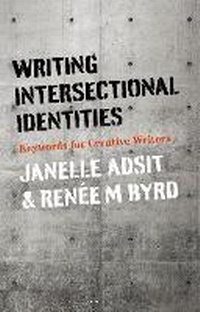
Writing Intersectional Identities
Keywords for Creative Writers
Published on 19. September 2019
Book
Paperback/Softback
248 pages
978-1-350-06572-7 (ISBN)
Description
Is it okay to write about people of other genders, races and identities? And how do I do this responsibly?
Whether you are working in fiction, poetry, drama or creative non-fiction, becoming conscious of how you represent people of different social identities is one of the most important responsibilities you have as a writer. This is the first practical guide to thinking and writing reflectively about these issues.
Organised in an easy-to-use A to Z format for practicing writers, teachers and students, Writing Intersectional Identities covers such key terms as:
Appropriation
Authenticity
Body
Class
Counternarrative
Disability
Essentialism
Gender
Indigenous
Power
Privilege
Representation
The book is meant for writers of fiction, poetry, screenplays and creative non-fiction who are seeking to develop a writing practice that is attentive to the world. The book is supported by a companion website at www.criticalcreativewriting.org.
Whether you are working in fiction, poetry, drama or creative non-fiction, becoming conscious of how you represent people of different social identities is one of the most important responsibilities you have as a writer. This is the first practical guide to thinking and writing reflectively about these issues.
Organised in an easy-to-use A to Z format for practicing writers, teachers and students, Writing Intersectional Identities covers such key terms as:
Appropriation
Authenticity
Body
Class
Counternarrative
Disability
Essentialism
Gender
Indigenous
Power
Privilege
Representation
The book is meant for writers of fiction, poetry, screenplays and creative non-fiction who are seeking to develop a writing practice that is attentive to the world. The book is supported by a companion website at www.criticalcreativewriting.org.
Reviews / Votes
What a bold, ambitious, and, entirely necessary book Writing Intersectional Identities is. In it, Adsit and Byrd radically examine critical debates within cultural and identity theory and politics to consider how these debates open new possibilities, challenges, and responsibilities for creative writers. Historically wide-ranging and intellectually expansive, the book grounds keywords such as "appropriation," "intersectionality," and "race," in rich, succinct, and timely discussions that provide countless opportunities for further exploration. But that's not all. Because even as Adsit and Byrd take on some of the most pressing issues in the larger fields of English and cultural studies, they refuse to look away from what these might mean for creative writing, its students and its teachers. I wish I had this book when I was starting out. It would have helped me a lot, and it would have helped my students too. * Professor Katharine Haake, Associate Chair of English, California State University, Northridge, USA * This book encourages students to engage critically with their culture and to evolve along with the cultural landscape. I will be returning to this book again and again as both a writer and a teacher. * Kate Moorhead, Lecturer in Creative Writing, University of East Anglia, UK *More details
Language
English
Place of publication
London
United Kingdom
Publishing group
Bloomsbury Publishing PLC
Target group
College/higher education
Dimensions
Height: 212 mm
Width: 138 mm
Thickness: 16 mm
Weight
320 gr
ISBN-13
978-1-350-06572-7 (9781350065727)
Copyright in bibliographic data and cover images is held by Nielsen Book Services Limited or by the publishers or by their respective licensors: all rights reserved.
Schweitzer Classification
Other editions
Additional editions
E-Book
09/2019
1st Edition
Bloomsbury Academic
€28.49
Available for download
E-Book
09/2019
1st Edition
Bloomsbury Academic
€28.49
Available for download
Persons
Janelle Adsit is Assistant Professor of Creative Writing at Humboldt State University, USA. She is editor of Critical Creative Writing: Essential Readings on the Writer's Craft (2018) and author of the book Toward an Inclusive Creative Writing: Threshold Concepts to Guide the Literary Writing Curriculum (2017).
Renee M. Byrd is Associate Professor in the Department of Sociology at Humboldt State University, USA. Her research focuses on race, gender, and mass imprisonment. Her writing can be found in the journal Social Justice, Abolition: A Journal of Insurgent Politics and on her blog Persistent Connections at www.persistentconnections.wordpress.com.
Renee M. Byrd is Associate Professor in the Department of Sociology at Humboldt State University, USA. Her research focuses on race, gender, and mass imprisonment. Her writing can be found in the journal Social Justice, Abolition: A Journal of Insurgent Politics and on her blog Persistent Connections at www.persistentconnections.wordpress.com.
Content
Acknowledgements
Introduction
For Students
For Instructors
Appropriation
Audience
Authenticity
Author
Belonging
Body
Class
Colonialism
Community
Consciousness
Counternarrative
Diaspora
Disability
Emotion
Essentialism
Gender
Globalization
Identity
Indigenous
Intersectionality
Language
Minoritized
Multiculturalism
National
Positionality
Power
Privilege
Race
Religion
Representation
Sexuality
Bibliography and Suggested Reading
Introduction
For Students
For Instructors
Appropriation
Audience
Authenticity
Author
Belonging
Body
Class
Colonialism
Community
Consciousness
Counternarrative
Diaspora
Disability
Emotion
Essentialism
Gender
Globalization
Identity
Indigenous
Intersectionality
Language
Minoritized
Multiculturalism
National
Positionality
Power
Privilege
Race
Religion
Representation
Sexuality
Bibliography and Suggested Reading