

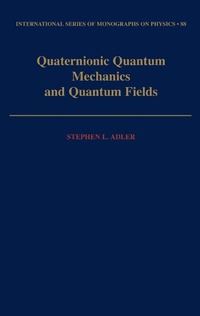
Quaternionic Quantum Mechanics and Quantum Fields
1st Edition
Published on 27. April 1995
599 pages
978-0-19-534506-3 (ISBN)
Description

It has been known since the 1930s that quantum mechanics can be formulated in quaternionic as well as complex Hilbert space. But systematic work on the quaternionic extension of standard quantum mechanics has scarcely begun. Authored by a world-renowned theoretical physicist, this book signals a major conceptual advance and gives a detailed development and exposition of quaternionic quantum mechanics for the purpose of determining whether quaternionic Hilbert space is the appropriate arena for the long sought-after unification of the standard model forces with gravitation. Significant results from earlier literature, together with many new results obtained by the author, are integrated to give a coherent picture of the subject. The book also provides an introduction to the problem of formulating quantum field theories in quaternionic Hilbert space. The book concludes with a chapter devoted to discussions on where quaternionic quantum mechanics may fit into the physics of unification, experimental and measurement theory issues, and the many open questions that still challenge the field. This well-written treatise is a very significant contribution to theoretical physics. It will be eagerly read by a wide range of physicists.
More details
Other editions
Additional editions
Stephen L. Adler
Quaternionic Quantum Mechanics and Quantum Fields
Book
06/1995
Oxford University Press Inc
€470.20
Shipment within 15-20 days
Content
- Intro
- Contents
- I: INTRODUCTION AND GENERAL FORMALISM
- 1 Introduction
- 1.1. Classical Versus Quantum Mechanics
- 1.2. Number Systems Used for Probability Amplitudes
- 1.3. Alternative Formulations of Quantum Mechanics
- 1.4. Notation and Introduction to Quaternionic Arithmetic
- 2 General Framework of Quaternionic Quantum Mechanics
- 2.1. States, Operators, Wave Functions, and Inner Products
- 2.2. Observables and Self-adjoint Operators
- 2.3. Symmetry Transformations and Anti-self-adjoint Operators
- 2.4. Time Development
- 2.5. Relationships Between Quaternionic, Complex, and Real Quantum Mechanics
- 2.6. Energy Eigenstates in Quaternionic, Complex, and Real Quantum Mechanics, and the Complex Embedding of Real Quantum Mechanics
- 2.7. Nonextendability to Octonionic Quantum Mechanics
- 3 Further General Results in Quaternionic Quantum Mechanics
- 3.1. Space Translations and Momentum
- 3.2. Rotations and Angular Momentum
- 3.3. Time Translations, Evolution of Expectation Values, and the Heisenberg Picture
- 3.4. The Uncertainty Principle in Quaternionic Quantum Mechanics
- 3.5. Representation of Symmetries of H
- 3.6. Simultaneous Diagonalization of Mutually Commuting Self-adjoint and Anti-self-adjoint Operators
- 3.7. Spin Angular Momentum and Hamiltonian Structure
- II: NONRELATIVISTIC QUATERNIONIC QUANTUM MECHANICS
- 4 One-Particle Quantum Mechanics - General Formalism
- 4.1. Restrictions on the Form of H from Translational, Rotational, and Galilean Invariance
- 4.2. Simplification of the Schrödinger Equation by Choice of Ray Representative
- 4.3. Projective Group Representations and the Quaternionic Schur's Lemma
- 4.4. Dynamics of Densities and Expectation Values
- 4.5. The Feynman Path Integral Formula: A Partial Analog
- 4.6. Time Reversal Invariance for Spin Zero Systems
- 4.7. Time Reversal Invariance with Spin
- 4.8. The Quaternionic Harmonic Oscillator
- 5 Stationary State Methods and Phase Methods
- 5.1. Reduction of |H| to a Complex Hermitian Operator
- 5.2. Reduction to an Optical Potential
- 5.3. Stationary State Perturbation Theory - Introduction
- 5.4. A Perturbation Theory Application - Leading Order Calculation of I[sub(H)],J[sub(H)],K[sub(H)], and |H|
- 5.5. Stationary State Perturbation Theory - Second-Order Expansion, the Degenerate Case, and Zero-Energy States
- 5.6. Variational Principles
- 5.7. The Adiabatic Approximation and the Geometric Phase
- 5.8. The Nonadiabatic Geometric Phase
- 5.9. The Quaternionic WKB Approximation
- 6 Scattering Theory and Bound States
- 6.1. One-Dimensional Scattering and Bound States - the Delta Function Potential Model
- 6.2. Spherically Symmetric Potentials
- 6.3. General Three-Dimensional Potentials: The S-Matrix Is C(l, i), but Time Reversal Violating
- 6.4. Bound-State-Associated Scattering Resonances
- 6.5. Analyticity Properties
- 6.6. General One-Dimensional Scattering
- 7 Methods for Time Development
- 7.1. Time-Dependent Perturbation Theory
- 7.2. Scattering Theory and the T-Matrix
- 7.3. Decay Theory for H[sub(0)] Energy Eigenstates
- 7.4. Use of the Interaction and Heisenberg Pictures, and the Quaternionic Forced Harmonic Oscillator
- 7.5. A Quaternionic Model for Time Reversal Violation in Particle Physics
- 8 Single-Channel Time-Dependent Formal Scattering Theory
- 8.1. Time Development of the State Vector and Green's Functions
- 8.2. The Möller Wave Operators and Their Properties
- 8.3. The S-Matrix
- 8.4. Symmetries of the S-Malrix
- 9 Multiparticle and Multichannel Methods
- 9.1. Restrictions on H from Translational, Rotational, and Galilean Invariance
- 9.2. Identical Particles
- Separation of Center of Mass Motion
- 9.3. The Tensor Product Problem and the Failure of Clustering
- 9.4. Asymptotic State Structure
- 9.5. Multichannel Time-Dependent Formal Scattering Theory
- 10 Further Multiparticle Topics
- 10.1. Fock Space and Second Quantization
- 10.2. Quasiparticle Transformation for a Particle-Number-Conserving One-Body Hamiltonian
- 10.3. Statistical Mechanics
- 10.4. An Optical Potential Analysis of Clustering
- III: RELATIVISTIC QUATERNIONIC QUANTUM MECHANICS
- 11 Relativistic Single-Particle Wave Equations: Spin-0 and Spin-1/2
- 11.1. The Quaternionic Free Klein-Gordon Equation
- 11.2. The Interacting Klein-Gordon Equation
- 11.3. Nonrelativistic Limit of the Klein-Gordon Equation
- 11.4. The Quaternionic Free Dirac Equation
- 11.5. The Interacting Dirac Equation and Its Nonrelativistic Reduction
- 11.6. Semirelativistic Reduction of the Interacting Klein-Gordon and Dirac Equations
- 11.7. A Survey of Properties of the Semirelativistic Equation
- 12 More on Relativistic Wave Equations: The Spin-1 Gauge Potential, Lagrangian Formulations, and the Poincaré Group
- 12.1. The Quaternionic Gauge Potential B[sub(µ)]
- 12.2. Lagrangians and C(l, i ) Structure and Symmetries
- 12.3. Representations of the Poincaré Group
- 13 Quaternionic Quantum Field Theory
- 13.1. The Klein Paradox and the Necessity for Quantum Field Theory
- 13.2. Quaternionic Embeddings of Complex Quantum Field Theories
- 13.3. Quaternionic Free Fields Formed as Superpositions of Formally Real or Complex Canonical Fields
- 13.4. Quaternionic Irreducible Representations of Compact Groups
- 13.5. Operator Gauge Invariant Total Trace Lagrangian Formulation of Quantum Dynamics
- 13.6. Operator Gauge Invariant Total Trace Lagrangian Formulation of Complex Quantum Mechanics
- 13.7. Operator Gauge Invariant Quaternionic Field Theories
- 13.8. Quaternionic Determinants and Gaussian Integrals
- 14 Outlook
- 14.1. Why Quaternionic Quantum Mechanics?
- 14.2. Experimental Tests and Measurement Theory Issues
- 14.3. Open Questions
- Appendix A. Proof of the Jacobi Identity for the Generalized Poisson Bracket
- Appendix B. Derivation of Gaussian Integral Formulas
- References
- Index
- A
- B
- C
- D
- E
- F
- G
- H
- I
- J
- K
- L
- M
- N
- O
- P
- Q
- R
- S
- T
- U
- V
- W
- Y
- Z
