

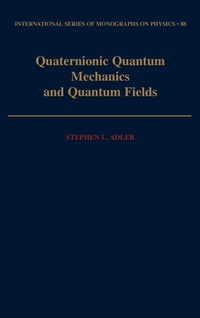
Quaternionic Quantum Mechanics and Quantum Fields
Published on 22. June 1995
Book
Hardback
608 pages
978-0-19-506643-2 (ISBN)
Description
This book presents a new formulation of quantum mechanics using quaternionic, rather than complex, numbers. The author is a highly respected theoretical physicist who has been working on quaternionic quantum mechanics for the last fourteen years. The author clearly explicates the relations between quaternionic, complex and real quantum mechanics, and the book is certain to be a major contribution to theoretical physics. Accessible to readers with a first-year graduate level quantum mechanics course.
Reviews / Votes
The professionalism shown by the author throughout the text is inviting us to look with open eyes to the perspectives opened by the enlargement of the field objects with which we are operating. * Zentralblatt fuer Mathematik, 885 * The book is highly professional and despite the feeling that any effort in investigating the quaterionic approach is useless, the reviewer is advocating for paying an interest in the field. The greatest merit of the monograph does not derive from the analyed aspects of the relativistic and non-relativistic quaternionic quantum mechanics but mainly from the impressive list of open questions presented by the author at the end of the monograph. That list is showing that the author is not practicing a "Glasperlenspiel" but rather that he is highly involved in the effort of understanding the very terrestrial physics. * Zentralblatt fuer Mathematik, 885 *More details
Series
Language
English
Place of publication
New York
United States
Target group
Professional and scholarly
Dimensions
Height: 235 mm
Width: 157 mm
Thickness: 39 mm
Weight
1113 gr
ISBN-13
978-0-19-506643-2 (9780195066432)
Copyright in bibliographic data and cover images is held by Nielsen Book Services Limited or by the publishers or by their respective licensors: all rights reserved.
Schweitzer Classification
Other editions
Additional editions
Stephen L. Adler
Quaternionic Quantum Mechanics and Quantum Fields
E-Book
04/1995
1st Edition
OUP eBook
€162.99
Available for download
Person
Content
PART I: INTRODUCTION AND GENERAL FORMALISM
1: Introduction
2: General Framework of Quaternionic Quantum Mechanics
3: Further General Results in Quaternionic Quantum Mechanics
PART II: NON-RELATIVISTIC QUATERNIONIC QUANTUM MECHANICS
4: One-Particle Quantum Mechanics--General Formalism
5: Stationary State Methods and Phase Methods
6: Scattering Theory and Bound States
7: Methods for Time-Development
8: Single Channel Time-Dependent Formal Scattering Theory
9: Multi-Particle and Multi-Channel Methods
10: Further Multi-Particle Topics
PART III: RELATIVISTIC QUATERNIONIC QUANTUM MECHANICS
11: Relativistic Single Particle Wave Equations Spin-0 and Spin-1/2
12: More on Relativistic Wave Equations: The Spin-1 Gauge Potential, Lagrangian Formulations, and the Poincare Group
13: Quaternionic Quantum Field Theory
14: Outlook
Appendix A: Proof of the Jacobi Identity for the Generalized Poisson Bracket
Appendix B: Derivation of Gaussian Integral Formulas
1: Introduction
2: General Framework of Quaternionic Quantum Mechanics
3: Further General Results in Quaternionic Quantum Mechanics
PART II: NON-RELATIVISTIC QUATERNIONIC QUANTUM MECHANICS
4: One-Particle Quantum Mechanics--General Formalism
5: Stationary State Methods and Phase Methods
6: Scattering Theory and Bound States
7: Methods for Time-Development
8: Single Channel Time-Dependent Formal Scattering Theory
9: Multi-Particle and Multi-Channel Methods
10: Further Multi-Particle Topics
PART III: RELATIVISTIC QUATERNIONIC QUANTUM MECHANICS
11: Relativistic Single Particle Wave Equations Spin-0 and Spin-1/2
12: More on Relativistic Wave Equations: The Spin-1 Gauge Potential, Lagrangian Formulations, and the Poincare Group
13: Quaternionic Quantum Field Theory
14: Outlook
Appendix A: Proof of the Jacobi Identity for the Generalized Poisson Bracket
Appendix B: Derivation of Gaussian Integral Formulas