

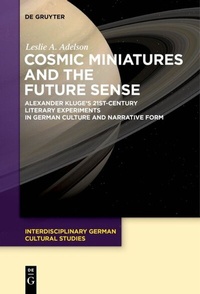
Cosmic Miniatures and the Future Sense
Description

Alexander Kluge's revolutionary storytelling for the 21 st -century pivots on the production of anti-realist hope under conditions of real catastrophe. Rather than relying on possibility alone, his experimental miniatures engender counterfactual horizons of futurity that are made incrementally accessible to lived experience through narrative form. Innovative close readings and theoretical reflection alike illuminate the dimensional quality of future time in Kluge's radical prose, where off-worldly orientation and unnatural narrative together yield new sensory perspectives on associative networks, futurity, scale, and perspective itself. This study also affords new perspectives on the importance of Kluge's creative writing for critical studies of German thought (including Kant, Marx, Benjamin, and especially Adorno), Holocaust memory, contemporary globalization, literary miniatures, and narrative studies of futurity as form. Cosmic Miniatures contributes an experiential but non-empirical sense of hope to future studies, a scholarly field of pressing public interest in endangered times.
Reviews / Votes
"Cosmic Miniatures makes a vital contribution to this growing body of scholarship about Kluge, but it also contributes to our understanding of futurity, narratology, "small forms," and the legacy of the Frankfurt School. Finally, even as it embraces cosmic and futural perspectives, Adelson's book is an intensive study of contemporary culture."
Matthew Johnson in: The Germanic Review 94.3 (2019), 267-270
"Masterful in its close readings, innovative in its theoretical and methodological approach, and visionary in its overarching conceptualization of Kluge's literary project, Adelson's study sets a new standard."
Richard Langston in: Gegenwartsliteratur. Ein germanistisches Jahrbuch 16 (2017), 360-362
"Given the immensity and variety of Kluge's production, scholars are tempted to address all of its aspects in the hope of somehow encompassing this astonishing body of work. Taking the opposite tack, Adelson trades in the extensive for the intensive, with brilliant results: equipped with the instruments of critical theory and postclassical narratology,
Cosmic Miniatures and the Future Sense
bores incisively at one small corner of the Klugean universe--the literary miniature--to reveal the vast philosophical realm that is contained in this minor form. With great analytic precision, stylistic nuance, and no small amount of imagination, Adelson has succeeded in placing Kluge in an entirely new constellation of thought."
(Devin Fore, Princeton University)
"Beautifully and clearly written, Leslie Adelson's study of the future sense in Kluge's 21
st
-century prose miniatures develops a breathtaking dialogue between theoretical archives rarely brought together: German critical theory meets postclassical narratology, and memory studies are opened up towards futurity on the entangled scales of the national, the planetary and the cosmic. In imbricating phenomenological, materialist and epistemological perspectives, this dialogue forcefully conceptualizes the understudied narrative dimension of Kluge's work while challenging contemporary narrative theory to make room for the ways in which Kluge's experiments with narrative voice, perspective and temporality expand the realm of the sensible towards counterfactual hope."
(Claudia Breger, Indiana University Bloomington)
More details
Other editions
Additional editions
Person
Leslie A. Adelson , Cornell University, Ithaca, NY, USA.
Content
- Intro
- Acknowledgements
- Contents
- Introduction: Hope in Time
- Part One. Cosmic Miniatures and Critical Horizons: Exercising the Future Sense
- 1 Heliotropic Horizons with and beyond Benjamin
- 2 Heliotropic Narrative with and beyond Adorno
- 2.1 Something Missing and Counterfactual Hope
- 2.2 Gap Aesthetics and "Ways Out"
- 2.3 Utopian Longing and Narrative Orientation
- 2.4 Adorno's "Heliotrope" and Oscillating Perspective
- 2.5 Kluge's Flawed Beauty and Unnatural Narration
- 2.6 Kluge's Future Narrative: "Saturday in Utopia"
- 3 Extraterrestrial Speculations with and beyond Kant
- Part Two. Global Miniatures and Marxist Horizons: Conjunctions in Narrative Time
- 1 Permanent Revolution
- 2 Global Connectivity
- 3 Revolutionary Subjectivity
- 4 Counter-Catastrophic Futurity
- Part Three. German Miniatures and Perspectival Horizons: Recalibrating Historical Voice
- 1 Persons One Can Lose and Those One Can Gain
- 2 The Six-Year-Old within Me, the Starry Sky above Me, and Narrative Voice
- 3 Long Arcs of Cosmic Formation and the Narrative Trajectory of First-Person Pronouns
- 4 Werner Scholem and the Life Writing of the Future Sense
- 5 Making Time: Zeit-Zeugen, Holocaust History, and Co-Operative Voice
- Postscript: Futurity as Fairy Tale? From Flaschenpost to Nachricht and More
- Works Cited
- Alphabetical List of Kluge Titles Discussed, in German and English
- Index of Persons
- Index of Works
- Index of Terms
