

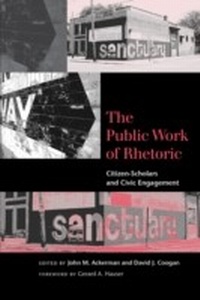
The Public Work of Rhetoric
Description

Compelling case studies and criticism of rhetorical practices aimed at social change
The Public Work of Rhetoric presents the art of rhetorical techné as a contemporary praxis for civic engagement and social change, which is necessarily inclusive of people inside and outside the academy. In this provocative call to action, editors John M. Ackerman and David J. Coogan, along with seventeen other accomplished contributors, offer case studies and criticism on the rhetorical practices of citizen-scholars pursuing democratic ideals in diverse civic communities-with partnerships across a range of media, institutions, exigencies, and discourses.
Challenging conventional research methodologies and the traditional insularity of higher education, these essays argue that civic engagement as a rhetorical act requires critical attention to our notoriously veiled identity in public life, to our uneasy affiliation with democracy as a public virtue, and to the transcendent powers of discourse and ideology. This can be accomplished, the contributors argue, by building on the compatible traditions of materialist rhetoric and community literacy, two vestiges of rhetoric's dual citizenship in the fields of communication and English. This approach expresses a collective desire in rhetoric for more politically responsive scholarship, more visible impact in public life, and more access to the critical spaces between universities and their communities.
The compelling case studies in The Public Work of Rhetoric are located in inner-urban and postindustrial communities where poverty is the overriding concern, in afterschool and extracurricular alternatives that offer new routes to literate achievement, in new media and digital representations of ethnic cultures designed to promote chosen identities, in neighborhoods and scientific laboratories where race is the dominant value, and in the policy borderlands between universities and the communities they serve. Through these studies and accounts, the contributors champion the notion that the public work of rhetoric is the tough labor of gaining access and trust, learning the codes and histories of communities, locating the situations in which rhetorical expertise is most effective, and in many cases jointly defining the terms for gauging social change.
All prices
More details
Other editions
Additional editions
Persons
Content
Contributors
John M. Ackerman
M. Lane Bruner
Ralph Cintron
Celeste M. Condit
David J. Coogan
Ellen Cushman
David Fleming
Linda Flower
Diana George
Jeffrey T. Grabill
Erik Green
Gerard A. Hauser
Susan C. Jarratt
David A. Jolliffe
Erik Juergensmeyer
Paula Mathieu
Carolyn R. Miller
Thomas P. Miller
Candice Rai
