

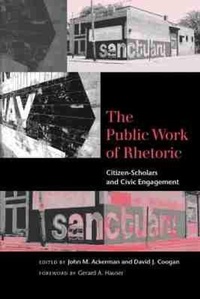
The Public Work of Rhetoric
Citizen-Scholars and Civil Engagement
Published on 30. May 2013
Book
Paperback/Softback
328 pages
978-1-61117-303-1 (ISBN)
Description
The Public Work of Rhetoric offers a timely and dynamic endorsement of rhetoric as a potent communications tool for civic engagement and social change, efforts necessarily inclusive of people inside and outside the academy. In this provocative call to action, editors John M. Ackerman and David J. Coogan, along with seventeen other accomplished contributors, offer case studies and criticism on the rhetorical practices of citizen-scholars pursuing democratic ideals in diverse civic communities--with partnerships across a range of media, institutions, exigencies, and discourses.
Challenging conventional research methodologies and the traditional insularity of higher education, these essays argue that civic engagement as a rhetorical act requires critical attention to our notoriously veiled identity in public life, to our uneasy affiliation with democracy as a public virtue, and to the transcendent powers of discourse and ideology. This can be accomplished, the contributors argue, by building on the compatible traditions of materialist rhetoric and community literacy. The case studies highlight efforts in inner-urban and postindustrial communities where poverty is the overriding concern, in afterschool and extracurricular alternatives that offer new routes to literate achievement, in new media and digital representations of ethnic cultures designed to promote chosen identities, in neighbourhoods and scientific laboratories where race is the dominant value, and in the policy borderlands between universities and the communities they serve. Through these accounts, contributors champion the notion that the public work of rhetoric is the tough labour of gaining access and trust, learning the codes and histories of communities, locating the situations in which rhetorical expertise is most effective, and in many cases jointly defining the terms for gauging social change.
Challenging conventional research methodologies and the traditional insularity of higher education, these essays argue that civic engagement as a rhetorical act requires critical attention to our notoriously veiled identity in public life, to our uneasy affiliation with democracy as a public virtue, and to the transcendent powers of discourse and ideology. This can be accomplished, the contributors argue, by building on the compatible traditions of materialist rhetoric and community literacy. The case studies highlight efforts in inner-urban and postindustrial communities where poverty is the overriding concern, in afterschool and extracurricular alternatives that offer new routes to literate achievement, in new media and digital representations of ethnic cultures designed to promote chosen identities, in neighbourhoods and scientific laboratories where race is the dominant value, and in the policy borderlands between universities and the communities they serve. Through these accounts, contributors champion the notion that the public work of rhetoric is the tough labour of gaining access and trust, learning the codes and histories of communities, locating the situations in which rhetorical expertise is most effective, and in many cases jointly defining the terms for gauging social change.
More details
Series
Language
English
Place of publication
South Carolina
United States
Target group
College/higher education
Professional and scholarly
Product notice
Paperback (trade)
Unsewn / adhesive bound
Dimensions
Height: 229 mm
Width: 152 mm
Thickness: 19 mm
Weight
481 gr
ISBN-13
978-1-61117-303-1 (9781611173031)
Copyright in bibliographic data and cover images is held by Nielsen Book Services Limited or by the publishers or by their respective licensors: all rights reserved.
Schweitzer Classification
Other editions
Additional editions
E-Book
03/2013
1st Edition
University of South Carolina Press
from
€51.39
Available for download
Persons
John M. Ackerman is an associate professor of communication at the University of Colorado at Boulder, USA where he directs the Program for Writing and Rhetoric and holds the Ineva Baldwin Chair of Arts and Sciences. His research on disciplinarity, architecture, and everyday life has appeared in a number of journals and edited collections.
David J. Coogan is an associate professor of English at Virginia Commonwealth University, USA. His work on community literacy, rhetorical theory, and social change has appeared in College Composition and Communication, College English, and Community Literacy and in the edited volume Active Voices.
David J. Coogan is an associate professor of English at Virginia Commonwealth University, USA. His work on community literacy, rhetorical theory, and social change has appeared in College Composition and Communication, College English, and Community Literacy and in the edited volume Active Voices.