

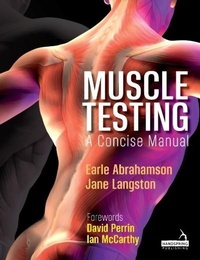
Muscle Testing
A Concise Manual
Published on 10. February 2020
224 pages
978-1-912085-66-8 (ISBN)
Description

Muscle testing - A Concise Manual, provides a reference for understanding how structure relates to function, and how by knowing function we can learn structural configurations.
The book summarises the key anatomical facts and figures, give methods for muscle testing by several techniques, and provides clinically useful information to supplement the tests.
The book summarises the key anatomical facts and figures, give methods for muscle testing by several techniques, and provides clinically useful information to supplement the tests.
More details
Edition
Digital original
Language
English
Place of publication
London
United Kingdom
Publishing group
Jessica Kingsley Publishers
Target group
College/higher education
Professional and scholarly
File size
126,44 MB
ISBN-13
978-1-912085-66-8 (9781912085668)
Copyright in bibliographic data and cover images is held by Nielsen Book Services Limited or by the publishers or by their respective licensors: all rights reserved.
Schweitzer Classification
Other editions
Additional editions
Book
10/2019
Handspring Publishing Limited
€43.50
Shipment within 3-4 weeks
Persons
Earle Abrahamson (Author)
Earle Abrahamson holds qualifications in human movement sciences, clinical psychology and pedagogy. He is professor in the scholarship of teaching and learning, a National Teaching and Principal fellow of Advance HE and teaching and learning specialist at the University of Hertfordshire (UK). Additionally, he is chair of the GCMT and a registrant board member of the CNHC. He has over 25 years experience in education and clinical practice and leads programmes and curriculum development in clinical anatomy and sports therapy.
Jane Langston (Author)
Jane Langston worked for over 20 years in haematology and blood transfusion laboratories within the National Health Service and is Fellow of the Institute of Biomedical Science. She went on to develop her skills as an Amatsu practitioner in a busy clinic in Hertfordshire for another 20 years. Jane is a teacher of Amatsu Soft Tissue Therapy and of anatomy and physiology and is a director of Amatsu Training School Ltd and Learn Anatomy Ltd.
Earle Abrahamson holds qualifications in human movement sciences, clinical psychology and pedagogy. He is professor in the scholarship of teaching and learning, a National Teaching and Principal fellow of Advance HE and teaching and learning specialist at the University of Hertfordshire (UK). Additionally, he is chair of the GCMT and a registrant board member of the CNHC. He has over 25 years experience in education and clinical practice and leads programmes and curriculum development in clinical anatomy and sports therapy.
Jane Langston (Author)
Jane Langston worked for over 20 years in haematology and blood transfusion laboratories within the National Health Service and is Fellow of the Institute of Biomedical Science. She went on to develop her skills as an Amatsu practitioner in a busy clinic in Hertfordshire for another 20 years. Jane is a teacher of Amatsu Soft Tissue Therapy and of anatomy and physiology and is a director of Amatsu Training School Ltd and Learn Anatomy Ltd.
Content
Section ONE INTRODUCTION
Introduction and principles of muscle testing
Overview of musculoskeletal anatomy, testing, and palpation
Biotensegrity and fascia - the connective tissue system
How to use this book
Section TWO MUSCLE TESTS BY REGION
Head and neck
Sternocleidomastoid
Scalenes (anterior, middle, and posterior)
Splenius capitis
Levator scapulae
Trapezius (upper fibers)
Shoulder and elbow
Trapezius (middle fibers)
Trapezius (lower fibers)
Supraspinatus
Infraspinatus
Teres minor
Subscapularis
Teres major
Deltoid (anterior fibers)
Deltoid (middle fibers)
Deltoid (posterior fibers)
Coracobrachialis
Biceps brachii
Triceps brachii
Forearm and wrist
Brachioradialis
Supinator
Pronator teres
Pronator quadratus
Opponens pollicis
Opponens digiti minimi
Torso and trunk
Pectoralis major (clavicular and sternal portions)
Pectoralis minor
Rectus abdominis
Transverse abdominis
Quadratus lumborum
Erector spinae group (sacrospinalis)
Latissimus dorsi
Serratus (anterior)
Rhomboid group (major and minor)
Pelvis
Psoas major and minor
Iliacus
Piriformis
Gluteus maximus
Gluteus medius
Tensor fasciae latae
Thigh and knee
Quadriceps femoris group
Rectus femoris
Vastus medialis
Vastus lateralis
Vastus intermedius
Hamstring group
Biceps femoris
Medial hamstrings (semitendinosus and semimembranosus)
Adductor magnus
Adductor longus and brevis
Gracilis
Popliteus
Sartorius
Lower leg, ankle, and foot
Gastrocnemius
Soleus
Tibialis anterior
Tibialis posterior
Fibularis group (peroneus)
Extensor hallucis longus
Flexor hallucis longus
Extensor digitorum longus
Extensor digitorum brevis
Section THREE GAIT TESTING
Introduction to gait testing
Contralateral shoulder and hip flexor gait test
Contralateral shoulder and hip extensor gait test
Contralateral shoulder and hip abductor gait test
Contralateral shoulder and hip adductor gait test
Contralateral psoas and pectoralis major gait test
Contralateral gluteus medius and abdominals gait test
