

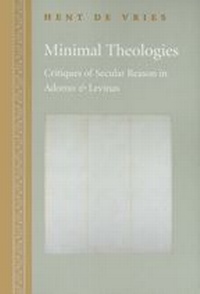
Minimal Theologies
Critiques of Secular Reason in Adorno and Levinas
Published on 22. April 2005
Book
Paperback/Softback
758 pages
978-0-8018-8017-9 (ISBN)
Description
What, at this historical moment "after Auschwitz," still remains of the questions traditionally asked by theology? What now is theology's minimal degree? This magisterial study, the first extended comparison of the writings of Theodor W. Adorno and Emmanuel Levinas, explores remnants and echoes of religious forms in these thinkers' critiques of secular reason, finding in the work of both a "theology in pianissimo" constituted by the trace of a transcendent other. The author analyzes, systematizes, and formalizes this idea of an other of reason. In addition, he frames these thinkers' innovative projects within the arguments of such intellectual heirs as Jurgen Habermas and Jacques Derrida, defending their work against later accusations of "performative contradiction" (by Habermas) or "empiricism" (by Derrida) and in the process casting important new light on those later writers as well.
Attentive to rhetorical and rational features of Adorno's and Levinas's texts, his investigations of the concepts of history, subjectivity, and language in their writings provide a radical interpretation of their paradoxical modes of thought and reveal remarkable and hitherto unsuspected parallels between their philosophical methods, parallels that amount to a plausible way of overcoming certain impasses in contemporary philosophical thinking. In Adorno, this takes the form of a dialectical critique of dialectics; in Levinas, that of a phenomenological critique of phenomenology, each of which sheds new light on ancient and modern questions of metaphysics, ethics, and aesthetics. For the English-language publication, the author has extensively revised and updated the prize-winning German version.
Attentive to rhetorical and rational features of Adorno's and Levinas's texts, his investigations of the concepts of history, subjectivity, and language in their writings provide a radical interpretation of their paradoxical modes of thought and reveal remarkable and hitherto unsuspected parallels between their philosophical methods, parallels that amount to a plausible way of overcoming certain impasses in contemporary philosophical thinking. In Adorno, this takes the form of a dialectical critique of dialectics; in Levinas, that of a phenomenological critique of phenomenology, each of which sheds new light on ancient and modern questions of metaphysics, ethics, and aesthetics. For the English-language publication, the author has extensively revised and updated the prize-winning German version.
Reviews / Votes
This fiercely intricate and intriguing work gestures towards a 'theological' position that avoids the Scylla of false hope and the Charybdis of nihilism... A suggestive, intelligent and erudite (non-linear) journey alongside Habermas, Adorno, Levinas and Derrida. -- Christopher J. Insole Times Literary Supplement 2006 A deeply impressive achievement and an important contribution to theological debate in the wake of Critical Theory and deconstruction. -- Colin Davis Modern Language Review 2006 Is modern or twentieth-century philosophy, as any cursory look would seem to indicate, overwhelmingly secular, or is there perhaps an unacknowledged entanglement with religion that may be constitutive of what the most sophisticated thinking was and continues to be? It is the latter alternative that Hent de Vries has explored in his now substantial body of research on the works of thinkers such as Emmanuel Levinas, Jean-Luc Marion, Jacques Derrida and Theodor W. Adorno-all of whom he takes to represent a kind of 'working through' of theological motifs in the register of conceptual, philosophical reflection. De Vries has previously published two acclaimed books on this topic- Philosophy and the Turn to Religion (1999) and Religion and Violence (2001)... Minimal Theologies is an important book that ought to find a wide readership. -- Espen Hammer Radical Philosophy 2005 A substantial contribution to the philosophy of religion and to the study of the thought of Adorno and Levinas. Studies in Religion / Sciences Religieuses 2006 Very demanding but rewarding book. -- Marsha Aileen Hewitt Religious Studies Review 2006 Deserves to be examined with care. -- Ryan Coyne Journal of Religion 2007More details
Language
English
Place of publication
Baltimore, MD
United States
Target group
College/higher education
Professional and scholarly
Product notice
Paperback (trade)
Dimensions
Height: 229 mm
Width: 152 mm
Thickness: 39 mm
Weight
998 gr
ISBN-13
978-0-8018-8017-9 (9780801880179)
DOI
10.1353/book.72145
Copyright in bibliographic data and cover images is held by Nielsen Book Services Limited or by the publishers or by their respective licensors: all rights reserved.
Schweitzer Classification
Other editions
Additional editions
E-Book
01/2020
Johns Hopkins University Press
€45.49
Available for download
Book
01/2020
Johns Hopkins University Press
€64.00
Article not available at the moment

Book
04/2005
Johns Hopkins University Press
€87.48
Article not available for order
Persons
Hent de Vries is professor of Modern European Thought in the Humanities Center and the Department of Philosophy at the Johns Hopkins University and professor of Philosophy at the University of Amsterdam. Among his books are Philosophy and the Turn to Religion and Religion and Violence: Philosophical Perspectives from Kant to Derrida, both available from Johns Hopkins. He is the co-editor, with Samuel Weber, of Violence, Identity, and Self-Determination and Religion and Media, and, with Mieke Bal, of the book series Cultural Memory in the Present.
Content
Preface and Acknowledgments
Abbreviations
Introduction: Tertium Datur
Part I. Antiprolegomena
Chapter 1. Toward a Critique of Theology
Chapter 2. A Possible Internal and External Differentiation of Habermas's Theory of Rationality
Part II. Dialectica
Chapter 3. Paradox and Aporia in Adorno's Philosophy of Nonidentity
Chapter 4. The Construction of Occidental Subjectivism: Reductio ad hominem versus Remembrance of Nature in the Subject
Chapter 5. The Breaking Apart of Western Objectivism and the Resurrection of the Particular and the Ephemeral in the Philosophy of History
Chapter 6. Metaphysical Experience
Part III. Phaenomenologica
Chapter 7. Paradox and Aporia in Levinas's Philosophy of the Ethical-Religious Other
Chapter 8. Levinas on Art and Truth
Chapter 9. The Dialectics of Subjectivity and the Critique of Objectivism
Chapter 10. Loosening Logocentrism: Language and Skepticism
Part IV. Hermeneutica Sacra sive Profana
Chapter 11. From Unhappy Consciousness to Bad Conscience
Chapter 12 "The Other Theology": Conceptual, Historical, and Political Idolatry
Appendix. The Theology of the Sign and the Sign of Theology: The Apophatics of Deconstruction
Bibliography
Index
Abbreviations
Introduction: Tertium Datur
Part I. Antiprolegomena
Chapter 1. Toward a Critique of Theology
Chapter 2. A Possible Internal and External Differentiation of Habermas's Theory of Rationality
Part II. Dialectica
Chapter 3. Paradox and Aporia in Adorno's Philosophy of Nonidentity
Chapter 4. The Construction of Occidental Subjectivism: Reductio ad hominem versus Remembrance of Nature in the Subject
Chapter 5. The Breaking Apart of Western Objectivism and the Resurrection of the Particular and the Ephemeral in the Philosophy of History
Chapter 6. Metaphysical Experience
Part III. Phaenomenologica
Chapter 7. Paradox and Aporia in Levinas's Philosophy of the Ethical-Religious Other
Chapter 8. Levinas on Art and Truth
Chapter 9. The Dialectics of Subjectivity and the Critique of Objectivism
Chapter 10. Loosening Logocentrism: Language and Skepticism
Part IV. Hermeneutica Sacra sive Profana
Chapter 11. From Unhappy Consciousness to Bad Conscience
Chapter 12 "The Other Theology": Conceptual, Historical, and Political Idolatry
Appendix. The Theology of the Sign and the Sign of Theology: The Apophatics of Deconstruction
Bibliography
Index