

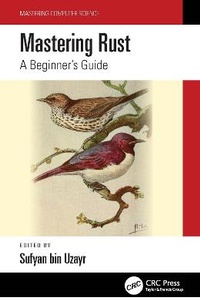
Mastering Rust
A Beginner's Guide
1st Edition
Published on 11. November 2022
Book
Hardback
298 pages
978-1-032-31904-9 (ISBN)
Description
Mastering Rust helps the reader master the powerful Rust programming language for creating stable and versatile applications and projects.
Rust is a dependable and robust programming language that was created with today's needs in mind, which is something that several other scripting languages lack. Rust was developed to provide high functions comparable to those of C and C++, and with a focus on code integrity, which is, arguably, lacking in languages such as C. Rust is a dynamically typed language that emphasizes performance and reliability, particularly in parallelism and storage organization. Rust allows you to store data on the tower or the shedload, and it recognizes the importance of performance optimization. It permits even more effective memory usage as well as faster memory management than most other programming languages in its league.
Make no mistake about it - Rust is a programming language with a strong learning curve, and is considered complicated by even the most experienced of developers. The rewards for learning Rust are aplenty, but the learning process itself requires a good deal of determination and hard work.
Nonetheless, Rust aims to provide a secure, concurrent, and practical systems language in ways that other programming languages do not, and this is primarily why Rust is often the preferred choice for building complex and highly stable apps. Rust boasts of advantages over many other programming languages in terms of expressiveness, speed, sound design, and memory storage. Though the language is new and constantly changing with time, there is an excellent opportunity in this field for future employment.
That said, to learn the reliable language that is Rust, you need to have an equally reliable companion guide in your hands, and this is where Mastering Rust comes in.
With Mastering Rust, learning Rust programming language becomes a charm, and will undoubtedly help readers advance their careers.
The Mastering Computer Science series is edited by Sufyan bin Uzayr, a writer and educator with more than a decade of experience in the computing field.
Rust is a dependable and robust programming language that was created with today's needs in mind, which is something that several other scripting languages lack. Rust was developed to provide high functions comparable to those of C and C++, and with a focus on code integrity, which is, arguably, lacking in languages such as C. Rust is a dynamically typed language that emphasizes performance and reliability, particularly in parallelism and storage organization. Rust allows you to store data on the tower or the shedload, and it recognizes the importance of performance optimization. It permits even more effective memory usage as well as faster memory management than most other programming languages in its league.
Make no mistake about it - Rust is a programming language with a strong learning curve, and is considered complicated by even the most experienced of developers. The rewards for learning Rust are aplenty, but the learning process itself requires a good deal of determination and hard work.
Nonetheless, Rust aims to provide a secure, concurrent, and practical systems language in ways that other programming languages do not, and this is primarily why Rust is often the preferred choice for building complex and highly stable apps. Rust boasts of advantages over many other programming languages in terms of expressiveness, speed, sound design, and memory storage. Though the language is new and constantly changing with time, there is an excellent opportunity in this field for future employment.
That said, to learn the reliable language that is Rust, you need to have an equally reliable companion guide in your hands, and this is where Mastering Rust comes in.
With Mastering Rust, learning Rust programming language becomes a charm, and will undoubtedly help readers advance their careers.
The Mastering Computer Science series is edited by Sufyan bin Uzayr, a writer and educator with more than a decade of experience in the computing field.
More details
Series
Language
English
Place of publication
London
United Kingdom
Publishing group
Taylor & Francis Ltd
Target group
Professional and scholarly
Professional
Illustrations
1 s/w Photographie bzw. Rasterbild, 8 s/w Zeichnungen, 17 s/w Tabellen, 9 s/w Abbildungen
17 Tables, black and white; 8 Line drawings, black and white; 1 Halftones, black and white; 9 Illustrations, black and white
Dimensions
Height: 234 mm
Width: 156 mm
Weight
453 gr
ISBN-13
978-1-032-31904-9 (9781032319049)
Copyright in bibliographic data and cover images is held by Nielsen Book Services Limited or by the publishers or by their respective licensors: all rights reserved.
Schweitzer Classification
Other editions
Additional editions
Book
11/2022
1st Edition
CRC Press
€50.94
Article exhausted; check different version
Person
Sufyan bin Uzayr is a writer, coder, and entrepreneur with more than a decade of experience in the industry. He has authored several books in the past, pertaining to a diverse range of topics, ranging from History to Computers/IT.
Sufyan is the Director of Parakozm, a multinational IT company specializing in EdTech solutions. He also runs Zeba Academy, an online learning and teaching vertical with a focus on STEM fields.
Sufyan specializes in a wide variety of technologies, such as JavaScript, Dart, WordPress, Drupal, Linux, and Python. He holds multiple degrees, including ones in Management, IT, Literature, and Political Science.
Sufyan is a digital nomad, dividing his time between four countries. He has lived and taught in universities and educational institutions around the globe. Sufyan takes a keen interest in technology, politics, literature, history, and sports, and in his spare time, he enjoys teaching coding and English to young students.
Learn more at sufyanism.com
Sufyan is the Director of Parakozm, a multinational IT company specializing in EdTech solutions. He also runs Zeba Academy, an online learning and teaching vertical with a focus on STEM fields.
Sufyan specializes in a wide variety of technologies, such as JavaScript, Dart, WordPress, Drupal, Linux, and Python. He holds multiple degrees, including ones in Management, IT, Literature, and Political Science.
Sufyan is a digital nomad, dividing his time between four countries. He has lived and taught in universities and educational institutions around the globe. Sufyan takes a keen interest in technology, politics, literature, history, and sports, and in his spare time, he enjoys teaching coding and English to young students.
Learn more at sufyanism.com
Content
Chapter 1
Getting Started with Rust
Chapter 2
Common Programming Concepts
Chapter 3
Understanding Ownership
Chapter 4
Using Structs for Related Data
Chapter 5
Enums and Pattern Matching
Chapter 6
Packages, Crates, and Modules
Chapter 7
Error Handling
Chapter 8
Generic Types, Traits, and Lifetimes
Chapter 9
I/O Project: Building a Command Line Program
Chapter 10
Cargo and crates.io
Chapter 11
Concurrency and State
Chapter 12
Object-oriented Programming in Rust
APPENDIX A: KEYWORDS
APPENDIX B: OPERATORS AND SYMBOLS
APPENDIX C: DERIVABLE TRAITS
Getting Started with Rust
Chapter 2
Common Programming Concepts
Chapter 3
Understanding Ownership
Chapter 4
Using Structs for Related Data
Chapter 5
Enums and Pattern Matching
Chapter 6
Packages, Crates, and Modules
Chapter 7
Error Handling
Chapter 8
Generic Types, Traits, and Lifetimes
Chapter 9
I/O Project: Building a Command Line Program
Chapter 10
Cargo and crates.io
Chapter 11
Concurrency and State
Chapter 12
Object-oriented Programming in Rust
APPENDIX A: KEYWORDS
APPENDIX B: OPERATORS AND SYMBOLS
APPENDIX C: DERIVABLE TRAITS