

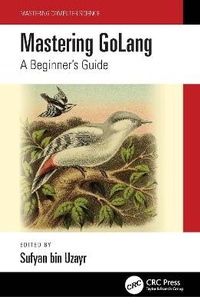
Mastering GoLang
A Beginner's Guide
1st Edition
Published on 11. November 2022
Book
Hardback
280 pages
978-1-032-31591-1 (ISBN)
Description
Mastering GoLang helps readers quickly understand the core concepts and then move on to practical projects using the Go programming language.
GoLang is often dubbed a game-changer in the world of programming languages. Instead of starting from scratch, Go was created using the C programming language. GoLang inherits C's disciplined grammar but with specific tweaks and enhancements to properly manage memory. This lessens the memory leakage problems that developers tend to face with C.
Go borrows and adapts notions from various programming languages while skipping characteristics that result in complicated, insecure, and unpredictable code. Go's concurrency features are well-suited to build the infrastructure for gigantic projects such as networking systems and distributed hardware. Go is also often employed in domains such as visuals, mobile applications, and Machine Learning.
Even though GoLang is a relatively new language, it has been adopted by several major organizations owing to its benefits, which include code clarity, custom libraries, adaptability, multithreading, and a simple build process. Because Go is gaining traction in the development community, learning GoLang can open up new avenues across various fields and career trajectories.
Since it is still a relatively newer language, quality literature pertaining to Go is often hard to find. This particular book covers all the bases that you might need, and is an ideal companion for beginner-level developers looking to master Go programming.
With Mastering GoLang, learning GoLang becomes an easy task, and learners can use their skills to create innovative projects.
The Mastering Computer Science series is edited by Sufyan bin Uzayr, a writer and educator with over a decade of experience in the computing field.
GoLang is often dubbed a game-changer in the world of programming languages. Instead of starting from scratch, Go was created using the C programming language. GoLang inherits C's disciplined grammar but with specific tweaks and enhancements to properly manage memory. This lessens the memory leakage problems that developers tend to face with C.
Go borrows and adapts notions from various programming languages while skipping characteristics that result in complicated, insecure, and unpredictable code. Go's concurrency features are well-suited to build the infrastructure for gigantic projects such as networking systems and distributed hardware. Go is also often employed in domains such as visuals, mobile applications, and Machine Learning.
Even though GoLang is a relatively new language, it has been adopted by several major organizations owing to its benefits, which include code clarity, custom libraries, adaptability, multithreading, and a simple build process. Because Go is gaining traction in the development community, learning GoLang can open up new avenues across various fields and career trajectories.
Since it is still a relatively newer language, quality literature pertaining to Go is often hard to find. This particular book covers all the bases that you might need, and is an ideal companion for beginner-level developers looking to master Go programming.
With Mastering GoLang, learning GoLang becomes an easy task, and learners can use their skills to create innovative projects.
The Mastering Computer Science series is edited by Sufyan bin Uzayr, a writer and educator with over a decade of experience in the computing field.
More details
Series
Language
English
Place of publication
London
United Kingdom
Publishing group
Taylor & Francis Ltd
Target group
Professional and scholarly
Professional
Illustrations
6 s/w Tabellen, 8 s/w Abbildungen, 8 s/w Zeichnungen
6 Tables, black and white; 8 Line drawings, black and white; 8 Illustrations, black and white
Dimensions
Height: 234 mm
Width: 156 mm
Weight
453 gr
ISBN-13
978-1-032-31591-1 (9781032315911)
Copyright in bibliographic data and cover images is held by Nielsen Book Services Limited or by the publishers or by their respective licensors: all rights reserved.
Schweitzer Classification
Other editions
Additional editions
Book
11/2022
1st Edition
CRC Press
€50.94
Article exhausted; check different version
Person
Sufyan bin Uzayr is a writer, coder and entrepreneur with over a decade of experience in the industry. He has authored several books in the past, pertaining to a diverse range of topics, ranging from History to Computers/IT.
Sufyan is the Director of Parakozm, a multinational IT company specializing in EdTech solutions. He also runs Zeba Academy, an online learning and teaching vertical with a focus on STEM fields.
Sufyan specializes in a wide variety of technologies, such as JavaScript, Dart, WordPress, Drupal, Linux and Python. He holds multiple degrees, including ones in Management, IT, Literature and Political Science.
Sufyan is a digital nomad, dividing his time between four countries. He has lived and taught in universities and educational institutions around the globe. Sufyan takes a keen interest in technology, politics, literature, history and sports, and in his spare time, he enjoys teaching coding and English to young students.
Learn more at sufyanism.com
Sufyan is the Director of Parakozm, a multinational IT company specializing in EdTech solutions. He also runs Zeba Academy, an online learning and teaching vertical with a focus on STEM fields.
Sufyan specializes in a wide variety of technologies, such as JavaScript, Dart, WordPress, Drupal, Linux and Python. He holds multiple degrees, including ones in Management, IT, Literature and Political Science.
Sufyan is a digital nomad, dividing his time between four countries. He has lived and taught in universities and educational institutions around the globe. Sufyan takes a keen interest in technology, politics, literature, history and sports, and in his spare time, he enjoys teaching coding and English to young students.
Learn more at sufyanism.com
Content
Chapter 1 - Getting Started with Go
Chapter 2 - GoLang Tools
Chapter 3 - Data Types
Chapter 4 - Variables and Constants
Chapter 5 - Operators and Control Structures
Chapter 6 - Arrays, Slices, and Maps
Chapter 7 - Functions and Recursion
Chapter 8 - Pointers
Chapter 9 - Structs and Interfaces
Chapter 10 - Concurrency and Goroutines
Chapter 11 - Packages in GoLang
Chapter 12 - The Core Packages
Appraisal
Chapter 2 - GoLang Tools
Chapter 3 - Data Types
Chapter 4 - Variables and Constants
Chapter 5 - Operators and Control Structures
Chapter 6 - Arrays, Slices, and Maps
Chapter 7 - Functions and Recursion
Chapter 8 - Pointers
Chapter 9 - Structs and Interfaces
Chapter 10 - Concurrency and Goroutines
Chapter 11 - Packages in GoLang
Chapter 12 - The Core Packages
Appraisal