


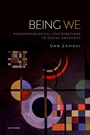
Being We
Phenomenological Contributions to Social Ontology
1st Edition
Published on 30. January 2025
Book
Hardback
240 pages
978-0-19-289448-9 (ISBN)
Description
What does it take to constitute a we with others and how does feeling, thinking, and acting as part of a we, transform one's sense of self, one's relation to others, and the way one experiences the world? Is individual subjectivity something that necessarily requires a communal grounding or does a we-relationship always presuppose a plurality of pre-existing selves? What kind of understanding of and relation to others is required if a we is to emerge? Questions regarding the ontological, epistemological, and social character of we is not only of contemporary societal relevance, but are also questions that were intensively discussed by early phenomenological philosophers such as Husserl, Reinach, Stein, Scheler, Walther, Gurwitsch, and Schutz.
Drawing on and engaging with ideas and distinctions found in these historical resources, Being We combines historical scholarship and systematic theorizing. It breaks new ground by interweaving work on selfhood and first-personal experience, social cognition, and collective intentionality, offers a much-needed cross fertilization between philosophy and theoretical considerations in the social sciences (sociology, anthropology, and social psychology), and provides a novel account of the complex interrelation between we, you, and I.
Drawing on and engaging with ideas and distinctions found in these historical resources, Being We combines historical scholarship and systematic theorizing. It breaks new ground by interweaving work on selfhood and first-personal experience, social cognition, and collective intentionality, offers a much-needed cross fertilization between philosophy and theoretical considerations in the social sciences (sociology, anthropology, and social psychology), and provides a novel account of the complex interrelation between we, you, and I.
Reviews / Votes
In Being We, Dan Zahavi provides arguments building from a sense of self to dyadic and triadic relations with others, and to larger groups like communities or national identities. Zahavi's central claim is that the self that underlies experience needs to be sufficiently accounted for in order to adequately make sense of social relations.... Another aim of Zahavi's book is to highlight many arguments from early phenomenologists related to the experiences of being with others. Here Zahavi shows again his mastery of and familiarity with phenomenology's rich history. That history is skillfully interwoven with and brought to bear on contemporary argumentation.... All in all, Being We is a helpful and substantive contribution to social ontology, as well as phenomenology. * Eric Chelstrom, Danish Yearbook of Philosophy *More details
Language
English
Place of publication
Oxford
United Kingdom
Target group
College/higher education
Product notice
sewn/stitched
Cloth over boards
Dimensions
Height: 239 mm
Width: 163 mm
Thickness: 23 mm
Weight
513 gr
ISBN-13
978-0-19-289448-9 (9780192894489)
Copyright in bibliographic data and cover images is held by Nielsen Book Services Limited or by the publishers or by their respective licensors: all rights reserved.
Schweitzer Classification
Other editions
Person
Dan Zahavi is Professor of Philosophy and Director of the Center for Subjectivity Research at the University of Copenhagen. Zahavi's primary research area is phenomenology and philosophy of mind, and their intersection with empirical disciplines such as psychiatry and psychology. In addition to various scholarly works on the phenomenology of Husserl, Zahavi has mainly written on the nature of selfhood, consciousness, self-consciousness, intersubjectivity, empathy, and most recently on topics in social ontology. His work has been translated into more than 30 languages.
Content
Introduction
Part I. We and I
1: We-experiences
2: An Individualist Bias
3: Basic Selfhood
4: Socially (un)constructed subjectivity
5: Husserlian Complexifications
6: Group Identification
7: The Question of Primacy
Part II. We and You
8: Empathy
9: Communication and Second-person Engagement
10: Shared Emotions
Part III. Varieties of We
11: Dyads and Triads
12: Communal Bonds
Part I. We and I
1: We-experiences
2: An Individualist Bias
3: Basic Selfhood
4: Socially (un)constructed subjectivity
5: Husserlian Complexifications
6: Group Identification
7: The Question of Primacy
Part II. We and You
8: Empathy
9: Communication and Second-person Engagement
10: Shared Emotions
Part III. Varieties of We
11: Dyads and Triads
12: Communal Bonds