

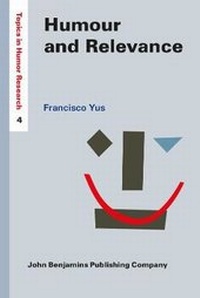
Humour and Relevance
Published on 18. March 2016
Book
Hardback
367 pages
978-90-272-0231-4 (ISBN)
Description
This book offers a cognitive-pragmatic, and specifically relevance-theoretic, analysis of different types of humorous discourse, together with the inferential strategies that are at work in the processing of such discourses. The book also provides a cognitive pragmatics description of how addressees obtain humorous effects. Although the inferences at work in the processing of normal, non-humorous discourses are the same as those employed in the interpretation of humour, in the latter case these strategies (and also the accessibility of contextual information) are predicted and manipulated by the speaker (or writer) for the sake of generating humorous effects. The book covers aspects of research on humour such as the incongruity-resolution pattern, jokes and stand-up comedy performances. It also offers an explanation of why ironies are sometimes labelled as humorous, and proposes a model for the translation of humorous discourses, an analysis of humour in multimodal discourses such as cartoons and advertisements, and a brief exploration of possible tendencies in relevance-theoretic research on conversational humour.
More details
Series
Language
English
Place of publication
Amsterdam
Netherlands
Target group
Professional and scholarly
Weight
835 gr
ISBN-13
978-90-272-0231-4 (9789027202314)
Copyright in bibliographic data and cover images is held by Nielsen Book Services Limited or by the publishers or by their respective licensors: all rights reserved.
Schweitzer Classification
Other editions
Additional editions
Francisco Yus
Humour and Relevance
E-Book
03/2016
1st Edition
John Benjamins Publishing Company
€123.99
Available for download
Person
Content
1. Acknowledgement; 2. Introduction; 3. Chapter 1. Relevance theory: Cognitive pragmatics of human communication; 4. Chapter 2. Relevance theory: General implications for humour research; 5. Chapter 3. Incongruity-resolution revisited; 6. Chapter 4. The intersecting circles model of humorous communication; 7. Chapter 5. Stand-up comedy monologues; 8. Chapter 6. Humorous ironies; 9. Chapter 7. Humour and translation; 10. Chapter 8. Multimodal humour: The case of cartoons in the press; 11. Chapter 9. Multimodal humour: The case of advertisements; 12. Chapter 10. A note on conversational humour; 13. References; 14. Name Index; 15. Subject Index