

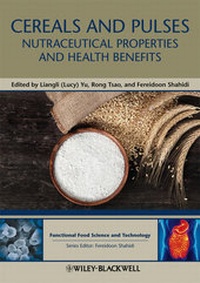
Cereals and Pulses
Nutraceutical Properties and Health Benefits
Published on 16. March 2012
Book
Hardback
328 pages
978-0-8138-1839-9 (ISBN)
Description
Cereal and pulse crops are staple foods that provide essential nutrients to many populations of the world. Traditionally, whole grains were consumed but most current foods are derived from refined fractions of cereal and pulse crops. Consumption of processed or refined products may reduce the health benefits of food. In wheat-based processed foods, for example, the removed 40% of the grain (mainly the bran and the germ of the wheat grain) contains the majority of the health beneficial components. These components, particularly non-essential phytochemicals such as carotenoids, polyphenols, phytosterols/ stanols, and dietary fibers, have been shown to reduce the risk of major chronic diseases of humans, such as cancer, cardiovascular diseases, and Parkinson's disease.
Such bioactives are therefore good candidates for ingredients of nutraceuticals and functional foods. There are many factors that can affect the bioactive content of cereal and pulse-based food ingredients, including genetics, growing and storage conditions, post-harvest treatments, food formulation and processing. All of these factors ultimately affect human health and wellness. Bioavailability is also important for these compounds for exerting their protective roles.
Cereals and Pulses: Nutraceutical Properties and Health Benefits provides a summary of current research findings related to phytochemical composition and properties of cereal and pulse crops. The nutraceutical properties of each major cereal and pulse are discussed. Coverage of cereals and pulse crops includes barley, oats, rice, rye, corn, adlay, wheat, buckwheat, psyllium, sorghum, millet, common beans, field peas, faba beans, chickpea, lentil and soybeans. Chapters for each crop discuss methods to improve crop utilization, nutraceutical components and properties, bioactive compositions, antioxidant properties, beneficial health effects, disease prevention activities, and areas for future research. Also included are two chapters that examine the beneficial health properties of dietary fibers and antioxidants. Edited and written by an international team of respected researchers, this book is a reference guide for scientists working in food ingredients, food product research and development, functional foods and nutraceuticals, crop breeding and genetics, human nutrition, post-harvest treatment and processing of cereal grains and pulses. It will enable them to effect value-added food innovation for health promotion and disease risk reduction.
Reviews / Votes
"Recommended. Graduate students, researchers/faculty, and professionals/practitioners." (Choice, 1 December 2012)More details
Product info
gebunden
Series
Edition
1. Auflage
Language
English
Place of publication
Hoboken
United Kingdom
Publishing group
John Wiley and Sons Ltd
Target group
College/higher education
Professional and scholarly
Dimensions
Height: 24.4 cm
Width: 17.2 cm
Thickness: 2.1 cm
Weight
798 gr
ISBN-13
978-0-8138-1839-9 (9780813818399)
Schweitzer Classification
Other editions
Additional editions
Liangli L. Yu | Rong Tsao | Fereidoon Shahidi
Cereals and Pulses
Nutraceutical Properties and Health Benefits
E-Book
01/2012
Wiley-Blackwell
€209.99
Available for download
Liangli L. Yu | Rong Tsao | Fereidoon Shahidi
Cereals and Pulses
Nutraceutical Properties and Health Benefits
E-Book
01/2012
Wiley-Blackwell
€209.99
Available for download
Persons
Professor Liangli (Lucy) Yu, Department of Nutrition and Food Science, University of Maryland, USA
Dr Rong Tsao, Guelph Food Research Center, Agriculture and Agri-Food Canada, Guelph, Ontario, Canada
Professor Fereidoon Shahidi, Department of Biochemistry, Memorial University of Newfoundland, Canada
Content
1. Cereals and pulses - An overview.
2. Effects of barley consumption on cardiovascular and diabetic risk.
3. Oats - Food, nutrition, and health.
4. Potential of rice grain and fractions in cancer prevention.
5. Hypolipidemic effects of rice bran oil.
6. Positive health beneficial effects of rye.
7. Corn.
8. Adlay (Job's tears).
9. Wheat.
10. Buckwheat.
11. Psyllium.
12. Sorghum.
13. Millet.
14. Common beans (Phaseolus vulgaris).
15. Field peas (Pisum sativum).
16. Faba bean (Vicia faba).
17. Chickpea (Cicer arietinum).
18. Lentil (Lens culinaris).
19. Soybean - Isoflavones and phytoestrogenic effect.
20. Soybean - Isoflavones and soy protein and bone health.
21. Soybean - Phytochemicals, soy protein isolates and hydrolysates and chronic diseases.
22. Health beneficial effects of dietary fiber.
23. Antioxidants and human health.