

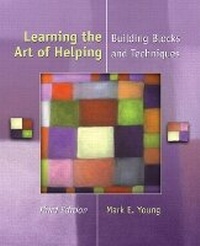
Learning the Art of Helping
Building Blocks and Techniques
3rd Edition
Published on 1. September 2004
Book
Paperback/Softback
384 pages
978-0-13-111753-2 (ISBN)
Description
For counseling techniques and for basic skills courses in counseling, social work, and psychology departments.
Assuming no prior knowledge of counseling techniques, this highly interactive text takes students, step-by-step through the acquisition of the skills and techniques for effectively helping their future clients. The author's straightforward writing style, clearly-stated instructions, and numerous practice exercises prepare students to use assessment information, plan treatment, and implement helping strategies. Coverage encompasses the full complement of commonly used techniques, from basic "building block" skills to more advanced therapeutic skills.
Assuming no prior knowledge of counseling techniques, this highly interactive text takes students, step-by-step through the acquisition of the skills and techniques for effectively helping their future clients. The author's straightforward writing style, clearly-stated instructions, and numerous practice exercises prepare students to use assessment information, plan treatment, and implement helping strategies. Coverage encompasses the full complement of commonly used techniques, from basic "building block" skills to more advanced therapeutic skills.
Reviews / Votes
"This text is superior to other skills texts in its level of depth and integration of related concepts for the beginner counselor in training. On the other hand, Young's text manages this integrated material in a way that appropriately challenges students without overwhelming them conceptually. A balance appears to have been achieved in this work between sophisticated presentation of related concepts and maintaining a level of readability for students who are new to the profession." -- Professor David Duys, Southern Illinois University at CarbondaleMore details
Edition
3rd edition
Language
English
Place of publication
United States
Publishing group
Pearson Education (US)
Target group
Professional and scholarly
Dimensions
Width: 235 mm
Thickness: 17 mm
Weight
596 gr
ISBN-13
978-0-13-111753-2 (9780131117532)
Copyright in bibliographic data and cover images is held by Nielsen Book Services Limited or by the publishers or by their respective licensors: all rights reserved.
Schweitzer Classification
Other editions
New editions
Book
11/2009
4th Edition
Pearson
€42.46
Article exhausted; check for reprint
Previous edition
Book
07/2000
2nd Edition
Pearson
€38.37
Article exhausted; check for reprint
Person
Mark Young is a Professor at the University of Central Florida. He received his doctorate from Ohio University in 1985. He has trained helpers for more than 17 years and worked in community mental health, private practice, college counseling centers, and corrections for more than 20 years. His professional writing has focused mainly on therapeutic methods and techniques and couples counseling. If you have comments or suggestions on what you have read, please send e-mail to meyoung@mail.ucf.edu.
Content
1. Helping as a Personal Journey.
2. The Nuts and Bolts of Helping.
3. The Therapeutic Relationship.
4. Helping Someone Who is Different.
5. Invitational Skills.
6. Reflecting Skills: Paraphrasing.
7. Reflecting Skills: Reflecting Feelings.
8. Reflecting Skills: Reflecting Meaning and Summarizing.
9. Challenging Skills.
10. Assessment and the Initial Interview.
11. Goal-Setting Skills.
12. Solution Skills.
13. Outcome Evaluation and Termination Skills.
14. Curative Factors and Advanced Skills: Part I.
15. Curative Factors and Advanced Skills: Part II.
2. The Nuts and Bolts of Helping.
3. The Therapeutic Relationship.
4. Helping Someone Who is Different.
5. Invitational Skills.
6. Reflecting Skills: Paraphrasing.
7. Reflecting Skills: Reflecting Feelings.
8. Reflecting Skills: Reflecting Meaning and Summarizing.
9. Challenging Skills.
10. Assessment and the Initial Interview.
11. Goal-Setting Skills.
12. Solution Skills.
13. Outcome Evaluation and Termination Skills.
14. Curative Factors and Advanced Skills: Part I.
15. Curative Factors and Advanced Skills: Part II.