

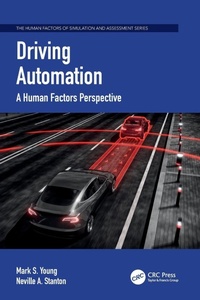
Driving Automation
A Human Factors Perspective
1st Edition
Published on 8. October 2024
Book
Paperback/Softback
274 pages
978-1-032-44824-4 (ISBN)
Description
The technology behind self-driving cars is being heavily promulgated as the solution to a variety of transport problems including safety, congestion, and impact on the environment. This text examines the key role that human factors plays in driving forward future vehicle automation in a way that realizes the benefits while avoiding the pitfalls.
Driving Automation: A Human Factors Perspective addresses a range of issues related to vehicle automation beyond the 'can we' to 'how should we'. It covers important topics including mental workload and malleable attentional resources theory, effects of automation on driver performance, in-vehicle interface design, driver monitoring, eco-driving, responses to automation failure, and human-centred automation.
The text will be useful for graduate students and professionals in diverse areas such as ergonomics/human factors, automobile engineering, industrial engineering, mechanical engineering, and health and safety.
Driving Automation: A Human Factors Perspective addresses a range of issues related to vehicle automation beyond the 'can we' to 'how should we'. It covers important topics including mental workload and malleable attentional resources theory, effects of automation on driver performance, in-vehicle interface design, driver monitoring, eco-driving, responses to automation failure, and human-centred automation.
The text will be useful for graduate students and professionals in diverse areas such as ergonomics/human factors, automobile engineering, industrial engineering, mechanical engineering, and health and safety.
More details
Series
Language
English
Place of publication
London
United Kingdom
Publishing group
Taylor & Francis Ltd
Target group
College/higher education
Professional and scholarly
Academic, Postgraduate, and Professional
Illustrations
39 s/w Abbildungen, 13 s/w Photographien bzw. Rasterbilder, 26 s/w Zeichnungen, 14 s/w Tabellen
14 Tables, black and white; 26 Line drawings, black and white; 13 Halftones, black and white; 39 Illustrations, black and white
Dimensions
Height: 234 mm
Width: 156 mm
Thickness: 16 mm
Weight
453 gr
ISBN-13
978-1-032-44824-4 (9781032448244)
Copyright in bibliographic data and cover images is held by Nielsen Book Services Limited or by the publishers or by their respective licensors: all rights reserved.
Schweitzer Classification
Other editions
Additional editions
E-Book
03/2023
1st Edition
CRC Press
€64.49
Available for download
E-Book
03/2023
1st Edition
CRC Press
€64.49
Available for download
Book
03/2023
1st Edition
CRC Press
€176.40
Shipment within 15-20 days
Persons
Mark S. Young is a visiting professor, Loughborough Design School, Loughborough University, UK. He has a BSc in Psychology and a Ph.D. in Human Factors and is a Chartered Fellow of the UK Chartered Institute of Ergonomics and Human Factors (CIEHF). His research interests focus on the human factors of transport systems and much of his research has been based on simulators, investigating issues such as driver workload, distraction, and the effects of automation and novel technologies.
Neville A. Stanton is a chartered psychologist, chartered ergonomist, and chartered engineer. He is a professor emeritus of human factors engineering in the School of Engineering at the University of Southampton, UK. He has degrees in Occupational Psychology (BSc), Applied Psychology (MPhil), and Human Factors Engineering (PhD, DSc) and has worked at the Universities of Aston, Brunel, Cornell, and MIT. His research interests include modelling, predicting, analysing, and evaluating human performance in systems as well as designing the interfaces and interaction between humans and technology.
Neville A. Stanton is a chartered psychologist, chartered ergonomist, and chartered engineer. He is a professor emeritus of human factors engineering in the School of Engineering at the University of Southampton, UK. He has degrees in Occupational Psychology (BSc), Applied Psychology (MPhil), and Human Factors Engineering (PhD, DSc) and has worked at the Universities of Aston, Brunel, Cornell, and MIT. His research interests include modelling, predicting, analysing, and evaluating human performance in systems as well as designing the interfaces and interaction between humans and technology.
Content
Stage 1: Setting out. 1. Context. 2. Promises, promises.... 3. Pay attention. Stage 2: Taking the load off. 4. How low is too low? 5. When is ACC not ACC? 6. What's skill got to do with it? 7. I thought you were driving! Stage 3: Human-centred automation. 8. What can automation do for us? 9. How do we get along? Stage 4: Letting George do it. 10. An autopian future?