

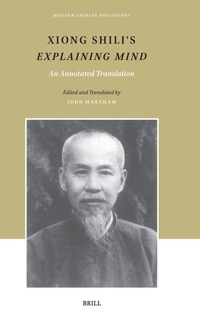
Xiong Shili's Explaining Mind
An Annotated Translation
Brill (Publisher)
Published on 13. November 2025
Book
Hardback
316 pages
978-90-04-74753-1 (ISBN)
Description
Explaining Mind is a representative text of Xiong Shili's mature onto-cosmology, moral psychology, and epistemology, in which he develops an extended account of mind, as both a moral concept and a metaphysical concept, while critically engaging key aspects of Buddhist, Daoist and Confucian thought. The book covers a diverse range of topics and themes, including the non-duality of Reality and function, philosophical psychology, the inherent mind and the habituated mind, the mind of humaneness, the inseparability of mind and matter, learning concerned with increasing knowledge daily (modern science) and learning concerned with removing ignorance daily (ancient philosophy), cultivation practices of Confucians and Buddhists, wisdom and knowledge, and the origin of badness and wrongdoing.
More details
Series
Language
English
Place of publication
Leiden
Netherlands
Target group
Professional and scholarly
Product notice
sewn/stitched
Cloth over boards
Dimensions
Height: 235 mm
Width: 155 mm
Thickness: 19 mm
Weight
621 gr
ISBN-13
978-90-04-74753-1 (9789004747531)
Copyright in bibliographic data and cover images is held by Nielsen Book Services Limited or by the publishers or by their respective licensors: all rights reserved.
Schweitzer Classification
Person
John Makeham specializes in the intellectual history of Chinese philosophy. His recent publications include Xiong Shili's Treatise on Reality and Function (OUP, 2023) and the edited volume The Awakening of Faith and New Confucian Philosophy (Brill, 2021).
Content
Acknowledgments
Abbreviation
Translator's Introduction
Edition and Translation of Explaining Mind ???
Preface
Part A, General Principles
1 Mind and Matter
1 Cause and Effect
2 Matter, Generative Vitality, and Mind
3 General Summary of the Principles of Reality and Function
4 Two Kinds of Learning
5 The Mind of Humaneness and Learning Concerned with Cultivating the Way
6 The Practices of Buddhism and Confucianism Compared
7 Specific Criticisms of Mahayana Buddhism
8 Critique of the Buddhists' Understanding of Main Kinds of Cravings
9 Concluding Criticisms of Buddhism
10 Concluding Criticisms of Daoism
2 Returning to Oneself
1 Zhuangzi and Hui Shi
2 Mind and Body
3 The Mind of Humaneness
4 Learning Concerned with the Pursuit of Things and Learning Concerned with Returning to Oneself
5 The Four Principles of Wisdom
6 Why Is There Wrongdoing?
7 Summary Evaluation the Teachings of the Daoists, the Buddhists, and the Confucian Way
8 Summary Account of How Knowledge Is Formed
9 Summary Reiteration of the Superior Merits of the Confucian Way of Returning to Oneself
Concluding Remarks
Part B, Synopsis (To be continued)
Appendix
Glossary of Key Terms
Bibliography
Index
Abbreviation
Translator's Introduction
Edition and Translation of Explaining Mind ???
Preface
Part A, General Principles
1 Mind and Matter
1 Cause and Effect
2 Matter, Generative Vitality, and Mind
3 General Summary of the Principles of Reality and Function
4 Two Kinds of Learning
5 The Mind of Humaneness and Learning Concerned with Cultivating the Way
6 The Practices of Buddhism and Confucianism Compared
7 Specific Criticisms of Mahayana Buddhism
8 Critique of the Buddhists' Understanding of Main Kinds of Cravings
9 Concluding Criticisms of Buddhism
10 Concluding Criticisms of Daoism
2 Returning to Oneself
1 Zhuangzi and Hui Shi
2 Mind and Body
3 The Mind of Humaneness
4 Learning Concerned with the Pursuit of Things and Learning Concerned with Returning to Oneself
5 The Four Principles of Wisdom
6 Why Is There Wrongdoing?
7 Summary Evaluation the Teachings of the Daoists, the Buddhists, and the Confucian Way
8 Summary Account of How Knowledge Is Formed
9 Summary Reiteration of the Superior Merits of the Confucian Way of Returning to Oneself
Concluding Remarks
Part B, Synopsis (To be continued)
Appendix
Glossary of Key Terms
Bibliography
Index