

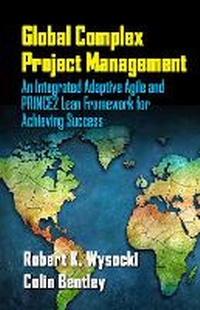
Global Complex Project Management
An Integrated Adaptive Agile and PRINCE2 Lean Framework for Achieving Success
Will be published approx. on 30. August 2016
Book
Hardback
368 pages
978-1-60427-126-3 (ISBN)
Description
This completely unique reference is from two recognized thought leaders and developers of proven approaches within the diverse world and practices of project management. It provides a new and innovative framework for more effectively managing complex and mission critical projects to deliver maximum business value to organizations in both the public and private sectors around the globe. The authors draw on the strengths of different schools of thought, including their own, and best practices to develop an integrated framework that is lean, agile, flexible, and adaptable to virtually any complex project.
More details
Language
English
Place of publication
United States
Target group
Professional and scholarly
Dimensions
Height: 229 mm
Width: 152 mm
Thickness: 20 mm
Weight
540 gr
ISBN-13
978-1-60427-126-3 (9781604271263)
Copyright in bibliographic data and cover images is held by Nielsen Book Services Limited or by the publishers or by their respective licensors: all rights reserved.
Schweitzer Classification
Other editions
Additional editions
Robert Wysocki
Global Complex Project Management
An Integrated Adaptive Agile and PRINCE2 Lean Framework for Achieving Success
E-Book
08/2016
J. Ross Publishing
€48.99
Available for download
Persons
Robert K. Wysocki is a project management guru and a pioneer in business analysis, information systems management, and business process management with over 45 years of combined experienced within these fields. He has authored 25 books on project management and information systems management, including his major best-seller Effective Project Management: Traditional, Adaptive, Extreme, now in its 7th edition. His most recent book, Effective Complex Project Management: An Adaptive Agile Framework for Delivering Business Value, was published in 2014.
Colin Bentley is a project management thought leader and the designer of the original PROMPTII/PRINCE Framework developed specifically for managing information technology projects and of PRINCE2, a more generic product management framework originally adopted for all UK government projects. Mr. Bentley authored all editions of the of PRINCE2 Manual, all Foundation and Practitioner exams for certification, and served as Chief Examiner until 2009. He still answers the Ask an expert questions on PRINCE2 for the APMG, an international professional certification organization.
Colin Bentley is a project management thought leader and the designer of the original PROMPTII/PRINCE Framework developed specifically for managing information technology projects and of PRINCE2, a more generic product management framework originally adopted for all UK government projects. Mr. Bentley authored all editions of the of PRINCE2 Manual, all Foundation and Practitioner exams for certification, and served as Chief Examiner until 2009. He still answers the Ask an expert questions on PRINCE2 for the APMG, an international professional certification organization.
Content
PART 1: OverviewChapter 1: IntroductionChapter 2: Overview of the Effective Complex Project Management FrameworkChapter 3: PRINCE2 LEAN: Are You a Cook or a Chef?Chapter 4: PRINCE2 LEAN: Project PlanningPART 2: PRINCE2 LEAN and the IDEATION PhaseChapter 5: Preparing the Business CaseChapter 6: Creating the Project Product DescriptionChapter 7: Preparing for the Initiation StagePART 3: PRINCE2 and the SET-UP PhaseChapter 8: Selecting the Project Core TeamChapter 9: Designing the Project ApproachChapter 10: Preparing the Project Initiation DocumentationPART 4: PRINCE2 and the EXECUTION PhaseChapter 11: Preparing for the Next StageChapter 12: Executing the Stage PlanChapter 13: Closing the StageChapter 14: Closing the ProjectPART 5: Putting It All TogetherChapter 15: Organizational InfrastructureChapter 16: Benefits of the PRINCE2 LEAN FrameworkEPILOGUEAPPENDIX A: GLOSSARYAPPENDIX B: REFERENCE BIBLIOGRAPHY"