

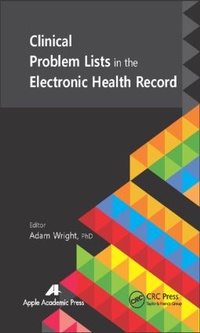
Clinical Problem Lists in the Electronic Health Record
1st Edition
Published on 24. November 2014
Book
Hardback
348 pages
978-1-77188-091-6 (ISBN)
Description
Edited by a professor at Harvard Medical School who has extensive experience in this field, this important and timely book presents a variety of perspectives on the organization of patient medical records around patient problems, presenting a more effective problem-oriented approach rather than the traditional data-oriented approach. It is comprehensive, covering the history and importance of the electronic health record, the attitudes toward and use of problem lists, strategies to improve the problem list, and applications in practice of the problem list.
More details
Language
English
Place of publication
Oakville
Canada
Target group
College/higher education
Professional and scholarly
Academic and Postgraduate
Illustrations
33 s/w Abbildungen
33 Illustrations, black and white
Dimensions
Height: 229 mm
Width: 152 mm
Weight
622 gr
ISBN-13
978-1-77188-091-6 (9781771880916)
Copyright in bibliographic data and cover images is held by Nielsen Book Services Limited or by the publishers or by their respective licensors: all rights reserved.
Schweitzer Classification
Other editions
Additional editions

Book
03/2021
1st Edition
Apple Academic Press Inc.
€109.70
Shipment within 3-4 weeks
E-Book
11/2014
1st Edition
Apple Academic Press Inc.
€191.99
Available for download
Person
Content
Introduction. Part I: History and Importance. Bringing Science to Medicine: An Interview with Larry Weed, Inventor of the Problem-Oriented Medical Record. Medical Records That Guide and Teach. Clinical Implications of an Accurate Problem List on Heart Failure Treatment. Part II: Attitudes and Use. Clinician Attitudes Toward and Use of Electronic Problem Lists: A Thematic Analysis. Healthcare Provider Attitudes Towards the Problem List in an Electronic Health Record: A Mixed-Methods Qualitative Study. Use of an Electronic Problem List by Primary Care Providers and Specialists. Distribution of Problems, Medications and Lab Results in Electronic Health Records: The Pareto Principle at Work. Part III: Improving the Problem List. An Automated Technique for Identifying Associations Between Medications, Laboratory Results and Problems. A Method and Knowledge Base for Automated Inference of Patient Problems from Structured Data in an Electronic Medical Record. Improving Completeness of Electronic Problem Lists Through Clinical Decision Support: A Randomized, Controlled Trial. Computerized Physician Order Entry of Medications and Clinical Decision Support Can Improve Problem List Documentation Compliance . Randomized Controlled Trial of an Automated Problem List With Improved Sensitivity. Part IV: Applications of the Problem List. Incomplete Care: On the Trail of Flaws in the System. Leveraging Electronic Health Records to Support Chronic Disease Management: The Need for Temporal Data Views. Indication-Based Prescribing Prevents Wrong-Patient Medication Errors In Computerized Provider Order Entry (CPOE). Index