

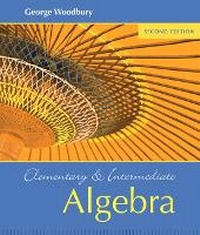
Elementary and Intermediate Algebra
2nd Edition
Published on 4. March 2008
Book
Hardback
1152 pages
978-0-321-50006-9 (ISBN)
Description
George Woodbury's Algebra Series empowers students for future success in college-level math courses through its early-and-often approach to functions and graphing, integrated study strategies, and quality exercise sets that encourage true conceptual understanding. By writing this text from the ground up as a single textbook, George has reduced the amount of overlap typically found in these courses and focused instead on providing more exercises and applications. The special Transition Chapter reviews elementary algebra topics while moving forward into intermediate algebra material, keeping students engaged in new topics.
One of the ways George prepares his students for future mathematics courses is by introducing the fundamental algebraic concepts of functions and graphing early and then consistently incorporating these concepts throughout the text. Strong exercise sets that provide both volume and variety are critical to student success, so George has written extensive sets that incorporate not only a substantial amount of skill and drill, but also plenty of writing exercises that encourage critical thinking and creativity. The key to success for developmental students is often not just about the math: it's about making sure that students understand how to study and prepare for a math class. To give students the confidence they require to succeed, George fully integrates study strategies throughout the text and also provides further guidance via an additional Study Skills Workbook, written specifically for his texts by Alan Bass.
One of the ways George prepares his students for future mathematics courses is by introducing the fundamental algebraic concepts of functions and graphing early and then consistently incorporating these concepts throughout the text. Strong exercise sets that provide both volume and variety are critical to student success, so George has written extensive sets that incorporate not only a substantial amount of skill and drill, but also plenty of writing exercises that encourage critical thinking and creativity. The key to success for developmental students is often not just about the math: it's about making sure that students understand how to study and prepare for a math class. To give students the confidence they require to succeed, George fully integrates study strategies throughout the text and also provides further guidance via an additional Study Skills Workbook, written specifically for his texts by Alan Bass.
More details
Edition
2nd edition
Language
English
Place of publication
United States
Publishing group
Pearson Education (US)
Target group
Professional and scholarly
Dimensions
Height: 254 mm
Width: 216 mm
Weight
2275 gr
ISBN-13
978-0-321-50006-9 (9780321500069)
Copyright in bibliographic data and cover images is held by Nielsen Book Services Limited or by the publishers or by their respective licensors: all rights reserved.
Schweitzer Classification
Other editions
New editions
Book
02/2013
3rd Edition
Pearson
€252.05
Shipment within 10-20 days
George Woodbury
Elementary & Intermediate Algebra
Book
03/2011
3rd Edition
Pearson
€216.37
Article is exhausted; no reprint
Previous edition
George Woodbury
Elementary and Intermediate Algebra
Book
02/2006
Pearson
€87.84
Article exhausted; check for reprint
Person
George Woodbury earned his bachelor's degree in mathematics from the University of California-Santa Barbara in 1990 and his master's degree in mathematics from California State University-Northridge, in 1994. He currently teaches at College of the Sequoias in Visalia, CA-just outside of Fresno. He has been honored as an instructor by both his students and his colleagues. Aside from teaching and writing, George served as the department chair of the math/engineering division from 1999-2004. George's Elementary and Intermediate Algebra, First Edition, was published in 2006.
Content
1. Review of Real Numbers
1.1 Integers, Opposites, and Absolute Values
1.2 Operations with Integers
1.3 Fractions
1.4 Operations with Fractions
1.5 Decimals and Percents
1.6 Representing Data Graphically
1.7 Exponents and Order of Operations
1.8 Introduction to Algebra
2. Linear Equations
2.1 Introduction to Linear Equations
2.2 Solving Linear Equations: A General Strategy
2.3 Problem Solving; Applications of Linear Equations
2.4 Applications Involving Percentages; Ratio and Proportion
2.5 Linear Inequalities
3. Graphing Linear Equations
3.1 The Rectangular Coordinate System; Equations in Two Variables
3.2 Graphing Linear Equations and Their Intercepts
3.3 Slope of a Line
3.4 Linear Functions
3.5 Parallel and Perpendicular Lines
3.6 Equations of Lines
3.7 Linear Inequalities
4. Systems of Equations
4.1 Systems of Linear Equations; Solving Systems by Graphing
4.2 Solving Systems of Equations by Using the Substitution Method
4.3 Solving Systems of Equations by Using the Addition Method
4.4 Applications of Systems of Equations
4.5 Systems of Linear Inequalities
5. Exponents and Polynomials
5.1 Exponents
5.2 Negative Exponents; Scientific Notation
5.3 Polynomials; Addition and Subtraction of Polynomials
5.4 Multiplying Polynomials
5.5 Dividing of Polynomials
6. Factoring and Quadratic Equations
6.1 An Introduction to Factoring; The Greatest Common Factor; Factoring by Grouping
6.2 Factoring Trinomials of the Form
6.3 Factoring Trinomials of the Form x2 + bx + c, where a ? 1
6.4 Factoring Special Binomials
6.5 Factoring Polynomials: A General Strategy
6.6 Solving Quadratic Equations by Factoring
6.7 Quadratic Functions
6.8 Applications of Quadratic Equations and Quadratic Functions
7. Rational Expressions and Equations
7.1 Rational Expressions and Functions
7.2 Multiplication and Division of Rational Expressions
7.3 Addition and Subtraction of Rational Expressions That Have the Same Denominator
7.4 Addition and Subtraction of Rational Expressions That Have Different Denominators
7.5 Complex Fractions
7.6 Rational Equations
7.7 Applications of Rational Equations
8. A Transition
8.1 Linear Equations and Absolute Value Equations
8.2 Linear Inequalities and Absolute Value Inequalities
8.3 Graphing Linear Equations and Functions; Graphing Absolute Value Functions
8.4 Review of Factoring; Quadratic Equations and Rational Equations
8.5 Systems of Equations (Two Equations in Two Unknowns, Three Equations in Three Unknowns)
9. Radical Expressions and Equations
9.1 Square Roots, Radical Notation
9.2 Rational Exponents
9.3 Simplifying, Adding, and Subtracting Radical Expressions
9.4 Multiplying and Dividing of Radical Expressions
9.5 Radical Equations and Applications of Radical Equations
9.6 The Complex Numbers
10. Quadratic Equations
10.1 Solving Quadratic Equations by Extracting Square Roots; Completing the Square
10.2 The Quadratic Formula
10.3 Equations That Are Quadratic in Form
10.4 Graphing Quadratic Equations
10.5 Applications Using Quadratic Equations
10.6 Quadratic and Rational Inequalities
11. Functions
11.1 Review of Functions
11.2 Linear Functions
11.3 Quadratic Functions
11.4 Other Functions and Their Graphs
11.5 The Algebra of Functions
11.6 Inverse Functions
12. Logarithmic and Exponential Functions
12.1 Exponential Functions
12.2 Logarithmic Functions
12.3 Properties of Logarithms
12.4 Exponential and Logarithmic Equations
12.5 Applications of Exponential and Logarithmic Functions
12.6 Graphing Exponential and Logarithmic Functions
13. Conic Sections
13.1 Parabolas
13.2 Circles
13.3 Ellipses
13.4 Hyperbolas
13.5 Nonlinear Systems of Equations
14. Sequences, Series, and the Binomial Theorem
14.1 Sequences and Series
14.2 Arithmetic Sequences and Series
14.3 Geometric Sequences and Series
14.4 The Binomial Theorem
Appendixes
A. Synthetic Division
B. Using Matrices to Solve Systems of Equations
C. Sample Solutions to Writing in Mathematics Exercises
1.1 Integers, Opposites, and Absolute Values
1.2 Operations with Integers
1.3 Fractions
1.4 Operations with Fractions
1.5 Decimals and Percents
1.6 Representing Data Graphically
1.7 Exponents and Order of Operations
1.8 Introduction to Algebra
2. Linear Equations
2.1 Introduction to Linear Equations
2.2 Solving Linear Equations: A General Strategy
2.3 Problem Solving; Applications of Linear Equations
2.4 Applications Involving Percentages; Ratio and Proportion
2.5 Linear Inequalities
3. Graphing Linear Equations
3.1 The Rectangular Coordinate System; Equations in Two Variables
3.2 Graphing Linear Equations and Their Intercepts
3.3 Slope of a Line
3.4 Linear Functions
3.5 Parallel and Perpendicular Lines
3.6 Equations of Lines
3.7 Linear Inequalities
4. Systems of Equations
4.1 Systems of Linear Equations; Solving Systems by Graphing
4.2 Solving Systems of Equations by Using the Substitution Method
4.3 Solving Systems of Equations by Using the Addition Method
4.4 Applications of Systems of Equations
4.5 Systems of Linear Inequalities
5. Exponents and Polynomials
5.1 Exponents
5.2 Negative Exponents; Scientific Notation
5.3 Polynomials; Addition and Subtraction of Polynomials
5.4 Multiplying Polynomials
5.5 Dividing of Polynomials
6. Factoring and Quadratic Equations
6.1 An Introduction to Factoring; The Greatest Common Factor; Factoring by Grouping
6.2 Factoring Trinomials of the Form
6.3 Factoring Trinomials of the Form x2 + bx + c, where a ? 1
6.4 Factoring Special Binomials
6.5 Factoring Polynomials: A General Strategy
6.6 Solving Quadratic Equations by Factoring
6.7 Quadratic Functions
6.8 Applications of Quadratic Equations and Quadratic Functions
7. Rational Expressions and Equations
7.1 Rational Expressions and Functions
7.2 Multiplication and Division of Rational Expressions
7.3 Addition and Subtraction of Rational Expressions That Have the Same Denominator
7.4 Addition and Subtraction of Rational Expressions That Have Different Denominators
7.5 Complex Fractions
7.6 Rational Equations
7.7 Applications of Rational Equations
8. A Transition
8.1 Linear Equations and Absolute Value Equations
8.2 Linear Inequalities and Absolute Value Inequalities
8.3 Graphing Linear Equations and Functions; Graphing Absolute Value Functions
8.4 Review of Factoring; Quadratic Equations and Rational Equations
8.5 Systems of Equations (Two Equations in Two Unknowns, Three Equations in Three Unknowns)
9. Radical Expressions and Equations
9.1 Square Roots, Radical Notation
9.2 Rational Exponents
9.3 Simplifying, Adding, and Subtracting Radical Expressions
9.4 Multiplying and Dividing of Radical Expressions
9.5 Radical Equations and Applications of Radical Equations
9.6 The Complex Numbers
10. Quadratic Equations
10.1 Solving Quadratic Equations by Extracting Square Roots; Completing the Square
10.2 The Quadratic Formula
10.3 Equations That Are Quadratic in Form
10.4 Graphing Quadratic Equations
10.5 Applications Using Quadratic Equations
10.6 Quadratic and Rational Inequalities
11. Functions
11.1 Review of Functions
11.2 Linear Functions
11.3 Quadratic Functions
11.4 Other Functions and Their Graphs
11.5 The Algebra of Functions
11.6 Inverse Functions
12. Logarithmic and Exponential Functions
12.1 Exponential Functions
12.2 Logarithmic Functions
12.3 Properties of Logarithms
12.4 Exponential and Logarithmic Equations
12.5 Applications of Exponential and Logarithmic Functions
12.6 Graphing Exponential and Logarithmic Functions
13. Conic Sections
13.1 Parabolas
13.2 Circles
13.3 Ellipses
13.4 Hyperbolas
13.5 Nonlinear Systems of Equations
14. Sequences, Series, and the Binomial Theorem
14.1 Sequences and Series
14.2 Arithmetic Sequences and Series
14.3 Geometric Sequences and Series
14.4 The Binomial Theorem
Appendixes
A. Synthetic Division
B. Using Matrices to Solve Systems of Equations
C. Sample Solutions to Writing in Mathematics Exercises