

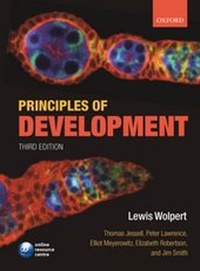
Principles of Development
3rd Edition
Published on 3. August 2006
Book
Paperback/Softback
576 pages
978-0-19-927536-6 (ISBN)
Description
The process of biological development is an amazing feat of tightly-regulated cellular growth and patterning, powerful enough to result in the emergence of a highly-complex living organism from just a single fertilized egg. But how does biological development occur? How can a single fertilized egg give rise to the limbs, organs, and other tissues that comprise a living organism? Principles of Development reveals the universal principles which govern the process of development. Written by one of the most influential developmental biologists of our time, Lewis Wolpert, it focuses on those systems that best illuminate common principles, demystifying the complex yet intricate processes through which biological development occurs. With co-authors whose expertise span the discipline, Principles of Development combines a careful exposition of the subject with insights from some of the world's pioneering developmental biology researchers, taking the student from the fundamentals through to latest discoveries in the field.Assuming no prior knowledge of the subject, and delivered in the lucid, engaging style for which Wolpert is renowned, Principles of Development is an invaluable resource for all students encountering this fascinating subject for the first time, and for the duration of their studies.
Online resource centre: Lecturer resources: Illustrations from the book available to download, to facilitate lecture preparation. Student resources: Multiple choice questions for students to check their understanding. Concept questions for students to explore their understanding of the key principles. Web links to further information resources (including web-based exercises) to encourage independent learning.
Online resource centre: Lecturer resources: Illustrations from the book available to download, to facilitate lecture preparation. Student resources: Multiple choice questions for students to check their understanding. Concept questions for students to explore their understanding of the key principles. Web links to further information resources (including web-based exercises) to encourage independent learning.
More details
Edition
3rd Revised edition
Language
English
Place of publication
Oxford
United Kingdom
Target group
College/higher education
Professional and scholarly
Edition type
Revised edition
Illustrations
650 figures, colour and halftone illustrations
Dimensions
Height: 268 mm
Width: 204 mm
Thickness: 25 mm
Weight
1450 gr
ISBN-13
978-0-19-927536-6 (9780199275366)
Copyright in bibliographic data and cover images is held by Nielsen Book Services Limited or by the publishers or by their respective licensors: all rights reserved.
Schweitzer Classification
Other editions
New editions
Cheryll Tickle | Alfonso Martinez Arias | Marysia Placzek
Wolpert's Principles of Development
Book
04/2025
7th Edition
Oxford University Press
€78.50
Available immediately
Lewis Wolpert
Principles of Development
Book
01/2011
4th Edition
Oxford University Press
€54.46
Shipment within 15-20 days
Lewis Wolpert
Principles of Development
Book
01/2011
4th Edition
Oxford University Press
€97.80
Article exhausted; check different version
Additional editions
Lewis Wolpert | Jim Smith | Tom Jessell
Principles of Development
Book
08/2006
3rd Edition
Oxford University Press
€92.85
Article exhausted; check different version
Previous edition
L. Wolpert
Principles of Development
Book
01/2002
2nd Edition
Oxford University Press
€111.42
Article exhausted; check for reprint
Content
1. History and basic concepts; 2. Development of the Drosophila body plan; 3. Patterning the vertebrate body plan I: axes and germ layers; 4. Patterning the vertebrate body plan II: the somites and early nervous system; 5. Development of nematodes, sea urchins, ascidians, and slime molds; 6. Plant development; 7. Morphogenesis: change in form in the early embryo; 8. Cell differentiation and stem cells; 9. Organogenesis; 10. Development of the nervous system; 11. Germ cells, fertilization and sex; 12. Growth and post-embryonic development; 13. Regeneration; 14. Evolution and development; GLOSSARY