

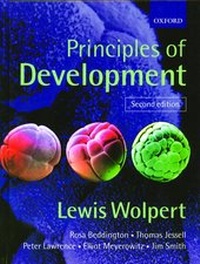
Principles of Development
2nd Edition
Published on 1. January 2002
Book
Hardback
568 pages
978-0-19-924939-8 (ISBN)
Description
A new edition of "Principles of Development", the authoritative undergraduate textbook on developmental biology. Written by a team of distinguished authors, led by Lewis Wolpert, one of the most influential developmental biologists of our time, the text focuses on principles and key concepts to guide students through this fascinating but often challenging subject. Those universal principles governing development in vertebrates, invertebrates, and plants are explained in a lively and engaging way, through both words and pictures.
More details
Edition
2nd Revised edition
Language
English
Place of publication
Oxford
United Kingdom
Target group
College/higher education
Edition type
Revised edition
Illustrations
col. ill.
full colour illustration throughout
Dimensions
Height: 264 mm
Width: 195 mm
ISBN-13
978-0-19-924939-8 (9780199249398)
Copyright in bibliographic data and cover images is held by Nielsen Book Services Limited or by the publishers or by their respective licensors: all rights reserved.
Schweitzer Classification
Other editions
New editions
Cheryll Tickle | Alfonso Martinez Arias | Marysia Placzek
Wolpert's Principles of Development
Book
04/2025
7th Edition
Oxford University Press
€78.50
Available immediately
Lewis Wolpert | Jim Smith | Tom Jessell
Principles of Development
Book
08/2006
3rd Edition
Oxford University Press
€45.54
Article exhausted; check for reprint
Previous edition

L. Wolpert
Principles of Development
Book
01/1998
Oxford University Press
€37.13
Article exhausted; check for reprint
Persons
Content
1. History and basic concepts; 2. Model systems; 3. Patterning the vertebrate body plan I: axes and germ layers; 4. Patterning the vertebrate body plan II: the mesoderm and early nervous system; 5. Development of the Drosophila body plan; 6. Development of nematodes, sea urchins, ascidians, and slime molds; 7. Plant development; 8. Morphogenesis: change in form in the early embryo; 9. Cell differentiation; 10. Organogenesis; 11. Development of the nervous system; 12. Germ cells and sex; 13. Regeneration; 14. Growth and post-embryonic development; 15. Evolution and development