

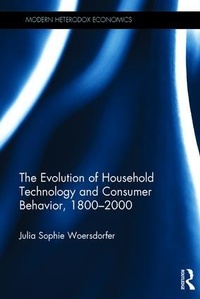
The Evolution of Household Technology and Consumer Behavior, 1800-2000
1st Edition
Published on 16. March 2017
Book
Hardback
238 pages
978-1-84893-595-2 (ISBN)
Description
The increasing division and specialization of labor between the market and the nonmarket sector is a central stylized fact of long-run economic development. Over time, a large share of activities which had formerly been carried out by the private household itself has become replaced by market alternatives, raising at the same time the demand for consumer goods.
The neoclassical economic framework of household production theory relates the increasing demand for household technology to rising wages and opportunity costs of time: the higher the wage rate, the more costly it is to spend time in unpaid housework activities. Consumer products are thus purchased to make household production processes more efficient and to substitute capital goods for the household's time (time substitution hypothesis). Although this hypothesis sounds plausible at first sight, it cannot capture the essential phenomena underlying the complex process of the mechanization of the home over the past 200 years. Its major weakness lies in the treatment of consumer preferences, whose explanatory potential is explicitly factored out.
Using the washing of clothes as a microcosm of household economics, this book examines long-term changes in cleanliness consumption patterns from the perspective of an evolutionary economic, psychologically informed consumer theory. Woersdorfer shows how the historical evolution of cleanliness consumption over the past 200 years is the result of the interplay of supply and demand side factors, namely, technical change in washing technology on one side and motivational driving forces and consumer learning capabilities on the other. Hence, not changing relative prices but innate consumer needs and consumer learning processes, leading to a growing understanding of how to satisfy those needs, are the essential driving forces behind the rising technological endowment of the home and the corresponding demand for household appliances.
The Evolution of Household Technology and Consumer Behavior, 1800-2000 will be of interest to researchers in the field of evolutionary economics, history of technology, economic history, innovation economics and sociology.
The neoclassical economic framework of household production theory relates the increasing demand for household technology to rising wages and opportunity costs of time: the higher the wage rate, the more costly it is to spend time in unpaid housework activities. Consumer products are thus purchased to make household production processes more efficient and to substitute capital goods for the household's time (time substitution hypothesis). Although this hypothesis sounds plausible at first sight, it cannot capture the essential phenomena underlying the complex process of the mechanization of the home over the past 200 years. Its major weakness lies in the treatment of consumer preferences, whose explanatory potential is explicitly factored out.
Using the washing of clothes as a microcosm of household economics, this book examines long-term changes in cleanliness consumption patterns from the perspective of an evolutionary economic, psychologically informed consumer theory. Woersdorfer shows how the historical evolution of cleanliness consumption over the past 200 years is the result of the interplay of supply and demand side factors, namely, technical change in washing technology on one side and motivational driving forces and consumer learning capabilities on the other. Hence, not changing relative prices but innate consumer needs and consumer learning processes, leading to a growing understanding of how to satisfy those needs, are the essential driving forces behind the rising technological endowment of the home and the corresponding demand for household appliances.
The Evolution of Household Technology and Consumer Behavior, 1800-2000 will be of interest to researchers in the field of evolutionary economics, history of technology, economic history, innovation economics and sociology.
More details
Series
Language
English
Place of publication
London
United Kingdom
Publishing group
Taylor & Francis Ltd
Target group
College/higher education
Product notice
sewn/stitched
Cloth over boards
Illustrations
9 s/w Abbildungen, 9 s/w Zeichnungen, 19 s/w Tabellen
19 Tables, black and white; 9 Line drawings, black and white; 9 Illustrations, black and white
Dimensions
Height: 234 mm
Width: 156 mm
Weight
498 gr
ISBN-13
978-1-84893-595-2 (9781848935952)
Copyright in bibliographic data and cover images is held by Nielsen Book Services Limited or by the publishers or by their respective licensors: all rights reserved.
Schweitzer Classification
Other editions
Additional editions
Julia Sophie Woersdorfer
The Evolution of Household Technology and Consumer Behavior, 1800-2000
Book
06/2020
1st Edition
Routledge
€59.00
Shipment within 15-20 days

Julia Sophie Woersdorfer
The Evolution of Household Technology and Consumer Behavior, 1800-2000
E-Book
03/2017
Routledge
€59.49
Available for download

Julia Sophie Woersdorfer
The Evolution of Household Technology and Consumer Behavior, 1800-2000
E-Book
03/2017
Routledge
€59.49
Available for download
Person
Julia Sophie Woersdorfer received her Ph.D. in Economics from the University of Jena, Germany in 2010. Afterward, she took a position as a research associate at the National Academy of Science and Engineering (acatech) before joining the Federal Competition Authority (Bundeskartellamt), Germany, as a civil servant.
Content
1 Beyond Time Substitution: An Evolutionary Economic Analysis into the Patterns of Cleanliness Consumption
2 Consumption Behavior as a Learning Process
3 The Origin of the Social Norm of Cleanliness
4 Toward the Modern Washday: Major Steps in the Development of Laundry Technology
5 Consumer Motivations and Washing Machine Advertisements
6 Patterns of Cleanliness Consumption and Time Use
7 Cleanliness Consumption and the Rebound Effect of Energy Efficiency
8 Explaining the Patterns of Cleanliness Consumption
2 Consumption Behavior as a Learning Process
3 The Origin of the Social Norm of Cleanliness
4 Toward the Modern Washday: Major Steps in the Development of Laundry Technology
5 Consumer Motivations and Washing Machine Advertisements
6 Patterns of Cleanliness Consumption and Time Use
7 Cleanliness Consumption and the Rebound Effect of Energy Efficiency
8 Explaining the Patterns of Cleanliness Consumption