

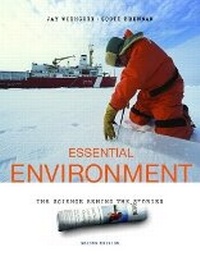
Essential Environment
The Science Behind the Stories
2nd Edition
Published on 22. November 2006
Book
Paperback/Softback
448 pages
978-0-8053-0640-8 (ISBN)
Description
Essential Environment: The Science Behind the Stories retains all the popular features of the landmark first edition-including its integrated central case study approach, and focus on the scientific process, current data and critical thinking- in a brief 15-chapter text.
The Second Edition features a new chapter on ecology with expanded coverage of community ecology and biomes. New end-of-chapter activities and interactive exercises on the Environmental Place Website help students hone the skills they need to make informed decisions on environmental issues. Calculating Ecological Footprint activities at the end of each chapter give students practice in applying individual decisions to larger scales. The Investigate It! interactive map on the website provides more than 120 additional case studies.You Decide web activities help students learn how to analyze data on global warming and conservation.
The Second Edition features a new chapter on ecology with expanded coverage of community ecology and biomes. New end-of-chapter activities and interactive exercises on the Environmental Place Website help students hone the skills they need to make informed decisions on environmental issues. Calculating Ecological Footprint activities at the end of each chapter give students practice in applying individual decisions to larger scales. The Investigate It! interactive map on the website provides more than 120 additional case studies.You Decide web activities help students learn how to analyze data on global warming and conservation.
More details
Edition
2nd edition
Language
English
Place of publication
Upper Saddle River
United States
Target group
Professional and scholarly
Dimensions
Width: 262 mm
Thickness: 17 mm
Weight
928 gr
ISBN-13
978-0-8053-0640-8 (9780805306408)
Copyright in bibliographic data and cover images is held by Nielsen Book Services Limited or by the publishers or by their respective licensors: all rights reserved.
Schweitzer Classification
Other editions
New editions
Jay H. Withgott | Scott R. Brennan
Essential Environment
The Science behind the Stories: United States Edition
Book
11/2008
3rd Edition
Pearson
€82.93
Article exhausted; check for reprint
Previous edition
Book
04/2005
Pearson Education (US)
€68.27
Article exhausted; check for reprint
Content
PART ONE, Foundations of Environmental Science
1. An introduction to environmental science
2. Environmental economics and environmental policy
3. Environmental systems: Chemistry, energy, and ecosystems
4. Evolution, biodiversity, and population ecology
5. Species interactions and community ecology
PART TWO, Environmental Issues and the Search for Solutions
6. Human population growth
7. Soils, agriculture, and the future of food
8. Biodiversity and conservation biology
9. Urbanization, land use, and resources management
10. Environmental health and toxicology
11. Freshwater and marine systems and resources
12. The atmosphere, air pollution, and global climate change
13. Nonrenewable energy sources and their environmental impacts
14. Renewable energy alternatives
15. Waste management
Epilogue: Sustainable Solutions
1. An introduction to environmental science
2. Environmental economics and environmental policy
3. Environmental systems: Chemistry, energy, and ecosystems
4. Evolution, biodiversity, and population ecology
5. Species interactions and community ecology
PART TWO, Environmental Issues and the Search for Solutions
6. Human population growth
7. Soils, agriculture, and the future of food
8. Biodiversity and conservation biology
9. Urbanization, land use, and resources management
10. Environmental health and toxicology
11. Freshwater and marine systems and resources
12. The atmosphere, air pollution, and global climate change
13. Nonrenewable energy sources and their environmental impacts
14. Renewable energy alternatives
15. Waste management
Epilogue: Sustainable Solutions