

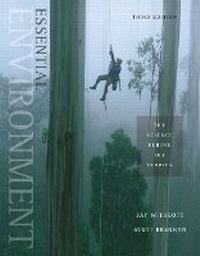
Essential Environment
The Science behind the Stories: United States Edition
3rd Edition
Published on 3. November 2008
Book
Paperback/Softback
456 pages
978-0-13-604531-1 (ISBN)
Description
Essential Environment: The Science Behind the Stories retains all the popular features of its parent volume, Environment: The Science behind the Stories-including its integrated central case study approach and its focus on the scientific process, current data, and critical thinking-in a brief 17-chapter text.
The Third Edition features expanded coverage of global climate change in a new stand-alone chapter. Coverage of geology, minerals, and mining is also enhanced in a new chapter. A new Activities Workbook supplement provides more activities and exercises than ever, and the Viewpoints essays are now in their own supplement with questions and web links. Myenvironmentplace.com offers a diverse selection of resources and interactive exercises that help students succeed in the course and hone the skills they need to make informed decisions on environmental issues.
The Third Edition features expanded coverage of global climate change in a new stand-alone chapter. Coverage of geology, minerals, and mining is also enhanced in a new chapter. A new Activities Workbook supplement provides more activities and exercises than ever, and the Viewpoints essays are now in their own supplement with questions and web links. Myenvironmentplace.com offers a diverse selection of resources and interactive exercises that help students succeed in the course and hone the skills they need to make informed decisions on environmental issues.
More details
Edition
3rd edition
Language
English
Place of publication
United States
Publishing group
Pearson Education (US)
Target group
Professional and scholarly
Dimensions
Height: 216 mm
Width: 275 mm
Thickness: 15 mm
Weight
922 gr
ISBN-13
978-0-13-604531-1 (9780136045311)
Copyright in bibliographic data and cover images is held by Nielsen Book Services Limited or by the publishers or by their respective licensors: all rights reserved.
Schweitzer Classification
Other editions
New editions
Jay H. Withgott | Matthew Laposata
Essential Environment
The Science behind the Stories Plus MasteringEnvironmentalScience with eText -- Access Card Package: United St
Book
10/2011
4th Edition
Benjamin Cummings
€121.07
Article is exhausted; no reprint
Previous edition
Book
11/2006
2nd Edition
Pearson Education (US)
€78.17
Article exhausted; check for reprint
Persons
Jay H. Withgott is a science and environmental writer with a background in scientific research and teaching. He holds degrees from Yale University, the University of Arkansas, and the University of Arizona. As a researcher, he has published scientific papers on topics in ecology, evolution, animal behavior, and conservation biology in journals including Proceedings of the National Academy of Sciences, Proceedings of the Royal Society of London B, Evolution, and Animal Behavior. He has taught university-level laboratory courses in ecology, ornithology, vertebrate diversity, anatomy, and general biology.
As a science writer, Jay has authored articles for a variety of journals and magazines including Science, New Scientist, BioScience, Smithsonian, Current Biology, Conservation in Practice, and Natural History. He combines his scientific expertise with his past experience as a reporter and editor for daily newspapers to make science accessible and engaging for general audiences.
Jay lives with his wife, biologist Susan Masta, in Portland, Oregon.
Scott Brennan has taught environmental science, ecology, resource policy, and journalism at Western Washington University and at Walla Walla Community College. He has also worked as a journalist, photographer, and consultant.
Scott has cultivated his expertise in environmental science and public policy by serving as Campaign Director of Alaskans for Responsible Mining, as Executive Conservation Fellow of the National Parks Conservation Association in Washington, D.C., and as a consultant to the U.S. Department of Defense Environmental Security Office at the Pentagon. When not at work, Scott is likely to be found exploring the Chugach Mountains and the Bristol Bay drainages in southwest Alaska. He lives with his wife, Angela, and their dogs Raven and Hatcher, in south central Alaska's Chester Creek Watershed.
As a science writer, Jay has authored articles for a variety of journals and magazines including Science, New Scientist, BioScience, Smithsonian, Current Biology, Conservation in Practice, and Natural History. He combines his scientific expertise with his past experience as a reporter and editor for daily newspapers to make science accessible and engaging for general audiences.
Jay lives with his wife, biologist Susan Masta, in Portland, Oregon.
Scott Brennan has taught environmental science, ecology, resource policy, and journalism at Western Washington University and at Walla Walla Community College. He has also worked as a journalist, photographer, and consultant.
Scott has cultivated his expertise in environmental science and public policy by serving as Campaign Director of Alaskans for Responsible Mining, as Executive Conservation Fellow of the National Parks Conservation Association in Washington, D.C., and as a consultant to the U.S. Department of Defense Environmental Security Office at the Pentagon. When not at work, Scott is likely to be found exploring the Chugach Mountains and the Bristol Bay drainages in southwest Alaska. He lives with his wife, Angela, and their dogs Raven and Hatcher, in south central Alaska's Chester Creek Watershed.
Content
I. FOUNDATIONS OF ENVIRONMENTAL SCIENCE
1. An introduction to environmental science
2. Environmental economics and environmental policy
3. Environmental systems: Chemistry, energy, and ecosystems
4. Evolution, biodiversity, and population ecology
5. Species interactions and community ecology
II. ENVIRONMENTAL ISSUES AND THE SEARCH FOR SOLUTIONS
6. Human population
7. Soils, agriculture, and the future of food
8. Biodiversity and conservation biology
9. Cities, forests, and parks: Land use and resource management
10. Environmental health and toxicology
11. Geology, minerals, and mining
12. Freshwater and marine systems and resources
13. The atmosphere and air pollution
14. Global climate change
15. Nonrenewable energy sources, their impacts, and energy conservation
16. Renewable energy alternatives
17. Waste management
Epilogue: Sustainable Solutions
1. An introduction to environmental science
2. Environmental economics and environmental policy
3. Environmental systems: Chemistry, energy, and ecosystems
4. Evolution, biodiversity, and population ecology
5. Species interactions and community ecology
II. ENVIRONMENTAL ISSUES AND THE SEARCH FOR SOLUTIONS
6. Human population
7. Soils, agriculture, and the future of food
8. Biodiversity and conservation biology
9. Cities, forests, and parks: Land use and resource management
10. Environmental health and toxicology
11. Geology, minerals, and mining
12. Freshwater and marine systems and resources
13. The atmosphere and air pollution
14. Global climate change
15. Nonrenewable energy sources, their impacts, and energy conservation
16. Renewable energy alternatives
17. Waste management
Epilogue: Sustainable Solutions