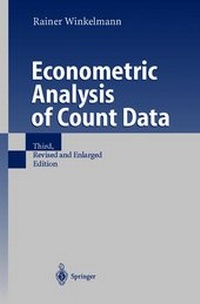
The primary objective of this book is to provide an introduction to the econometric modeling of count data for graduate students and researchers. It should serve anyone whose interest lies either in developing the field fur ther, or in applying existing methods to empirical questions. Much of the material included in this book is not specific to economics, or to quantita tive social sciences more generally, but rather extends to disciplines such as biometrics and technometrics. Applications are as diverse as the number of congressional budget vetoes, the number of children in a household, and the number of mechanical defects in a production line. The unifying theme is a focus on regression models in which a dependent count variable is modeled as a function of independent variables which mayor may not be counts as well. The modeling of count data has come of age. Inclusion of some of the fundamental models in basic textbooks, and implementation on standard computer software programs bear witness to that. Based on the standard Poisson regression model, numerous extensions and alternatives have been developed to address the common challenges faced in empirical modeling (unobserved heterogeneity, selectivity, endogeneity, measurement error, and dependent observations in the context of panel data or multivariate data, to name but a few) as well as the challenges that are specific to count data (e. g. , over dispersion and underdispersion).
Reviews / Votes
From the reviews:
JOURNAL OF THE AMERICAN STATISTICAL ASSOCIATION
"Winkleman has published numerous articles on using content models in economics and other social science journals. Because these are both applied and theoretical, he is well suited to write a monograph in this area. This book provides a very useful survey for anyone doing serious research using count data.for those who are doing substantive research using count data, [this book] will prove quite useful."
From the reviews of the fourth edition:
"The main objective of the book is to introduce count models at a graduate level so that these models can be used by students, researchers or interested practitioners. . For all researchers who are concerned with count data the book offers a very good introduction into this field of research and many examples and interpretations of the results. Therefore, the book provides an excellent starting point for working in this area of applied research." (Herbert S. Buscher, Zentralblatt MATH, Vol. 1032 (7), 2004)
Edition
3rd rev. and enlarged ed.
Language
Place of publication
Publishing group
Target group
Professional and scholarly
Edition type
Illustrations
20 s/w Tabellen
13 figures, 20 tables
Dimensions
Height: 23.5 cm
Width: 15.5 cm
Weight
ISBN-13
978-3-540-67340-8 (9783540673408)
DOI
10.1007/978-3-662-04149-9
Schweitzer Classification
Introduction.- Poisson Regression Model.- Some Thoughts on Methodology.- Some Thoughts on Methodology.- Examples.- Organization of the Book.- Probability Models for Count Data.- Introduction.- Poisson Distribution.- Further Distributions for Count Data.- Modified Count Data Distributions.- Generaliziations.- Duration Analysis and Count Data.- Econometric Modeling - Basic Issues.- Poisson Regression Model.- Estimation.- Sources of Misspecification.- Testing for Misspecification.- Econometric Modeling - Extensions.- Introduction.- Unobserved Heterogeneity.- Dependent Count Process.- Exogenous Selectivity.- Endogenous Selectivity.- Endogenous Regressors.- Generalized Variance Models.- Correlated Count Data.- Multivariate Count Data.- Panel Data Models.- Time-Series Count Data Models.- Bayesian Analysis of Count Variables.- Bayesian Analysis of the Poisson Model.- A Poisson Model with Underreporting.- Estimation of the Multivariate Poisson-log-normal Model by MCMC.- Estimation of a Random Coefficients Model by MCMC.- Applications.- Accidents.- Health Economics.- Demography.- Marketing and Management.- Labor Mobility.