

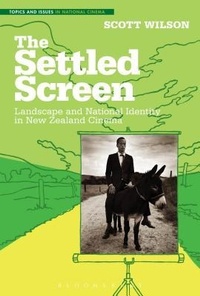
The Settled Screen
Landscape and National Identity in New Zealand Cinema
Will be published approx. on 1. January 2026
Book
Hardback
256 pages
978-1-62892-040-6 (ISBN)
Description
The Settled Screen: Landscape and National Identity in New Zealand Cinema is the first title to explore the relationship between the representation of landscape and the development of both a national cinema and a national identity. Through the early years of New Zealand's cinema, prior to any formalized governmental support, those few feature length narrative films repeated wholesale the modes of representing the landscape and its inhabitants, while the developing documentary and travelogue industries would construct the fantasy of `Maoriland' with New Zealand becoming internationally known as a green paradise, a Pacific idyll with an exotic, tamed, indigenous population. This precursor of the now contemporary `Brand New Zealand` - itself a modern, politically-corrected version of these earlier narratives - would be adjusted and amended over time, especially with the formation of the New Zealand Film Commission in the late 1970s, but never entirely discarded.
Beginning with a discussion on films in which landscape - and particularly the colonial or settler landscapes - have been represented in other Western cinemas, like The Searchers and Thelma & Louise, Wilson compares in indigenous films like Whale Rider, To Love a Maori and The Piano to exemplify the simultaneous strands of New Zealand cinema: a way of marketing the country based on the success of such spectacular films as Peter Jackson's Tolkien epics, and the simultaneous attempts by Maori, immigrant and minority filmmakers to find a way to represent other stories in this land without recourse to the tropes of a by-now dominant national industry.
Beginning with a discussion on films in which landscape - and particularly the colonial or settler landscapes - have been represented in other Western cinemas, like The Searchers and Thelma & Louise, Wilson compares in indigenous films like Whale Rider, To Love a Maori and The Piano to exemplify the simultaneous strands of New Zealand cinema: a way of marketing the country based on the success of such spectacular films as Peter Jackson's Tolkien epics, and the simultaneous attempts by Maori, immigrant and minority filmmakers to find a way to represent other stories in this land without recourse to the tropes of a by-now dominant national industry.
More details
Series
Language
English
Place of publication
New York
United States
Publishing group
Bloomsbury Publishing Plc
Target group
College/higher education
Product notice
sewn/stitched
Cloth over boards
With dust jacket
Illustrations
20 bw illus
Dimensions
Height: 229 mm
Width: 152 mm
Thickness: 25 mm
Weight
454 gr
ISBN-13
978-1-62892-040-6 (9781628920406)
Copyright in bibliographic data and cover images is held by Nielsen Book Services Limited or by the publishers or by their respective licensors: all rights reserved.
Schweitzer Classification
Person
Scott Wilson is Senior Lecturer at Unitec Institute of Technology, New Zealand, and lectures in film and media studies. His most recent publication is The Politics of Insects: David Cronenberg's Cinema of Confrontation (2011).
Content
Chapter 1 - Introduction: The Settled Screen
Chapter 2 - Ecologies of Vision: First Contact and European Looking
Chapter 3 - The Tourist Spectacular
Chapter 4 - (White) Men Alone (at Last)
Chapter 5 - The Emptied Landscape
Chapter 6 - People into Places
Chapter 7 - Other Picturesques/Critical Voices
Chapter 8 - Conclusions: Backwards into the Future
Bibliography
Filmography
Index
Chapter 2 - Ecologies of Vision: First Contact and European Looking
Chapter 3 - The Tourist Spectacular
Chapter 4 - (White) Men Alone (at Last)
Chapter 5 - The Emptied Landscape
Chapter 6 - People into Places
Chapter 7 - Other Picturesques/Critical Voices
Chapter 8 - Conclusions: Backwards into the Future
Bibliography
Filmography
Index