

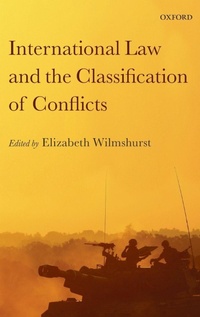
International Law and the Classification of Conflicts
Published on 2. August 2012
Book
Hardback
568 pages
978-0-19-965775-9 (ISBN)
Description
This book comprises contributions by leading experts in the field of international humanitarian law on the subject of the categorisation or classification of armed conflict. It is divided into two sections: the first aims to provide the reader with a sound understanding of the legal questions surrounding the classification of hostilities and its consequences; the second includes ten case studies that examine practice in respect of classification.
Understanding how classification operates in theory and practice is a precursor to identifying the relevant rules that govern parties to hostilities. With changing forms of armed conflict which may involve multi-national operations, transnational armed groups and organized criminal gangs, the need for clarity of the law is all-important. The case studies selected for analysis are Northern Ireland, DRC, Colombia, Afghanistan (from 2001), Gaza, South Ossetia, Iraq (from 2003), Lebanon (2006), the so-called war against Al-Qaeda, and future trends. The studies explore the legal consequences of classification particularly in respect of the use of force, detention in armed conflict, and the relationship between human rights law and international humanitarian law. The practice identified in the case studies allows the final chapter to draw conclusions as to the state of the law on classification.
Understanding how classification operates in theory and practice is a precursor to identifying the relevant rules that govern parties to hostilities. With changing forms of armed conflict which may involve multi-national operations, transnational armed groups and organized criminal gangs, the need for clarity of the law is all-important. The case studies selected for analysis are Northern Ireland, DRC, Colombia, Afghanistan (from 2001), Gaza, South Ossetia, Iraq (from 2003), Lebanon (2006), the so-called war against Al-Qaeda, and future trends. The studies explore the legal consequences of classification particularly in respect of the use of force, detention in armed conflict, and the relationship between human rights law and international humanitarian law. The practice identified in the case studies allows the final chapter to draw conclusions as to the state of the law on classification.
Reviews / Votes
This book achieves the highest standards of scholarship and represents a real step forward in international understanding of these most complex issues. Its impressive authority will ensure that it is widely consulted and cited, and will do much to drive forward the debate in the years ahead. I recommend the book heartily and congratulate all involved in its preparation. * William Boothby, International Affairs * This volume is a worth-while addition to the literature on classification of conflicts in IHL. It brings together some of the most eminent international scholars in IHL who offer their views on classification and on several relevant controversial questions. The analysis and debate generated offer the reader a comprehensive overview of-and plenty of food for thought on-the problems relating to classification... In short, this is a book definitely worth reading by anyone interested in classification of conflicts. * Vaios Koutroulis, Journal of International Humanitarian Legal Studies * Her book is a welcome and valuable addition to the literature on the law of armed conflict. Thanks to the inclusion of the case studies, the book has managed to move away from a purely accademic monograph to become an exceptionally useful tool to assist nations and their operational lawyers when making classification decisions. It therefore deserves the attention of students, accademics and practitioners alike. * Vincent Roobaert. Nato Legal Gazette * The on-the-ground approach demonstrated in this work has the very real merit of taking international lawyers, or more accurately international humanitarian lawyers, somewhat out of their comfort zone ... besides providing clarity for the expert on the vexed issue of classification of conflicts it will also be a resource for the more general reader with an interest in international humanitarian law and how it works in practice. * Judith Gardam, British Yearbook of International Law * Individual case studies are of invariably high qualityand yield myriad points of analytical interest. ... the case studies are well selected and thoroughly discussed. * Ioannis Kalpouzos, Leiden Journal of International Law *More details
Language
English
Place of publication
Oxford
United Kingdom
Target group
Professional and scholarly
Legal advisers to governments, armed forces, NGOs, and international organisations; academics, postgraduate students of international humanitarian law, armed conflict, and war studies
Dimensions
Height: 240 mm
Width: 161 mm
Thickness: 35 mm
Weight
1010 gr
ISBN-13
978-0-19-965775-9 (9780199657759)
Copyright in bibliographic data and cover images is held by Nielsen Book Services Limited or by the publishers or by their respective licensors: all rights reserved.
Schweitzer Classification
Other editions
Additional editions
Elizabeth Wilmshurst
International Law and the Classification of Conflicts
E-Book
08/2012
1st Edition
OUP Oxford
€148.79
Available for download
Elizabeth Wilmshurst
International Law and the Classification of Conflicts
E-Book
08/2012
1st Edition
OUP Oxford
€120.89
Available for download
Person
Elizabeth Wilmshurst CMG is Associate Fellow in International Law, at Chatham House (the Royal Institute of International Affairs) and a visiting professor at University College, London University. She was a legal adviser in the United Kingdom diplomatic service between 1974 and 2003, during which time she was the Legal Adviser to the UK mission to the United Nations in New York between 1994 and 1997. She is a co-author of An Introduction to International Criminal Law and Procedure (2nd ed. Cambridge, 2010) and a co-editor of Perspectives on the ICRC Study on Customary International Humanitarian Law (Cambridge, 2007).
Content
PART I; PART II; PART III: CASE STUDIES; PART IV