

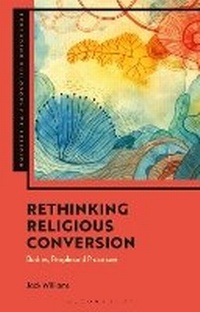
Rethinking Religious Conversion
Bodies, People and Processes
Published on 14. November 2024
Book
Hardback
224 pages
978-1-350-38321-0 (ISBN)
Description
Drawing on methods from religious studies, philosophy, and cognitive science, Jack Williams develops a unique and interdisciplinary approach to the study of religious conversion. This is the first major philosophical study of conversion to treat the phenomenon as a long-term process, shaped by the convert's embodiment and immersion in a linguistic, social, and ritual community.
Williams' analysis of the conversion process is rooted in a view of cognition as both embodied and affective, and is informed by the latest research in phenomenology, affect theory, neuroscience, and enactivist cognitive science. In conversation with diverse conversion narratives, he advances a theory of conversion that is not restricted to a modern, Western context but that can be applied to experiences of conversion across global history and culture.
Rethinking Religious Conversion displays an original approach to the philosophical study of diverse religious practices. By bringing together a diverse array of contemporary and historical scholarship, it revitalizes the study of conversion for both philosophy and religious studies.
Williams' analysis of the conversion process is rooted in a view of cognition as both embodied and affective, and is informed by the latest research in phenomenology, affect theory, neuroscience, and enactivist cognitive science. In conversation with diverse conversion narratives, he advances a theory of conversion that is not restricted to a modern, Western context but that can be applied to experiences of conversion across global history and culture.
Rethinking Religious Conversion displays an original approach to the philosophical study of diverse religious practices. By bringing together a diverse array of contemporary and historical scholarship, it revitalizes the study of conversion for both philosophy and religious studies.
Reviews / Votes
This is a creative monograph in the best traditions of empirically-based Study of Religion/s which mounts a sophisticated interdisciplinary argument in favour of the corporeal site of conversion in subjects' experience. -- Steven Sutcliffe, University of Edinburgh, UK In this multi-dimensional exploration of the dynamics of religious conversion, Jack Williams offers an illuminating account of a process that cannot be reduced to a mere change of mind. Describing the cognitive, affective, social, and embodied elements that characterize conversion, he provides a rich interpretation of a significant phenomenon. -- David Fergusson, University of Cambridge, UK With an interdisciplinary and multireligious sensibility, Jack Williams has produced a study of religious conversion that breaks new ground in philosophy of religion. Making proficient use of philosophical methods, both analytic and phenomenological, Rethinking Religious Conversion engages productively with various areas of religious studies and the study of human cognition. While keenly focused on the complex phenomenon of religious conversion, the book typifies a way forward for philosophy of religion more broadly. -- Mikel Burley, University of Leeds, UKMore details
Series
Language
English
Place of publication
London
United Kingdom
Publishing group
Bloomsbury Publishing PLC
Target group
Professional and scholarly
Dimensions
Height: 236 mm
Width: 156 mm
Thickness: 18 mm
Weight
480 gr
ISBN-13
978-1-350-38321-0 (9781350383210)
Copyright in bibliographic data and cover images is held by Nielsen Book Services Limited or by the publishers or by their respective licensors: all rights reserved.
Schweitzer Classification
Other editions
Additional editions
E-Book
10/2024
1st Edition
Bloomsbury Academic
€31.99
Available for download
Person
Content
Abbreviations
Acknowledgements
Introduction
Part I. Context
1. What is Conversion?
2. Embodiment as the Existential Context of Conversion
3. Conversion and Changing Religious Beliefs
Part II. Conversion
4. Language: Linguistic Communities and The Affectivity of Speech
5. Community: The Affective Need to Belong
6. Ritual: Embodied World Construction
Conclusion
Notes
Bibliography
Index
Acknowledgements
Introduction
Part I. Context
1. What is Conversion?
2. Embodiment as the Existential Context of Conversion
3. Conversion and Changing Religious Beliefs
Part II. Conversion
4. Language: Linguistic Communities and The Affectivity of Speech
5. Community: The Affective Need to Belong
6. Ritual: Embodied World Construction
Conclusion
Notes
Bibliography
Index