

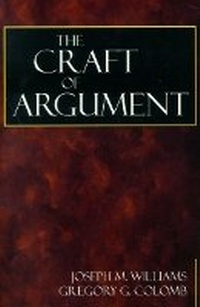
The Craft of Argument
Published on 1. December 2001
Book
Paperback/Softback
512 pages
978-0-321-01264-7 (ISBN)
Description
Written by the authors of such successful composition titles as Style: Ten Lessons in Clarity and Grace (AWL) and The Craft of Research (Chicago UP), The Craft of Argument is an argument rhetoric worth looking at! The Craft of Argument is based on the Toulmin system of argument and has a brief selection of readings. Reviewers have raved about the modifications to Toulmin that Williams and Colomb have made. This book can be described as "Toulmin developed for writing" or "A Toulmin for Writers."
More details
Language
English
Place of publication
United States
Publishing group
Pearson Education (US)
Target group
Professional and scholarly
Dimensions
Height: 229 mm
Width: 154 mm
Thickness: 19 mm
Weight
608 gr
ISBN-13
978-0-321-01264-7 (9780321012647)
Copyright in bibliographic data and cover images is held by Nielsen Book Services Limited or by the publishers or by their respective licensors: all rights reserved.
Schweitzer Classification
Other editions
New editions
Joseph M. Williams | Gregory G. Colomb
The Craft of Argument
Book
05/2003
2nd Edition
Pearson
€48.27
Article exhausted; check for reprint
Content
Topical Contents of the Writing Process Sections.
Preface for Teachers.
A Message to Students.
How to Use This Book.
Acknowledgments.
I. THE NATURE OF ARGUMENT.
1. Argument and Rationality.
2. Argument as Civil Conversation.
3. Motivating Your Argument.
II. DEVELOPING YOUR ARGUMENT.
4. Articulating Claims.
5. Reasons and Evidence.
6. Reporting Evidence.
7. Warranting Claims and Reasons.
8. Acknowledgments and Responses.
A Checklist for Planning and Revising.
III. THINKING ABOUT THINKING IN ARGUMENTS.
9. The Forms of Reasoning.
10. Arguments About Meanings.
11. Arguments About Causes.
IV. THE LANGUAGES OF ARGUMENT.
12. Clear Language.
13. The Overt and Covert Force of Language.
Appendix 1. Fallacies.
Appendix 2. A Quick Guide to Citations.
READINGS.
1. Attitudes Toward Teaching and Learning.
2. Bingeing, Risk and Public Health.
3. Lying.
Credits.
Index.
Preface for Teachers.
A Message to Students.
How to Use This Book.
Acknowledgments.
I. THE NATURE OF ARGUMENT.
1. Argument and Rationality.
2. Argument as Civil Conversation.
3. Motivating Your Argument.
II. DEVELOPING YOUR ARGUMENT.
4. Articulating Claims.
5. Reasons and Evidence.
6. Reporting Evidence.
7. Warranting Claims and Reasons.
8. Acknowledgments and Responses.
A Checklist for Planning and Revising.
III. THINKING ABOUT THINKING IN ARGUMENTS.
9. The Forms of Reasoning.
10. Arguments About Meanings.
11. Arguments About Causes.
IV. THE LANGUAGES OF ARGUMENT.
12. Clear Language.
13. The Overt and Covert Force of Language.
Appendix 1. Fallacies.
Appendix 2. A Quick Guide to Citations.
READINGS.
1. Attitudes Toward Teaching and Learning.
2. Bingeing, Risk and Public Health.
3. Lying.
Credits.
Index.