

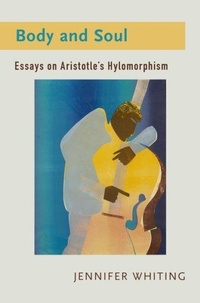
Body and Soul
Essays on Aristotle's Hylomorphism
Published on 10. October 2023
Book
Hardback
328 pages
978-0-19-766600-5 (ISBN)
Description
Body and Soul: Essays on Aristotle's Hylomorphism is one of three volumes collecting previously published essays by Jennifer Whiting. This volume contains two sets of essays, one centered on Aristotle's account of an animal's body as standing to its soul as matter (hule) to form (morphe), the other exploring Aristotle's conception of practical reason as the proper form of human desire.
In the first set Whiting presents Aristotle's conception of the soul as the form and essence of an organic (and so living) body as part of his solution to Presocratic puzzles about whether there is a real (and not simply conventional) distinction between the coming-to-be (or passing-away) of an individual substance and what is merely the alteration or rearrangement of pre-existing stuffs. The solution also involves taking each individual animal within a species to have its own numerically distinct "individual" form, which (unlike species forms traditionally conceived) exists when and only when it does.
The remaining essays account for various deficiencies in the lives of rational animals by appeal to the explanatory asymmetries afforded by Aristotle's teleology, where formal and final causes dominate when things go as they should (teleologically speaking) go, and material-efficient causes dominate when things go wrong. Just as Aristotle traces the birth of females to the failure of menstrual fluid to be fully "mastered" by the formal movements in the father's semen, so too he traces akratic and other defective forms of action to the failure of desires to be fully "mastered" by the activities of reason. Whiting argues that phronesis is on this account the proper form of the desiring part of the soul, which (when things go well) is one with the practically reasoning part.
In the first set Whiting presents Aristotle's conception of the soul as the form and essence of an organic (and so living) body as part of his solution to Presocratic puzzles about whether there is a real (and not simply conventional) distinction between the coming-to-be (or passing-away) of an individual substance and what is merely the alteration or rearrangement of pre-existing stuffs. The solution also involves taking each individual animal within a species to have its own numerically distinct "individual" form, which (unlike species forms traditionally conceived) exists when and only when it does.
The remaining essays account for various deficiencies in the lives of rational animals by appeal to the explanatory asymmetries afforded by Aristotle's teleology, where formal and final causes dominate when things go as they should (teleologically speaking) go, and material-efficient causes dominate when things go wrong. Just as Aristotle traces the birth of females to the failure of menstrual fluid to be fully "mastered" by the formal movements in the father's semen, so too he traces akratic and other defective forms of action to the failure of desires to be fully "mastered" by the activities of reason. Whiting argues that phronesis is on this account the proper form of the desiring part of the soul, which (when things go well) is one with the practically reasoning part.
More details
Language
English
Place of publication
New York
United States
Target group
Professional and scholarly
Product notice
sewn/stitched
Cloth over boards
Dimensions
Height: 238 mm
Width: 163 mm
Thickness: 26 mm
Weight
626 gr
ISBN-13
978-0-19-766600-5 (9780197666005)
Copyright in bibliographic data and cover images is held by Nielsen Book Services Limited or by the publishers or by their respective licensors: all rights reserved.
Schweitzer Classification
Other editions
Additional editions
E-Book
08/2023
OUP eBook
€69.99
Available for download
E-Book
08/2023
OUP eBook
€69.99
Available for download
Person
Jennifer Whiting is Distinguished Professor of Philosophy at the University of Pittsburgh. She has taught at Harvard, Cornell, and the University of Toronto (where she was Chancellor Jackman Professor of Philosophy). She has been a fellow at Stanford's Center for Advanced Study in the Behavioral Sciences and Cornell's Society for Humanities and has received fellowships from the ACLS, Howard Foundation, and NEH. In 2006, she received the Royal Society of Canada's Konrad Adenauer Research Award.
Other essays by Whiting are collected in First, Second, and Other Selves: Essays on Friendship and Personal Identity (OUP 2016) and in Living Together: Essays on Aristotle's Ethics (OUP 2023)
Other essays by Whiting are collected in First, Second, and Other Selves: Essays on Friendship and Personal Identity (OUP 2016) and in Living Together: Essays on Aristotle's Ethics (OUP 2023)
Content
Preface
Acknowledgements
Introduction
1. Form and Individuation in Aristotle
2. Aristotle on Form and Generation
3. Living Bodies
4. Metasubstance: Critical Notice of Frede-Patzig and Furth
5. Locomotive Soul: The Parts of Soul in Aristotle's Scientific Works
6. Hylomorphic Virtue: Cosmology, Embryology, and Moral Development in Aristotle
7. Nicomachean Ethics VII.3 on Akratic Ignorance (with Martin Pickave)
8. The Lockeanism of Aristotle
9. The Mover(s) of Rational Animals: De Anima III.11 in context
Reprint Information
Indexes
Acknowledgements
Introduction
1. Form and Individuation in Aristotle
2. Aristotle on Form and Generation
3. Living Bodies
4. Metasubstance: Critical Notice of Frede-Patzig and Furth
5. Locomotive Soul: The Parts of Soul in Aristotle's Scientific Works
6. Hylomorphic Virtue: Cosmology, Embryology, and Moral Development in Aristotle
7. Nicomachean Ethics VII.3 on Akratic Ignorance (with Martin Pickave)
8. The Lockeanism of Aristotle
9. The Mover(s) of Rational Animals: De Anima III.11 in context
Reprint Information
Indexes