

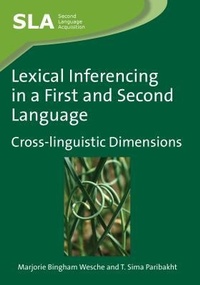
Lexical Inferencing in a First and Second Language
Cross-linguistic Dimensions
Published on 26. November 2009
Book
Hardback
216 pages
978-1-84769-223-8 (ISBN)
Description
This book presents a comprehensive review of previous research on lexical inferencing, co-authored by Kirsten Haastrup, and a major new trilingual study of lexical inferencing by both first (L1) and second language (L2) readers. Research since the 1970s on this apparently universal cognitive process in L2 reading and vocabulary learning is surveyed, including the kinds of knowledge and textual cues L2 readers use when inferring unknown word meanings, factors influencing their success and knowledge retention, and relevant theory. A comparative study of L1 and L2 lexical inferencing by Persian and French and English speakers is then presented, focusing on evidence of L1 transfer in the L2 inferencing process, its success and readers' gains in L2 word knowledge. Influences of the specific L1 are distinguished from those of native versus non-native proficiency, relative cultural familiarity of texts, readers' L2 proficiency, text language features and other factors. The relative typological distance between readers' L1 and L2 is reflected in systematic differences between L1 speakers of Persian and French in their L2 lexical inferencing. Implications are drawn for L2 instruction at advanced levels.
Reviews / Votes
In this study of lexical inference several topical and important strands in SLA research are woven together to form an impressive whole: lexical knowledge, cross-linguistic influence, reading comprehension and the difference between L1-and L2-speakers. The tests are skilfully planned and executed and lead to a convincing discussion of the results. This will be a most useful book for anyone working in the field of SLA. -- Hakan Ringbom, Emeritus Professor of English, Abo Akademi University, Finland One valuable suggestion made by the authors in the light of this study is that when large typological distances exist, reading and vocabulary instruction should include explicit work on morphology, and even special attention to the commonest words in the L2 that are not lexicalized in the L1. Although this already exists in many ELL programs, the new Wesche and Paribakht's study helps provide confirmatory evidence of the value of such exercises, as well as for the inferencing training that also commonly occurs in instructed L2 contexts. -- Ron Martinez, School of English Studies, University of Nottingham * Book reviews / System 39 (2011) 113-127 *More details
Series
Language
English
Place of publication
Bristol
United Kingdom
Publishing group
Channel View Publications Ltd
Target group
Professional and scholarly
Product notice
sewn/stitched
Cloth over boards
Dimensions
Height: 211 mm
Width: 150 mm
Thickness: 18 mm
Weight
386 gr
ISBN-13
978-1-84769-223-8 (9781847692238)
Copyright in bibliographic data and cover images is held by Nielsen Book Services Limited or by the publishers or by their respective licensors: all rights reserved.
Schweitzer Classification
Other editions
Additional editions
Marjorie Bingham Wesche | T. Sima Paribakht
Lexical Inferencing in a First and Second Language
Cross-linguistic Dimensions
Book
11/2009
Multilingual Matters
€42.00
Shipment within 10-20 days
Marjorie Bingham Wesche | T. Sima Paribakht
Lexical Inferencing in a First and Second Language
Cross-linguistic Dimensions
E-Book
11/2009
1st Edition
Multilingual Matters
€104.09
Available for download
Complete work / Part of the work

David Singleton | Simone E. Pfenninger
Second Language Acquisition Collection 3 (Vols 41-60)
Book
Multilingual Matters
€1,032.48
The article will not be published
Persons
Marjorie (Mari) Wesche is a former Professor and currently an Adjunct Professor at the Official Languages and Bilingualism Institute of the University of Ottawa. Her teaching and research specialties are in second language acquisition including vocabulary acquisition; language aptitude and performance-based testing; and content-based instruction including immersion. Since the early 1990s she and her colleague, Sima Paribakht, have been involved in joint research on L2 vocabulary acquisition and reading, including several major research projects involving lexical inferencing. She has published widely in all these areas.
T. Sima Paribakht is a Professor at the Official Languages and Bilingualism Institute of the University of Ottawa. She is currently Director of the Instituteas Academic Programs. Her current research interests include second language vocabulary development through reading, the effect of the first language on second language lexical processing, testing vocabulary knowledge, and second language vocabulary teaching. She has authored and edited several books and has published a number of book chapters and articles in these and other areas.
T. Sima Paribakht is a Professor at the Official Languages and Bilingualism Institute of the University of Ottawa. She is currently Director of the Instituteas Academic Programs. Her current research interests include second language vocabulary development through reading, the effect of the first language on second language lexical processing, testing vocabulary knowledge, and second language vocabulary teaching. She has authored and edited several books and has published a number of book chapters and articles in these and other areas.
Content
Part I Lexical Inferencing: A Research Review
Chapter 1 Research on the Lexical Inferencing Process and its Outcomes
Chapter 2 Cross-linguistic Issues in Lexical Inferencing
Part II Trilingual Study of Lexical Inferencing in a First and Second Language
Chapter 3 Conceptualization and Methodology
Chapter 4 L1 Influences on Knowledge Source Use in L2 Lexical Inferencing
Chapter 5 Inferencing Success and Initial Development of Word Knowledge
Chapter 6 Trilingual Study Summary, Discussion and Implications
Chapter 1 Research on the Lexical Inferencing Process and its Outcomes
Chapter 2 Cross-linguistic Issues in Lexical Inferencing
Part II Trilingual Study of Lexical Inferencing in a First and Second Language
Chapter 3 Conceptualization and Methodology
Chapter 4 L1 Influences on Knowledge Source Use in L2 Lexical Inferencing
Chapter 5 Inferencing Success and Initial Development of Word Knowledge
Chapter 6 Trilingual Study Summary, Discussion and Implications